
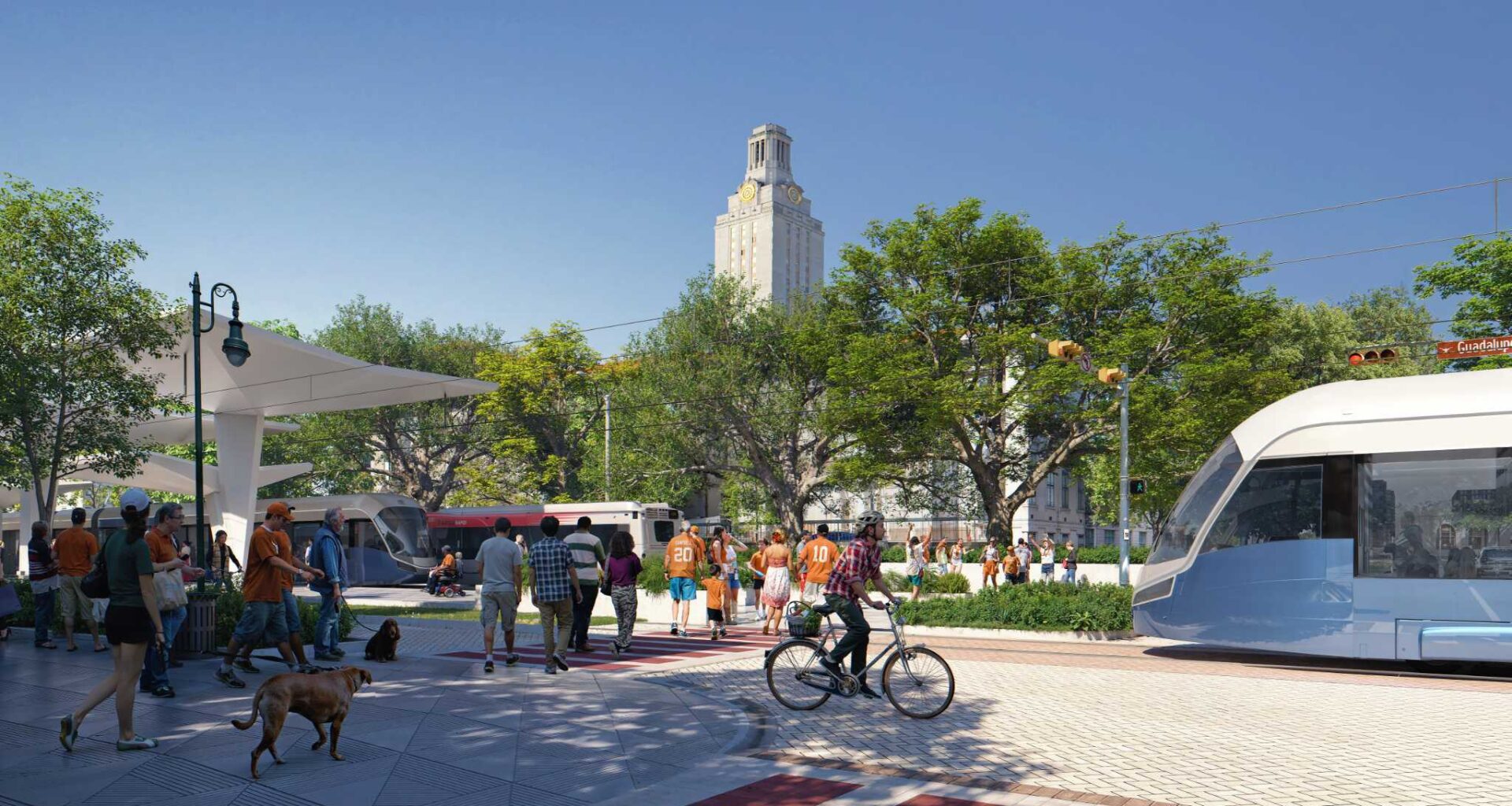
A conceptual rendering shows what the Austin Light Rail system could look like along the Drag, near The University of Texas campus.
Austin Transit Partnership
The legal battle surrounding Austin’s multibillion-dollar Project Connect light-rail plan is paused again after a lengthy hearing Thursday in a Travis County District Court that sent the case back to the appeals process.

Judge Maria Cantú Hexsel denied challenges to her court’s jurisdiction in the case, which centers on the legality of the funding plan for the train. Attorney General Ken Paxton’s office immediately appealed Hexsel’s decision, likely setting up another long court battle.
Article continues below this ad
Hexsel also denied a request from the city of Austin and the Austin Transit Partnership, the local government corporation responsible for building the light-rail system, to dismiss portions of the lawsuit challenging the project’s funding.
ATP and the city also appealed Hexsel’s ruling.
The case stems from two lawsuits filed in 2023 that were later consolidated. The first was brought by a group of residents including business owners, current and former elected officials and social justice advocates who argued that the light-rail project has been scaled back so significantly that it no longer reflects what Austin voters approved more than five years ago.
The second was filed by ATP and the city, which seek a court’s permission to issue bonds for the project.
Article continues below this ad
The combined case could determine whether ATP can secure major portions of the project’s funding, which could determine whether it can proceed.
Hexsel did not rule on the legality of the funding mechanism Thursday. Instead, she ruled on a procedural challenge known as a plea to the jurisdiction, affirming the court’s ability to rule on the overall case.
Paxton’s office argued the attorney general alone, and not a court, has the ability to determine whether ATP can issue bonds. ATP asserted that state law gives it the ability to ask a court to validate the bonds.
Artist conceptual visualization shows how the light-rail line might look at the intersection of East Riverside Drive and South Pleasant Valley Road.
Austin Transit Partnership
The Texas Supreme Court in May ruled the case could not move forward before a trial court judged the jurisdictional challenge. A different Travis County court previously declined to rule on the plea before heading to trial.
Article continues below this ad
Since Paxton’s office and ATP immediately challenged Hexsel’s jurisdictional ruling, the case is frozen again until the Fifteenth Court of Appeals — and likely the Texas Supreme Court — can review her decisions.
“I do have a mandate from the Texas Supreme Court with respect to this case,” Hexsel said Thursday. “For that reason, while it is up on appeal, the underlying proceedings are stayed.”
Though Thursday’s decisions set up a potentially protracted appeals process, attorney Bill Aleshire, who is representing the plaintiffs in the underlying lawsuit, said the decision is “a victory for Austin taxpayers” because it keeps challenges to the light-rail plan alive.
“It is high time (Mayor Kirk Watson) and Members of the Austin City Council rethink the inefficient, unaffordable, and illegal Project Connect Light Rail Project and go back to the voters with a mass transit system that can be immediately citywide quicker with an honest price tag and a feasible construction schedule,” Aleshire said.
Article continues below this ad
A conceptual rendering shows what the inside of Austin’s future light rail trains could look like once completed.
Austin Transit Partnership
ATP officials also counted the judgment as a win.
“Today’s ruling confirms that the legal tactic used by the Attorney General to prevent a judge from ruling on our bond program has no legal basis,” said Casey Burack, ATP’s executive vice president for business and legal affairs. “We appreciate the court’s quick action to remove this procedural roadblock and look forward to our day in court.”
Voters overwhelmingly endorsed the light-rail plan in November 2020 as part of Project Connect. Early proposals envisioned as many as 28 miles of track across the city. Local officials later reduced the plan to fewer than 10 miles, citing rising construction costs.
Article continues below this ad
The 2020 ballot measure authorized a 20% increase in Austin’s property tax rate dedicated to transit improvements. Under the plan, the city would transfer that revenue to ATP, which would use the funds to repay bonds issued to finance the project’s construction.
The pause in the legal fight does not necessarily mean that construction on the light-rail system will stop, however. Preconstruction work has been underway since May, and ATP has remained confident the project will break ground in 2027.
The agency recently signed more than $100 million worth of contracts with construction firms and a railcar manufacturer to begin the project. It hopes to open the light-rail line by 2033.
Article continues below this ad