
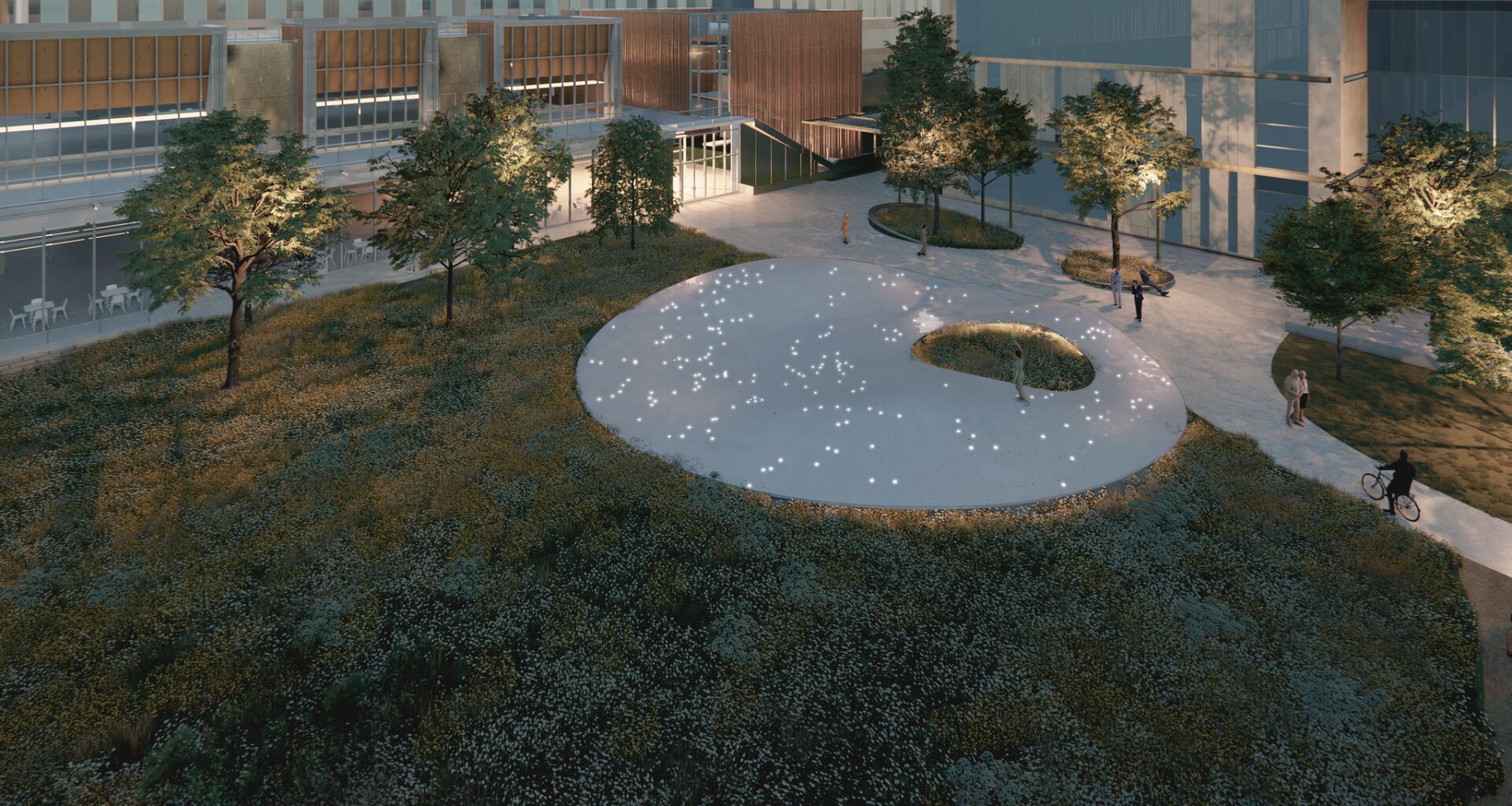
Maya Lin’s “Floating Landscape” on the University of Texas campus will feature at night the constellations visible on Sept. 15, 1883, the date of UT’s founding.
University of Texas Landmarks
Maya Lin, the famed American architect, designer and sculptor behind the Vietnam Veterans Memorial in Washington, D.C., and the Civil Rights Memorial in Montgomery, Alabama, is slated to produce her first work in Texas.

In 2027, the grounds of the new Autry C. Stephens Engineering Discovery Building on the University of Texas campus will become home to a subtle, 3,600-square-foot outdoor structure titled “Floating Landscape.”
Article continues below this ad
Renderings show students resting in a restored meadow that rolls around an opening that, as dusk grows, will display the alignment of stars over Austin from Sept. 15, 1883, the date of UT’s founding.
“The new engineering building was approved in 2021, and I reached out to Maya in 2022,” said Andrée Bober, founding director and curator of Landmarks, UT’s award-winning public art program, which includes selections from the Metropolitan Museum of Art. “I had admired her practice for years and felt she was the ideal artist for this project because her work moves fluidly between sculpture, landscape, architecture and environmental design.”
Engineers solve problems creatively, Bober points out, and that’s how Lin approaches a site.
“She wasn’t asking where the work of art should go. She was asking how the landscape itself could become the art,” Bober continued. “That’s a fundamentally different way of thinking and the kind of ambition we hoped to bring to this project.”
Article continues below this ad
Where to see ‘Floating Landscape’
Maya Lin attends the 2022 Time100 Gala.
Michael Loccisano/Getty Images
The new building, designed by CO Architects for the highly ranked Cockrell School of Engineering, sits in a flood-prone area above Waller Creek, which runs through the heart of campus alongside San Jacinto Boulevard.
“The university has been committed to restoring the 1,300-foot stretch on our grounds for many years, so improving stormwater management was already part of the scope,” Bober said. “What impressed me was that Maya didn’t see that as a constraint but as an opportunity. Her design creates a meadow of native grasses and herbaceous plants, developed in consultation with the Lady Bird Johnson Wildflower Center (and Lion Heart Places).
Article continues below this ad
“The plantings will help absorb excess water, slow erosion, and restore habitat. I love that the engineering is in plain sight. It’s solving a real problem while creating a landscape people will want to spend time in. That’s where the art and the engineering come together.”
On April 9, 2027, UT will host a public conversation between Maya Lin and Jana La Brasca, an art historian and curatorial contributor for the project.
“Much of my work begins with the landscape and the experience of moving through space,” Lin said. “This project grew out of the ecology of the site and the openness of the Texas sky, creating a gathering place within the daily life of the university.”
At night, it will glow with embedded LED lights that correspond to the constellations in the Texas sky at a specific point in history. This celestial reference reflects Lin’s longtime interest in connecting natural systems with civic identity and cultural memory.
Article continues below this ad
“The lighting is one of my favorite aspects because it’s something people may not even notice on their first visit,” Bober said. “Embedded in the floating landscape are points of light that recreate the Texas night sky as it appeared over Austin on September 15, 1883, the day the university was founded. It’s a quiet gesture that connects the university’s past with the students who will shape its future.”
Roger Bonnecaze, dean of the Cockrell School of Engineering, added that the art “reflects the kind of interdisciplinary thinking that defines engineering at UT. The project brings together design, material innovation, environmental awareness and public engagement in a way that will inspire our students for years to come.”
Maya Lin before Texas
During the day, Maya Lin’s “Floating Landscape” is designed to attract students and others to relax in a restored meadow above Waller Creek.
University of Texas Landmarks
In 1981, while Lin was still a 21-year-old undergraduate at Yale University, she won a coveted commission for the Vietnam Veterans Memorial. The controversial choice of an Asian American artist and her minimalist proposal — a long, low stretch of black granite panels engraved with the names of service members who had died in the Vietnam War — led critics to call the design a “black gash of shame.”
Article continues below this ad
Yet once completed, it became one of the most enduring attractions on the National Mall. Visitors who lost family, friends or combat buddies in the war immediately searched the alphabetical list of names. In 2007, it was ranked No. 10 in an American Institute of Architects poll of America’s Favorite Architecture.
The nearby Vietnam Women’s Memorial and the representational “Three Soldiers” statues salute nurses and combatants in more traditional ways.
Lin’s public works include “A Parallel Nature” for JPMorgan Chase’s global headquarters and “Wavefield,” her largest earthwork to date, located at the Storm King Art Center near New Windsor, New York.
Bober emphasized why Lin, with this background, was commissioned for this particular project.
Article continues below this ad
“We don’t commission artists because we already know what they should make,” Bober said. “We want them to ask questions the rest of us haven’t thought to ask. We knew we wanted a significant work of art for the site, but we didn’t prescribe what form it should take.”
Lin came back with a proposal to create a gathering place and restore part of the landscape while addressing the site’s environmental challenges all at once, Bober said. “Those were ideas we hadn’t anticipated, which is exactly what you hope for in a commission.”
Lin’s finished project is expected to fit into Landmarks’ success story, already acknowledged as one of the best university public art programs. Among its gems are “Monocrome for Austin,” artist Nancy Rubins’s dynamic assembly of 70 or so recycled aluminum canoes in front of the Norman Hackerman Building; “The Color Inside,” one of James Turrell’s “Skyspaces,” housed on the roof of the William C. Powers, Jr. Student Activity Center, and, most recently, “Autobiography: Circles,” a dazzling four-story glass façade assembly by artist Howardena Pindell at the George I. Sánchez Building.
Article continues below this ad
“Few artists have shaped the American public imagination as profoundly as Maya Lin,” Bober said. “What moves me most about ‘Floating Landscape’ is the way it invites people to inhabit the work rather than simply observe it. It functions as civic infrastructure, creating a place that is sculpture, habitat, observatory and public commons all at once.”