
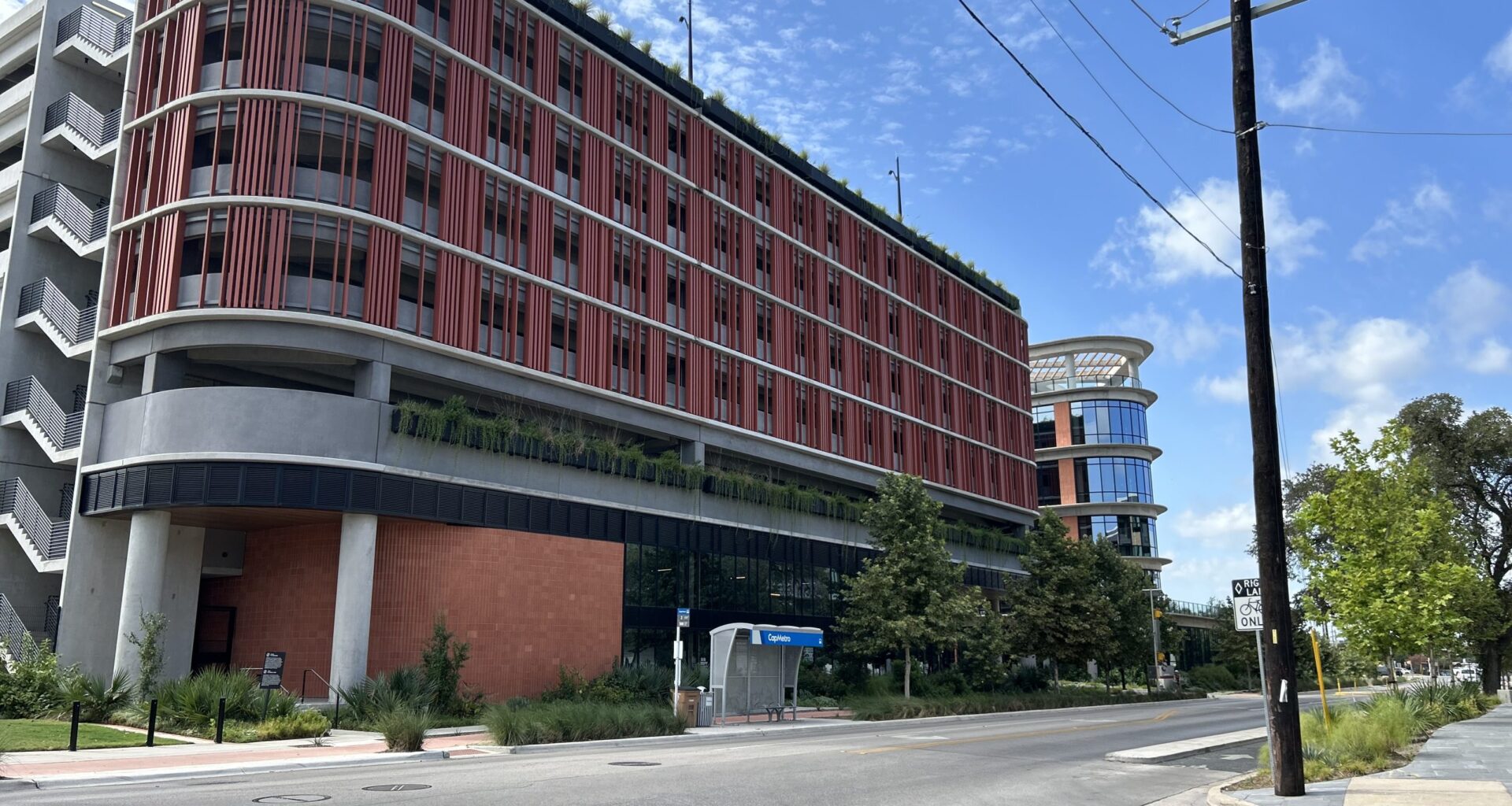
An outdoor yoga deck, basketball court, and native wildflower meadow are not amenities found in a typical workplace. Nor are pickleball courts or an elevated boardwalk. But, that’s exactly what the wellness-minded, sustainably developed Springdale Green boasts on its website.
Jay Paul Company, a California-based real estate firm, completed the 30-acre office complex near the intersection of Airport Boulevard and Springdale Road in October 2025. Still, in the nine months since the development was completed, the campus has yet to find a tenant.
The Austin office market has been saturated for years, with more available inventory than renters. A lot of the vacancies, explained Mandy Pope of the University of Texas-Austin’s Real Estate Center, come from the remote-work era. During the COVID-19 pandemic, Austin-based companies moved away from in-person offices. “The office was vacated,” Pope said. “It really stirred things up.”
Office vacancy in Austin is sitting around 24.2%, according to a recent market analysis from commercial real estate advising firm Avison Young. Ariel Guerrero, central region manager for market intelligence at Avison Young, said that big technology companies drove development for years; tech and AI developers were looking for massive office spaces. Now, demand is falling back to smaller companies, who just don’t need as much space. “There’s just not as many ‘mega-deals’ right now,” Guerrero said.
According to Pope, companies in Austin are starting to make a return to the office. According to a June study, nationally, the percentage of employees who work fully remote or hybrid has stayed around 22% over the last two years. “Austin will come back; this is just another dip, to be expected,” she said. A recent report by the Downtown Austin Alliance revealed that Downtown weekly foot traffic is back to 93% of what it was before COVID, a sign that in-person work is on the rebound.
Pope said that the development may just be a little ahead of itself. “This area hasn’t really taken off yet,” Pope explained. “It’s sort of like a chicken-and-egg situation with a lot of these big developments.”
The two massive office spaces, parking garage, fitness center, and acres of usable green space are the result of years of remediation and restorative work. The 881,000-square-foot Springdale Green sits in a 500-year floodplain, on top of a former “tank farm.” For decades, beginning in the 1950s, the land was used to host facilities that stored crude oil and gasoline, contaminating large stretches of East Austin land. A project like this, Pope said, likely took years of investment from the developers. To remediate the area alone was a multi-year, costly effort.
One neighbor, JP Pifer, who has lived on Saucedo Street since 2021, says he has had his eye on the development since they broke ground. “We were consistently blown away by how the developer really spared no expense in the buildout of the office space,” Pifer wrote to the Chronicle. “I can care less if the office is empty and actually prefer it that way. I both love and respect what they did in terms of wetland and savannah rehabilitation.”
Even with other flashy new apartment developments in the rapidly gentrifying strip of Airport Boulevard, Springdale Green’s sleek design and unprecedented size stand out in the neighborhood. In East Austin, vacancy rates are elevated at 36%, slightly higher than in the Downtown market, according to Avison Young.
Pifer thinks the building is a welcome addition to the neighborhood, but he has concerns about whether, and when, the building is leased. He worries that a big tech or AI company moving in would drive housing demand way up. “That’s great for everyone else in the area with the golden handcuffs, but it sucks for long-term residents and then folks like myself who just want to live in the neighborhood as-is,” Pifer wrote.
Jay Paul Company is actively leasing Springdale Green. They did not respond to specific questions about the development.
In their portfolio, Jay Paul Company advertises the space as “part backyard, part conference room, part social lounge.” Class-A buildings – high-quality, modern structures – like the ones at Springdale Green, and Google’s new high-tech “Sail Tower,” have the highest absorption rates across Austin, and vacancy has dropped by 19.6% this year, Guerrero reported.
The campus was also home to swaths of invasive species and hounded by chronic flooding until Jay Paul purchased the land. The company, along with dwg., a local landscape architecture firm, mitigated flooding with stormwater management, rehabilitated contaminated soil, and restored native species, according to the Sustainable SITES Initiative. A 650,000-gallon stormwater irrigation system, along with other green infrastructure efforts, has earned the development LEED Gold Certification and Sustainable SITES Gold Certification – presumably attractive qualities for an environmentally conscious tenant (or, more cynically, one looking to green-wash its efforts elsewhere).
“This building was designed when Austin was seeing unprecedented growth from technology companies,” Guerrero said. “I don’t think there is a demand problem, just a gap between the original expectation and actual tenant behavior.”
Meanwhile, the complex sits dormant among established neighbors like service stations and strip malls, as well as newcomers like condo buildings and coffee shops. Whether Springdale Green manages to ride the recent wave of tech investment has yet to be seen, but if Austin has proven anything over the last century, it’s that real estate is rarely a losing proposition.
This article appears in August 14 • 2026.
A note to readers: Bold and uncensored, The Austin Chronicle has been Austin’s independent news source for over 40 years, expressing the community’s political and environmental concerns and supporting its active cultural scene. Now more than ever, we need your support to continue supplying Austin with independent, free press. If real news is important to you, please consider making a donation of $5, $10 or whatever you can afford, to help keep our journalism on stands.