
DALLAS — At the University of Texas at Dallas, researchers are asking themselves a simple question.
“Is the food that you are eating actually safe?“ said Kundan Mishra, a Ph.D. student at UT Dallas.
It’s a question that’s becoming harder to ignore. Since May, the Centers for Disease Control and Prevention (CDC) has received reports of nearly 14,000 laboratory-confirmed cases of cyclosporiasis in the U.S., an intestinal illness known for causing explosive diarrhea.
“We’re seeing you can’t eat this. You can’t go to this restaurant… be aware of this,” said Bianca David, a Ph.D. student at UT Dallas.
The researchers are trying to find a faster way to know what’s in our food.
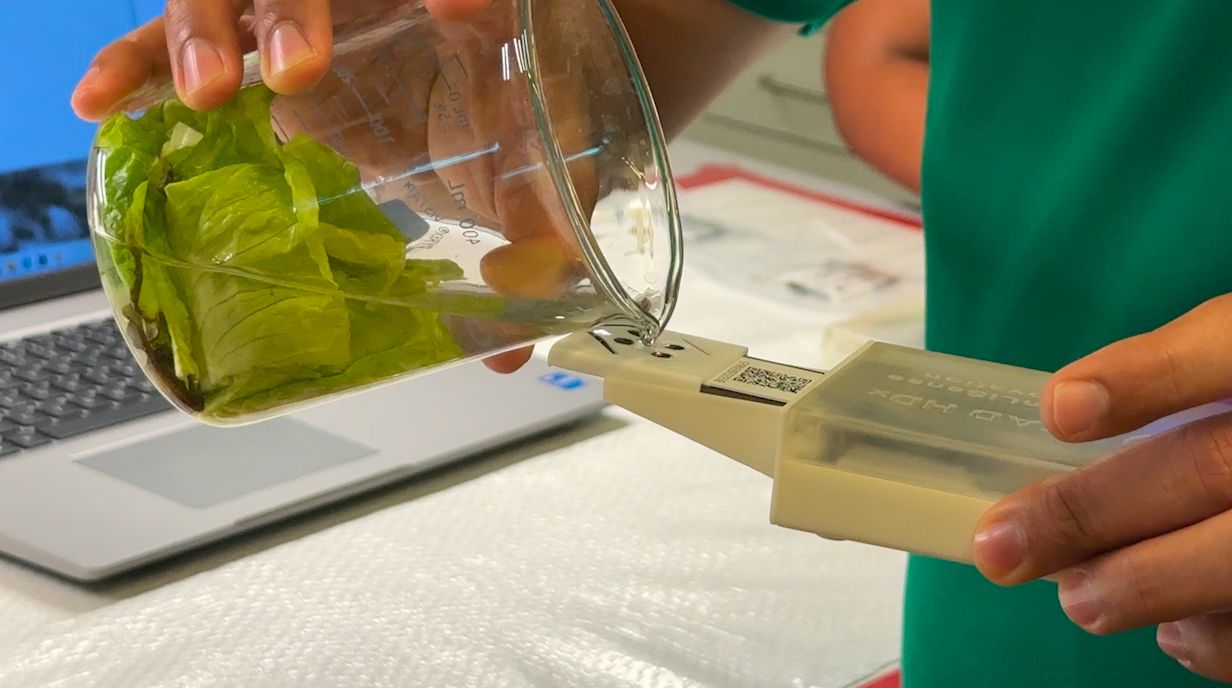
“You can see the salad looks fresh, but we do not know whether the contamination there. The pesticide pathogen is available in this form,” said Mishra.
That’s where a new device comes in. Mishra and David are part of a team developing a portable sensor called the Rapid Electro-Analytical Device, or READ.
The concept is pretty simple: take a sample of the food, put it on the sensor and let the technology do the rest. Researchers say the device can detect up to 16 different contaminants at the same time.
“Something as simple as, ‘Hey, I bought a salad today. Oh, is it infected?’ We’re able to provide that with our device,” said David.
Mishra has spent over four years developing the technology. And with food-borne illnesses making headlines, these researchers say faster detection could make a difference.
“We have a salad, shook it in a portable water and hold it for 20 seconds and take a dropper,” said Mishra.
“The sample on the electrode. And we have an app. Within a minute it will tell you whether the food is safe to eat, or it is not safe to eat,” said Mishra.
For now, the team is testing the technology in the field and looking for partners to bring it to market.
“What I want for this is not to be a lab prototype, but to be a product, a product that can be purchased,” said Shalini Prasad, a bioengineering professor at UT Dallas.
The researchers hope the technology can ultimately give people more confidence in what they’re eating.