
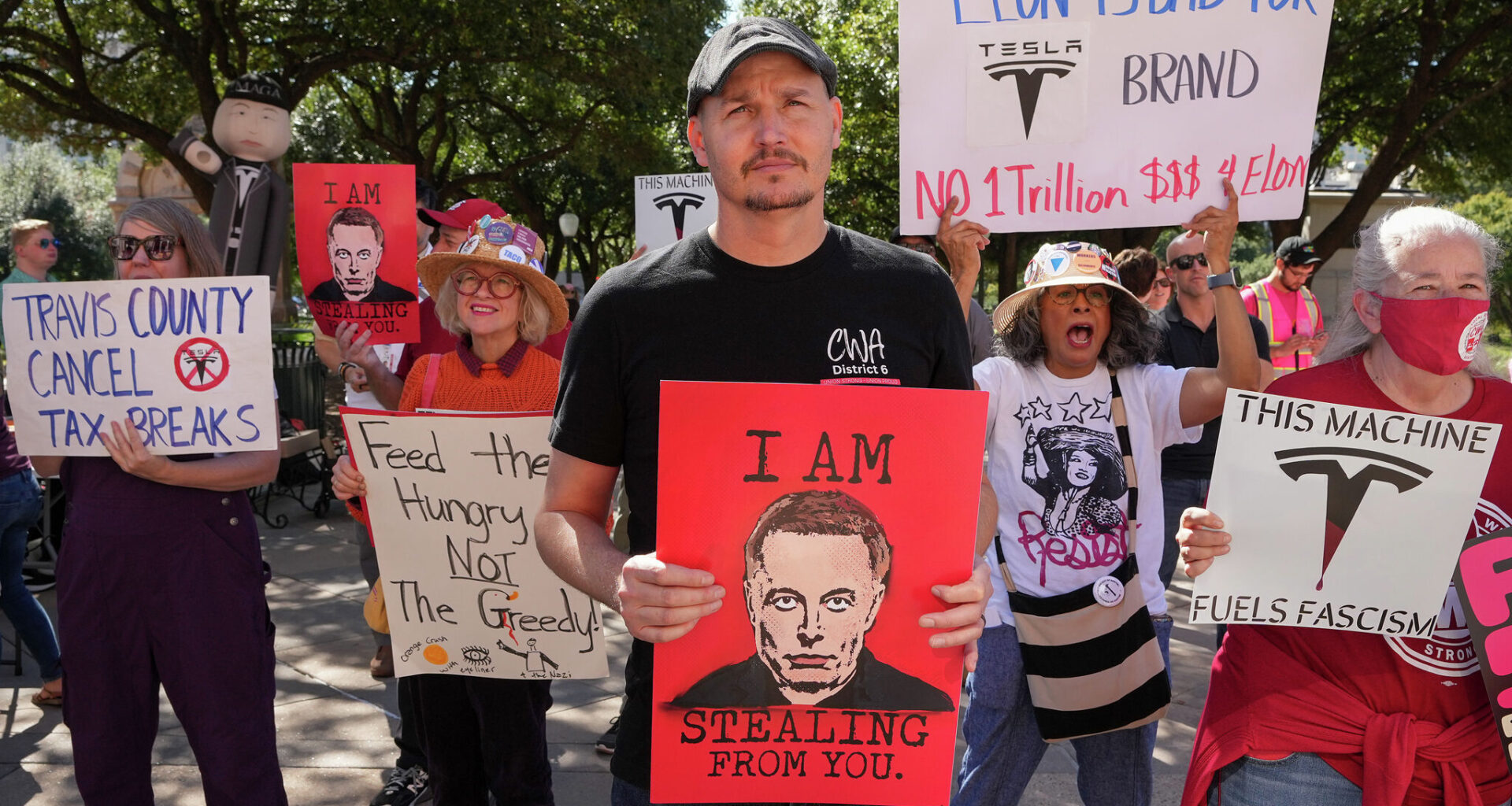
Colossal gaps between the pay a typical worker receives and that of their company’s CEO aren’t so unusual these days — especially in Texas.
But Tesla is hardly an outlier according to a new report from the AFL-CIO, the nation’s largest federal of labor unions. In fact, Texas has some of the nation’s widest gaps in CEO-to-work pay ratios. Other states with sizable gaps include Montana and Ohio, while Vermont and Alaska have swung in the opposite direction. Alaska, for example, had a CEO-to-worker ratio of 24-to-one among Russell 3000 companies.
Massive gaps between the pay of workers and their CEO are increasingly common as massive pay plans become increasingly common. Even taking Musk — the poster boy for giant compensation — out of the equation, the average pay ratio of S&P 500 companies increased from 285 to one in 2024 to 312 to one in 2025. In dollars, the average CEO pay at such companies increased 21%, from $18.9 million in 2024 to $22.8 million in 2025.
Musk’s own compensation is tied to stock-based awards and none of the shares have vested so he has not yet received that pay. But he’s seeking to meet specific targets that would grant the shares to him.
“Too many working people across the country are struggling to afford the basics, much less save for college or retirement,” the labor federation said. “Some states serve as stark examples of the incredible gap between CEOs and the hardworking people who make their companies profitable.”
In Texas, the companies with the most dramatic CEO-to-worker pay ratios — after Tesla — include entities tied to food and retail like Wingstop, Brinker International and FirstCash Holdings. Respectively, those gaps are 1,590 to one, 1,274 to one and 1,131 to one.
Still, Texas companies across other industries maintain stark CEO-to-worker pay ratios. CBRE Group, Hewlett Packard Enterprise, Caterpillar and Southwest Airlines were among the S&P 500 companies with some of the highest gaps.
By sector, manufacturing saw the highest average CEO-to-worker pay ratio: 11,139 to one. Arts and entertainment, along with educational services, are the sectors that saw the next highest ratios.
The AFL-CIO said in its report that CEOs should be compensated fairly, but noted that workers’ share of U.S. national income has fallen to the lowest level since World War II and warns of threats that can loom with high CEO pay.
“Excessive CEO compensation contributes to growing economic inequality,” the report says. “It creates the risk that CEOs will make short-term decisions to maximize their pay, even if it hurts the company’s long-term health. And it’s simply unfair to the workers whose labor generates the profit these CEOs capitalize on.”