
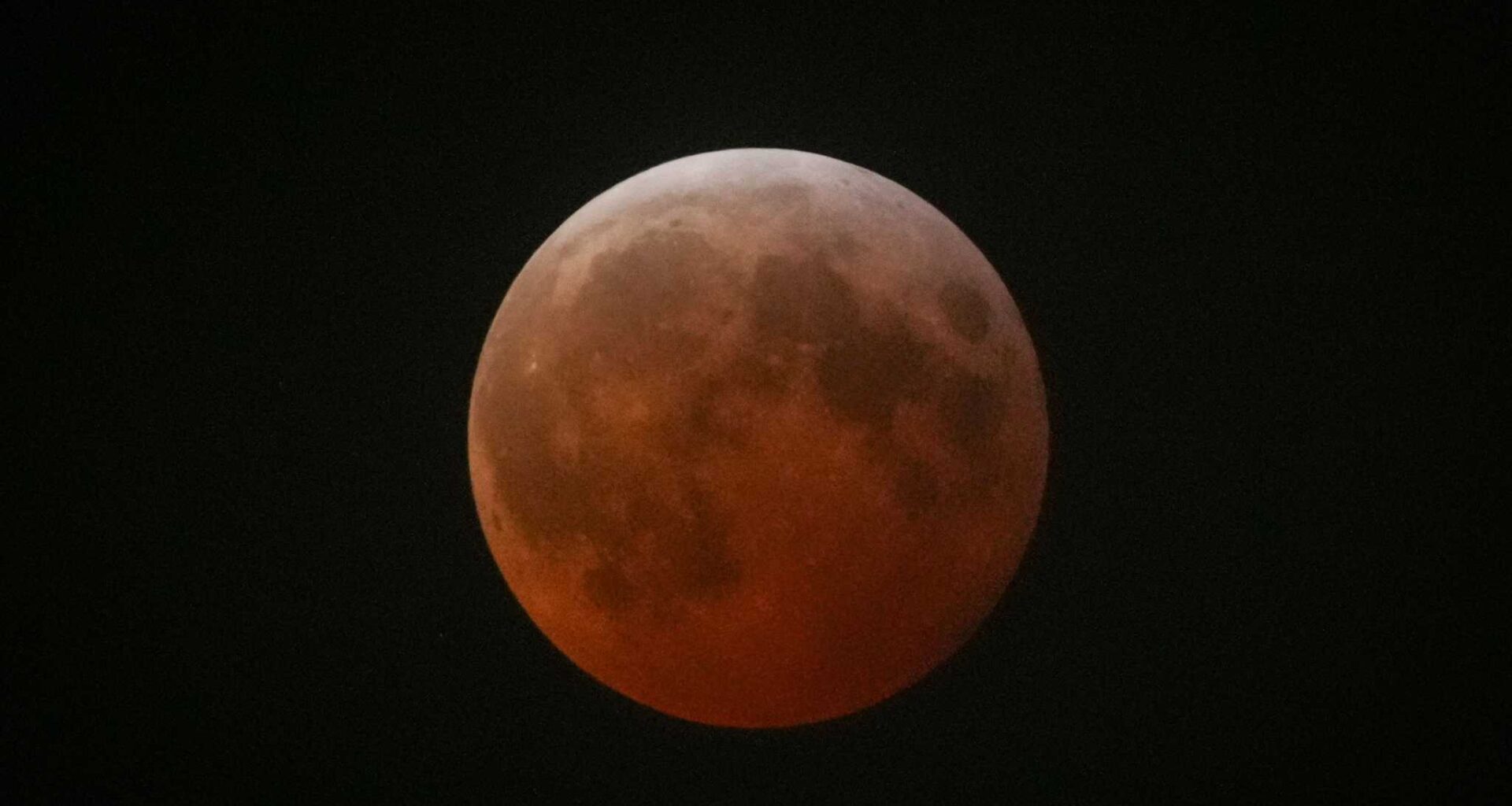
The moon will take a reddish hue on Aug. 27 as it moves through the darkest part of the Earth’s shadow, casting the world’s sunsets onto its surface.
A lunar eclipse, also called a blood moon, occurs when the Earth passes between the sun and the moon. It won’t be a total eclipse. But at 94% eclipsed, Houstonians will want to step outside before going to bed, said Rice University astronomer Pat Hartigan.
“This one is definitely worth it,” Hartigan said in an email. “It is the spectacle of the summer for sure.”
The moon will enter the dark part of the Earth’s shadow at 9:34 p.m. and will reach its maximum eclipse at 11:13 p.m. The show ends at 12:52 a.m., Hartigan said.
All but a sliver of the moon will turn red as sunlight filters through the Earth’s atmosphere and onto the moon. Its position in the sky – “well above the horizon,” Hartigan said – and timing will make it easy to spot from Houston, as long as the weather cooperates.
“The most striking part of a total lunar eclipse is often how the moon appears just before it fully enters the darkest part of the Earth’s shadow, when the part illuminated by the sun has shrunk to a narrow yellow crescent while the eclipsed part glows a deep reddish color,” Hartigan said. “We will be able to experience this beautiful sight with a deep partial eclipse like this one.”
Houstonians’ last opportunity to see a total lunar eclipse was earlier this year on the morning of March 3. The next total lunar eclipse visible from Houston will be on June 25, 2029.