
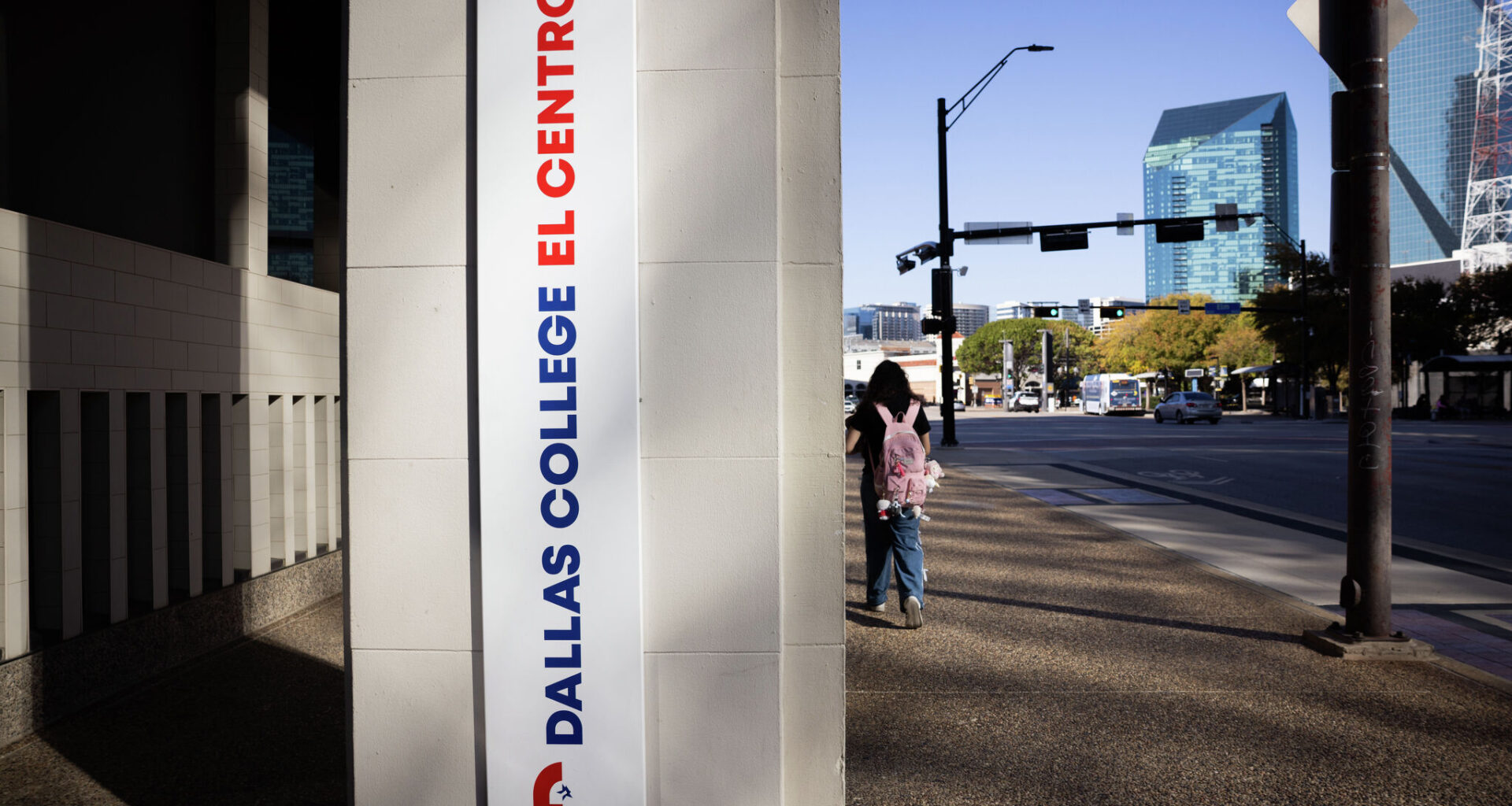
The exterior of Dallas College’s El Centro Campus in downtown Dallas on Friday, Nov. 14, 2025.
Juan Figueroa/Dallas Morning News
It’s a tough budget season for community colleges in Texas.

Out of the three main sources of revenue for community colleges — state funding, tuition, and property taxes — two of them have taken hits this budget season. The state suddenly cut funding for community colleges across the board, and Gov. Greg Abbott kept tuition frozen this year, limiting two major funding blocks for colleges. North Texas community colleges are no exception.
Combined, state funding and tuition make up nearly 40% of Dallas College’s revenue and over 30% of Tarrant County College’s revenue.
Article continues below this ad
North Texas colleges have managed to work around them by finding creative revenue sourcing and cutting corners without touching the core of the operation: teaching and learning.
What challenges do community colleges face?
This year, the state is cutting funding because, ironically, community colleges are performing too well. When Texas overhauled its community college funding model in 2023, it hinged funds on outcomes — things like credentials earned and transfers to four-year schools — rather than enrollment.
Except, community college outcomes far exceeded initial projections, and the state can no longer afford the original financing model. To keep community colleges within budget, the state’s higher education board last month decreased funding weights for academically and economically disadvantaged students, as well as adult learners over age 25.
Statewide, community colleges saw a 6.5% dip in public dollars, but changes differ across schools. Dallas College will lose about 3% in state funds, and Tarrant County College will lose over 6%.
Article continues below this ad
Related: Dallas College sets the scene for ‘Y’allywood’ with new virtual film soundstage
Despite the cuts, community college leaders assured state lawmakers in July that this was a “temporary blip,” and funding will level off as the state readjusts its formula.
“We were excited about [outcome funding],” said Pam Anglin, chief financial officer of Tarrant County College. “This was a win for everyone, the residents of Texas, the state, everyone. … but it’s time that we make some tweaks to the formula so that the state can continue to fund the outcomes and there’s no disincentive for the colleges.”
In contrast, Collin College will actually see more state funding next year, to the tune of $4 million — a 7% increase — that spokesperson Griselda Perez attributed to growing population and increased student success. In 2025, Collin College awarded over 10,000 credentials, nearly double from five years earlier.
Related: How Dallas is building a path to a living-wage future
Article continues below this ad
Community colleges are also feeling the impact of frozen tuition. In May, Abbott renewed his tuition freeze for the fourth consecutive year, promising to keep college affordable. For colleges facing stagnant or declining enrollment, frozen tuition means lost revenue.
Dallas College finds alternate revenue sources
Despite the tuition freeze, Dallas College’s tuition revenue grew by 4% due to increasing enrollment. Combined with more property tax revenue and “non-traditional” funding sources, the school is on track to have a balanced budget of $777 million in the next fiscal year, only a 0.8% difference from this year.
Related: Dallas College unveils plans, names developer for new downtown El Centro campus
Anything outside the three main sources of funding — tuition, state funding and property taxes — is considered non-traditional revenue. This year, Dallas College hopes to bring in $2 million through things like charging fees for use of campus space and athletic partnerships.
Article continues below this ad
However, some trustees warned that renting out campus space could shut out smaller community organizations that Dallas College has historically worked with, ones who do not necessarily have the money to pay a rental fee.
“I would just caution you all please not to go too much to the other extreme and shut our campuses out,” trustee Diana Flores said at a finance committee meeting this month. “Even though community is not in our name anymore, we’re still at heart a community college.”
Tarrant County College considers property tax increase
Tarrant County College faced a “perfect storm” this budget season, Anglin said. In addition to state funding cuts and frozen tuition, she also knew their property tax revenue, which makes up the largest share of the college’s budget, would go down.
“It’s a hard budget to put together when you have all three areas of revenue being impacted in the same year,” she said.
Article continues below this ad
Right now, the college is considering a property tax rate increase to make up some of that lost revenue, which must be finalized by the end of September. The proposed increase would add about $7.72 per $100,000 of taxable value.
Tarrant County College was not expecting to have to increase property taxes. Going into this budget season, Anglin did not expect state funding to drop because the college’s student outcomes far exceeded the initial projections. Tarrant County College will receive about $59.6 million — $4 million less than anticipated. In addition, the continued tuition freeze means the college had to reverse course on some fees they planned to introduce to keep up with inflationary costs.
The DMN Education Lab deepens the coverage and conversation about urgent education issues critical to the future of North Texas.
The DMN Education Lab is a community-funded journalism initiative, with support from Bobby and Lottye Lyle, Communities Foundation of Texas, The Dallas Foundation, Dallas Regional Chamber, Deedie Rose, Garrett and Cecilia Boone, Judy and Jim Gibbs, The Meadows Foundation, The Murrell Foundation, Ron Steinhart, Solutions Journalism Network, Southern Methodist University, Sydney Smith Hicks, and the University of Texas at Dallas. The Dallas Morning News retains full editorial control of the Education Lab’s journalism.