
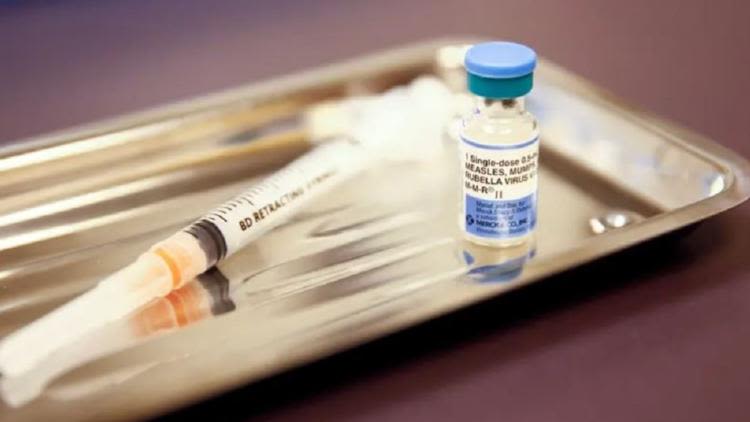
Fewer children in Dallas are starting school vaccinated against measles and other preventable diseases, mirroring a national decline that health officials say is putting communities at greater risk.
Only 82% of Dallas ISD kindergarteners were vaccinated against measles during the 2025-26 school year, down from nearly 98% in 2019-20.
Across Dallas County, about 90% of kindergarteners received the measles, mumps and rubella, or MMR, vaccine, according to Dr. Philip Huang, director of Dallas County Health and Human Services.
Huang said the decline is concerning as measles cases continue to rise.
“Absolutely it’s concerning,” Huang said. “We’ve seen the last two years record number of measles cases we haven’t seen in 30 years. This year has already surpassed the number we saw last year.”
The decline extends beyond kindergarten.
Among Dallas ISD seventh graders, just 77% were vaccinated against Tdap, which protects against tetanus, diphtheria and pertussis, during the 2025-26 school year. About 75% had received the meningococcal vaccine.
Huang said those rates are also concerning. In the 2023-24 school year, vaccination rates for those shots were closer to 90%.
“Measles was eliminated in the U.S. in 2000, and now we’re backtracking and starting to see these cases again and again last year we had two measles deaths in children and they were totally preventable,” Huang said.
He said several factors have contributed to declining vaccination rates in recent years.
“These mixed messages coming from the federal level, all of these are undermining our efforts to try to get the kids vaccinated. We all share the same interest in protecting our children. This misinformation is confusing parents,” Huang said. “In particular, with our Hispanic community, we’ve really seen a big drop-off in those numbers. In Dallas almost 40% of the population is Hispanic. That has a big impact on what we’re seeing in our clinics and certainly DISD also.”
National vaccination rates also falling
The Dallas numbers come as new federal data shows childhood vaccination rates are declining nationwide.
During the 2025-26 school year, 4.2% of U.S. kindergartners had an exemption from at least one required vaccine, up from 3.6% the previous year. It is the highest exemption rate on record, with exemptions increasing in 41 states and Washington, D.C.
The vast majority of those exemptions were for nonmedical reasons.
At the same time, the national MMR vaccination rate among kindergartners fell to 92.4%. Health experts say at least 95% vaccination coverage is generally needed to maintain community protection against measles. About 280,000 kindergartners did not have documentation showing they had completed the MMR series.
The decline comes as the U.S. faces its worst measles year in decades. CDC data shows 2,566 confirmed measles cases in 2026, surpassing the 2025 total of 2,289.
Trump vaccine order adds to debate
The new vaccination data also comes shortly after President Donald Trump signed an executive order calling for major changes to the nation’s childhood immunization schedule.
The order calls for reducing the number of diseases covered by broadly recommended childhood vaccines and separating the combined MMR vaccine into individual shots, although those individual vaccines are not currently available.
Dr. Philip Dr. James Campbell, chair of the committee on infectious diseases for the American Academy of Pediatrics has warned against the new executive order.
“Our main concern is that it leads to a lot of confusion for families,” Campbell said. “Because on the one hand, the CDC continues to recommend those vaccines and provides us the data on why they’re so important.”
The AAP says even small drops in measles vaccination rates can lead to more outbreaks because community immunity requires more than 95% of susceptible people to be immunized.
For North Texas families, local health officials are urging parents to talk with their pediatricians and make sure children are up to date on recommended vaccines.