
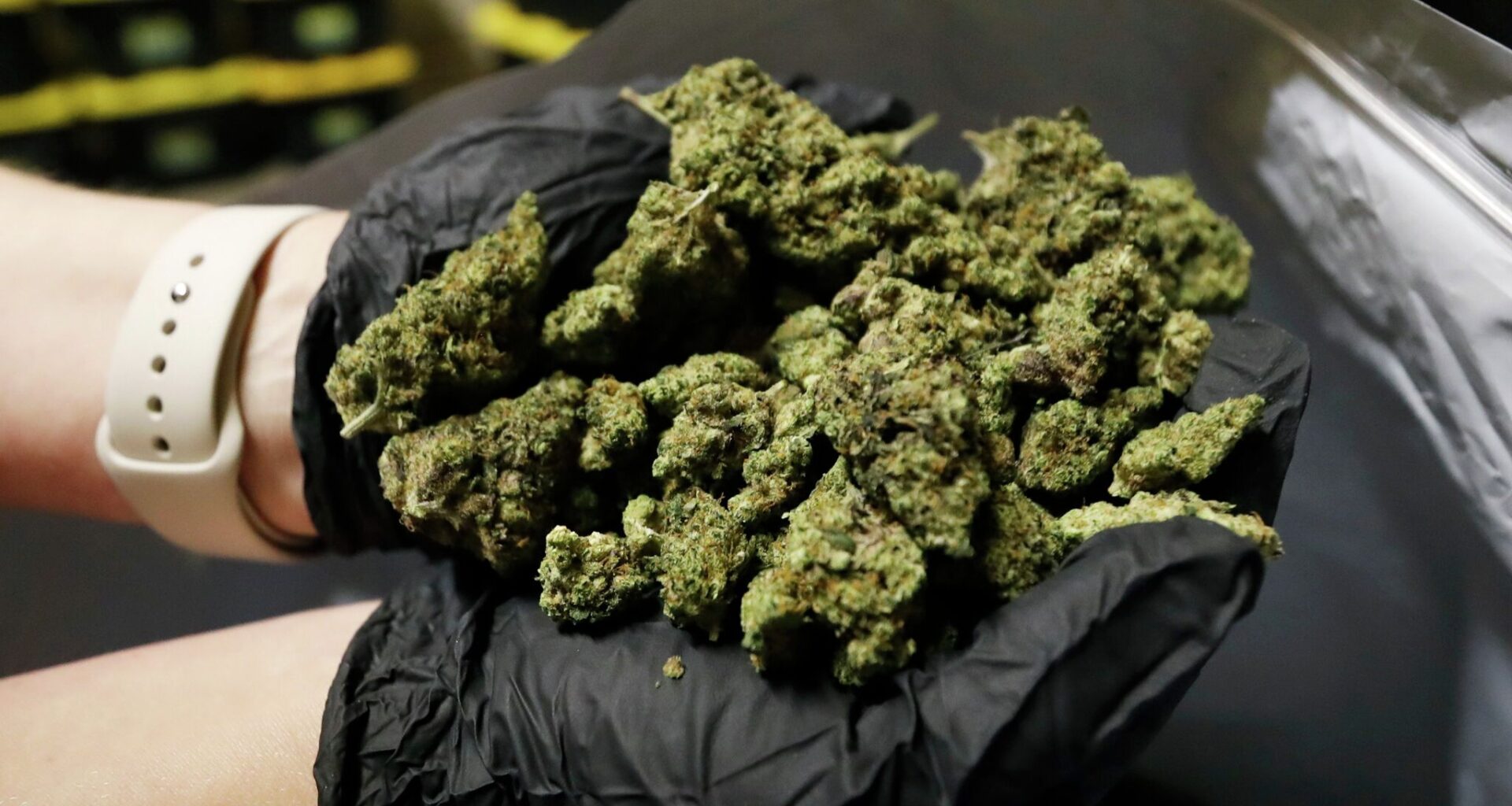
A 16-hour committee hearing was the latest in an ongoing legislative push to halt the proliferation of legal THC-containing hemp products in the state, like this product pictured in 2023 in a Lubbock facility.
Mark Rogers/For the Avalanche-Jo
A week ago, a federal judge scuttled a last-ditch effort from hemp farmers, businesses and consumers to temporarily block Texas’ ban on THC products.
In his ruling, U.S. District Judge Jeffrey Brown said that the parties who filed the lawsuit did not sufficiently demonstrate that the ban would cause “irreparable harm.”
We’d argue that for many adults, THC wasn’t causing much irreparable harm either, but that didn’t stop the state from overreacting and banning a handful of synthetic, hemp-derived products last month. With the ban in full effect, Texas now has an incoherent, Gordian knot of marijuana regulations so incomprehensible that reading through it makes one feel vaguely stoned.
Article continues below this ad
Recreational marijuana in Texas remains technically illegal. Hemp — a derivative of the exact same plant species — is legal, but only if by dry weight a product contains no more than 0.3% delta-9 THC, the psychoactive compound in cannabis that gets you high. So tinctures, gummies, seltzers — products that can still get you plenty buzzed — with legal amounts of THC are still legal. But vape pens with THC are banned. Any and all forms of synthetic THC are also kaput. That includes, delta-8, delta-10 and THCP. Lawmakers also want Willie Nelson to stop smoking a joint the old fashioned way, with “flower,” because they banned smokeable hemp — though that prohibition has been paused by the courts.
Got all that? Neither do we! So you can imagine, it’s been quite a headache for hemp retailers, who are scrambling to figure out what products they can keep on their shelves. One store cashier told Chron.com that they buy most of their products well in advance, and any joint or vape that is now banned will have to be shipped back to the manufacturer.
The financial impact to these businesses will be seismic. A recent report by a cannabis market analyst estimated that Texas’ retail hemp revenue ballooned to $4.3 billion in 2025. The hemp industry provides 53,300 jobs and collective wages rose to $2.1 billion. There are 14,000 licensed hemp sellers in Texas and 8,000 hemp storefronts. Many will likely have to shut their doors.
Even the delta-9 products that are still legal are in danger. While Gov. Greg Abbott vetoed an outright THC ban the last legislative session, it’s still very much a live issue. State Sen. Charles Perry, R-Lubbock, who authored that bill in 2025, has said he plans to introduce a new bill next session.
Article continues below this ad
If businesses and hemp consumers defy the statewide ban, there are now significant legal consequences. The banned synthetic THC variants are classified as Schedule I drugs — the same classification as heroin. Mere possession is now a felony, with a punishment of up to two years in prison and $10,000 in fines. And even a vape pen with an otherwise legal type of THC can land you behind bars for up to a year and a $4,000 fine.
Whether these new laws will be stringently enforced remains to be seen. Harris County, for instance, has long deprioritized low-level marijuana possession under four ounces. The District Attorney’s Office runs a diversion program for marijuana offenders, which includes a 90-day community supervision period.
A segment of Houston voters want to push decriminalization a step further. A progressive advocacy organization successfully petitioned for a citywide ballot referendum calling for the Houston Police Department to formally deprioritize misdemeanor cannabis possession.
Of course, this would all be a lot less confusing if we just treated marijuana like we do alcohol — as a vice that is tightly regulated and limited to licensed businesses and adult consumers. Instead we’re stuck with a regulatory regime where we’ve banned the marijuana equivalent of beer while allowing the sale of overproof Jello shots. Polls of Texans show broad support for legalizing marijuana. More than half the states in the country have already done it, raising significant sums of tax revenue as a result.
Article continues below this ad
Leaving the status quo in place only leaves jobs and businesses hanging in the balance, while cracking the door open for even more prohibitive measures to come. It’s time to put Reefer Madness in Texas to an end once and for all.