
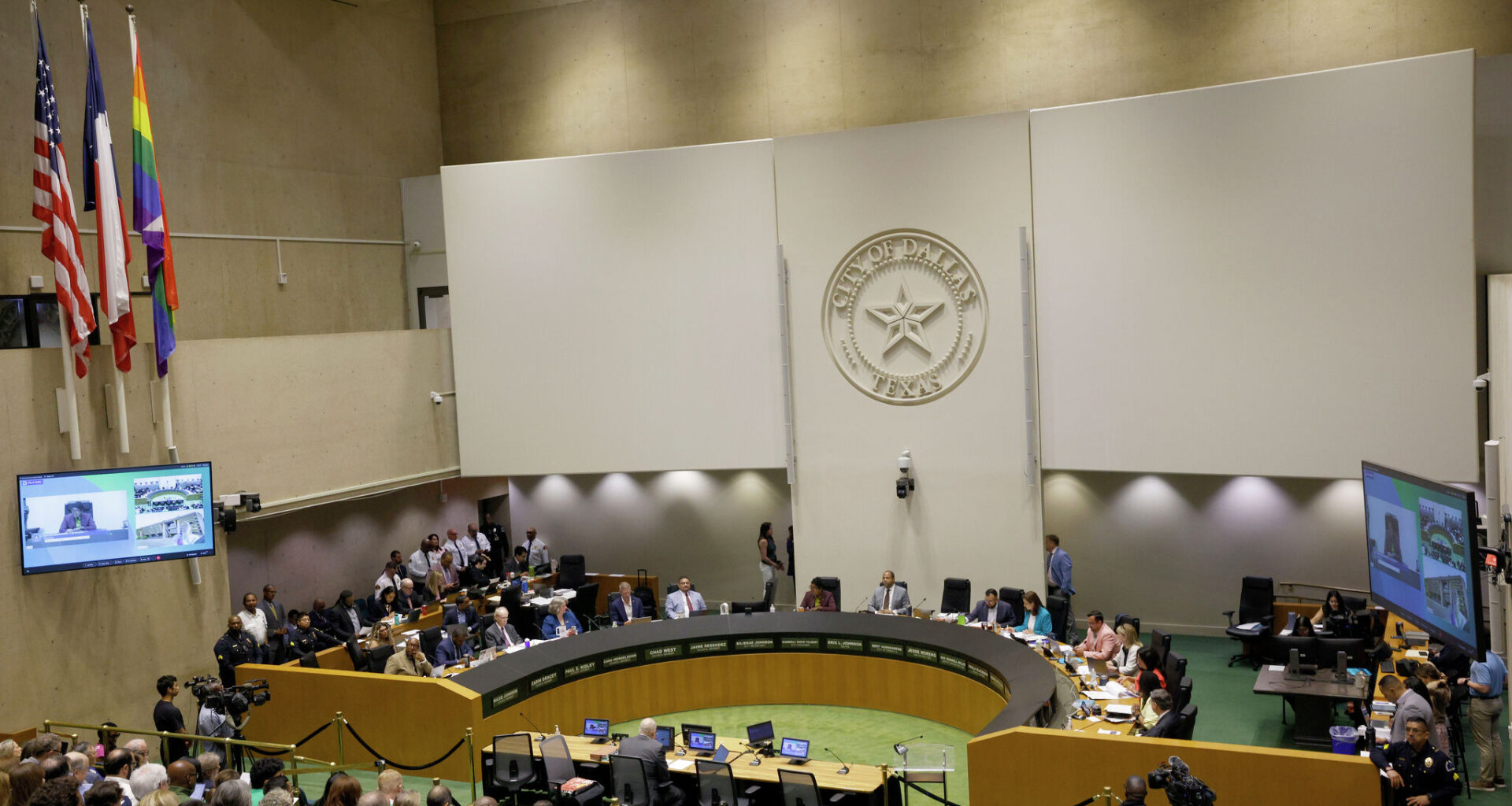
Reducing the number of districts in the Dallas City Council could improve collaboration and strengthen representation, writes Dennis D’Amico.
Chitose Suzuki/The Dallas Morning News
Why does the Dallas city government so often struggle to act with clarity, urgency and a citywide sense of purpose?
Dallas’ governing foundation is cracked in two places: a shortage of civic-minded leaders charged with a citywide concern for all of Dallas, and a system that fosters a self-serving, lumbering government structure.
The current debates — whether it’s about fixing up or tearing down City Hall, or repairing streets or building homes for the homeless, or facing allegations of misconduct in city business — are emblematic of a rudderless ship of state. When Dallas switched to the 14-1 system in the 1990s — creating 14 single-member districts and one at-large mayor — I was concerned city politics would drift into the narrow, fragmented mindset of ward politics.
Article continues below this ad
I was born and raised in St. Louis, a city long shaped by ward politics in ways similar to Chicago. I saw firsthand how damaging that political mindset can be. St. Louis was once the eighth-largest city in the United States, with more than 856,000 residents. Today, its population is about 278,000, placing it far down the list of American cities.
The governing attitude during those years seemed simple: me first, my ward second, and the city last. A system burdened by favoritism, inaction and occasional misconduct turned inward and produced imbalances in power and accountability. More often than not, ward politicians were more beholden to the party than what was good for the city.
A 2020 W.E. Upjohn Institute for Employment Research suggested, for example, that the ward structure of the government may have a bearing on the number of building permits issued. “After switching to ward voting,” the study indicated, “towns reduce housing permits on average by 21 percent. The decline is even larger for multifamily housing permits, especially in towns with high homeownership rates.” The study did mention that “Ward voting, however, affects many outcomes, and can increase minority representation in local government.”
The turn of the screw
In 1990, Dallas took a step that seemed forward-looking but may have helped trigger a long downward turn. A voting-rights lawsuit before the U.S. District Court for the Northern District of Texas resulted in a court order that created the 14-1 structure in the name of democratization and greater racial diversity.
Article continues below this ad
By expanding the council and redrawing districts to change its political, racial and ethnic composition, Dallas may have lost much of the civic effectiveness that once defined its “can do” spirit. The intentions were good, but the results have been disappointing.
Anyone who then listened to council meetings broadcast on WRR radio would get an earful of how the new system was not working. The haranguing was exhausting. Verbal brickbats across the horseshoe created a corrosive environment, and Dallas began to lose momentum.
In those early years, the Dallas Citizens Council functioned at times like an informal inspector general. Its behind-the-scenes influence was imperfect, but it helped keep city decisions pointed toward a broader civic perspective rather than narrow district interests. And it groomed civic-minded citizens.
The DCC still exists, a shell of its former self. It talks the language of leadership, but without the voice it once had. It no longer appears to develop or advance strong civic leaders with a citywide view. Experienced, effective leaders are needed. Citizens who can move the city forward — not activists focused on narrow interests or on their districts that operate as silos of influence.
What about reforms?
Admittedly, the problem is less with individual council members than it is with the 14-1 system itself. I am sure our council members have the best of intentions. Yet the structure would seem to encourage parochialism and create political silos. Reducing the number of districts could improve collaboration and strengthen representation. I would keep the council-manager system, as Dallas Morning News contributor Dallas Cothrum suggests, but restructure representation this way:
Article continues below this ad
Reduce the number of single-member districts to eight, creating an 11-member council.
Elect three members at-large: a mayor, a deputy mayor, and one additional at-large council member for a broader focus on the entire city.
A smaller council could reduce political crosstalk and horseshoe posturing. The 435-member U.S. House of Representatives offers a warning: When too many competing interests harden into factions, consensus becomes nearly impossible. Dallas should encourage council members to listen more closely to one another, give citizens meaningful time to be heard and build a governing mindset that puts Dallas first.
Mayoral leadership
The mayor and council members too often rely on “staff.” The word is repeated so often around the horseshoe that it has become a substitute for decisive leadership. Examples from other cities demonstrate that strong mayoral leadership can make dramatic progress when they guide both the council and the city manager toward a clear civic agenda. But under the 14-1 system, even a committed leader faces a difficult task. We will need to carefully define what our strong mayor means to us. In too many cases, self-interest can overwhelm servant leadership.
To be clear, earlier eras were not perfect. No system of government is, and every system requires vigilance. But Dallas once felt less dominated by parochial favoritism and narrow district interests. The council appeared more concerned with the city as a whole.
Article continues below this ad
The silo effect of 14 competing fiefdoms is real. Anyone who has tried to speak at a council meeting knows that the exchanges are closely held. The structure and the sheer number of competing voices have weakened the city’s ability to govern in the broader public interest.
How do we stop the slide? One possibility is to form a politically diverse, ad hoc action committee made up of experienced executives from Dallas’ corporate community and other citizens with the judgment and experience to identify potential council candidates. Its charge would be to find, recruit and prepare servant-leaders who genuinely love the city.
Such a group might resemble the Dallas Citizens Council, supplemented by a Dallas Regional Chamber element focused only on the core city, and strengthened by leaders from other civic organizations.
True servant leaders are hard to find. Many office-seekers are simply trying to climb another rung on the political ladder. Others are reluctant because public office demands sacrifice, invites criticism and offers little reward.
Effective civic leaders often must be recruited directly and persuasively — almost, metaphorically, pulled by their lapels. Perhaps that is the biggest problem: There does not seem to be anyone obvious to turn to.
Article continues below this ad
Dennis D’Amico, a 52-year resident of Dallas, is a retired advertising agency owner and executive, and a management consultant.
Have thoughts about this? Send a letter to the editor using our letters form or email letters@dallasnews.com. Letters should be no more than 200 words and include the first and last name of the writer and city of residence.