
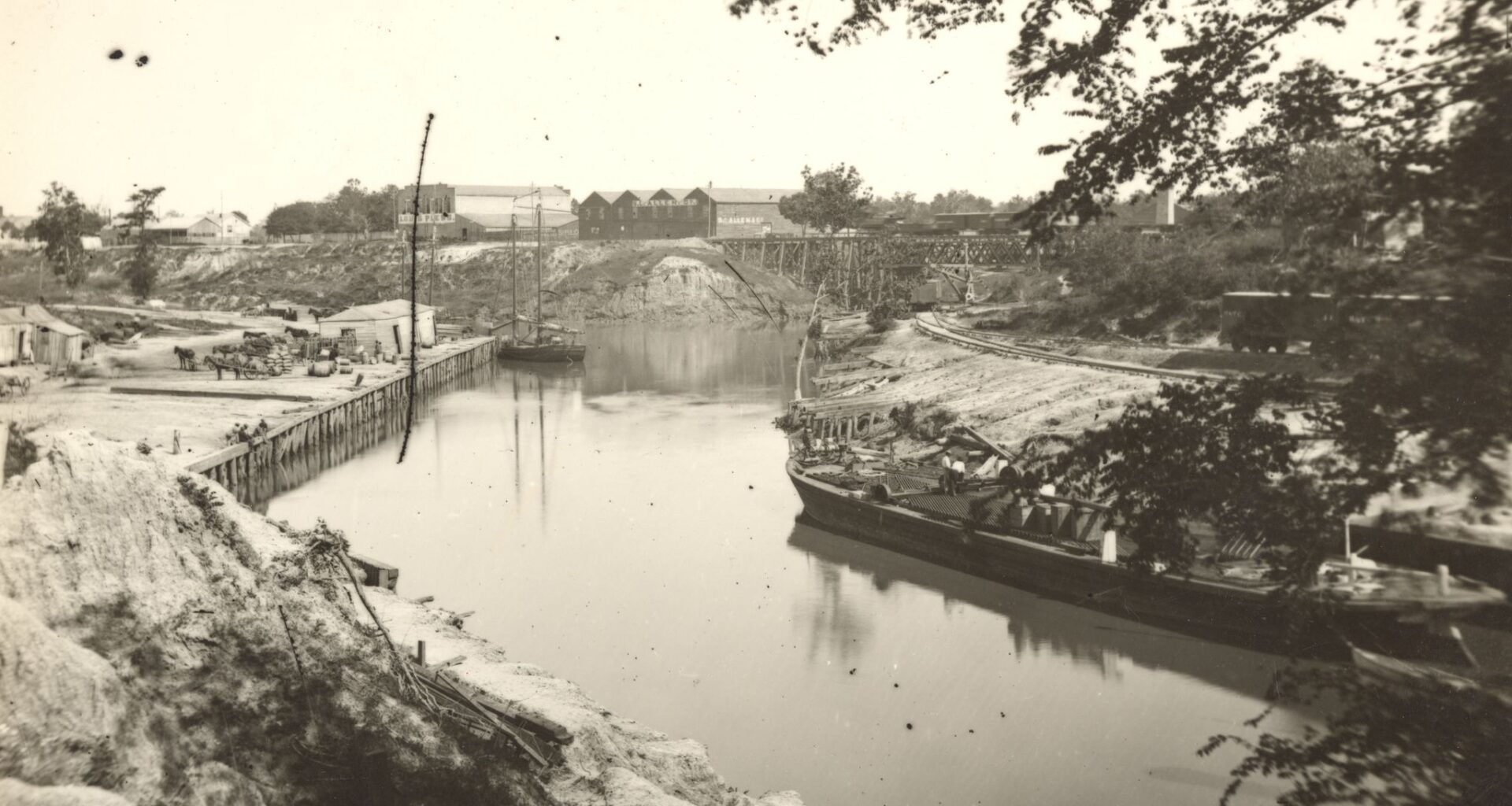
Houston Ship Channel, circa 1887. S. L Allen & Co (CENTER BACKGROUND)
Eidson Studio/Houston Chronicle Files
The SS Ellora navigates the Houston Ship Channel back when barges and steamboats traveled its waters.
Cecil Thomson/Houston Chronicle Files
This 1953 aerial photo shows the Long Reach Terminal in the Houston Ship Channel.
Owen Johnson/Houston Chronicle
This article was first published June 15, 2016. It has been updated and is being republished as part of the Chronicle’s 125 project.
In Houston’s earliest days, the city’s exports — mostly cotton and timber — moved to market on the shallow waters of Buffalo Bayou, carried by flat-bottom boats to Galveston, where they were loaded on ships bound for distant ports. The bayou was later dredged to improve maneuverability and accommodate shallow-draft steamships when they began making the run to Galveston in the late 1800s.
By the early 20th century, however, as the young oil industry and local economy boomed, city leaders realized that Houston needed a more direct connection to national and international markets. That spurred years of planning, fundraising, and more dredging of Buffalo Bayou, culminating on Nov. 10, 1914, with the opening of the Houston Ship Channel.
Article continues below this ad
The 52-mile waterway brought oceangoing ships to Houston, shifting commercial power from Galveston and, in the process, making Houston the capital of the modern energy industry. As the old expression goes, said Patrick Jankowski, retired senior vice president of research at the Greater Houston Partnership, “Houston is a village that created a port that created a city.”
“It was the first economic driver of the region,” Jankowski said in 2016, “and it remains as important today as it was when in opened.”
Today, the Port Houston complex is the nation’s largest port for waterborne tonnage. More than 8,300 deep-draft vessels and 231,000 barges move more than 309 million short tons of cargo through the Houston Ship Channel each year, according to Port Houston (which rebranded from Port of Houston in 2020).
Today, marine cargo activity along the Houston Ship Channel supports more than 1.5 million jobs in Texas and 3.3 million jobs nationwide, according to Port Houston’s latest economic impact study.
Article continues below this ad
When the Ship Channel opened 112 years ago, thousands of Houstonians lined its banks near the new Port of Houston, a scene the Houston Chronicle described as “pandemonium.” A floating band played the national anthem. The mayor’s daughter dropped white rose petals into the water. A 21-gun salute sounded. In Washington, President Woodrow Wilson pushed a button to fire a cannon in Houston by remote control to officially open the channel to traffic.
More than a decade earlier, two key events had come together to spur the development of the canal. In 1900, the devastating Galveston hurricane, which killed 6,000 to 8,000 people, destroyed the port there. Until then, Galveston was the center of commerce for Texas; afterward, money and influence shifted to Houston.
The following year, the discovery of the Spindletop gusher in Beaumont launched the Texas oil industry and positioned Houston at the center of the oil rush. As new inventions like automobiles and airplanes demanded more and more petroleum, Houston found that it needed better access to national and global markets in the new age of liquid fuels.
To make the Ship Channel happen, Houston’s leaders came up with what was then a novel idea: forming a partnership between the local and federal governments.
Fortunately, Houston had a civic-minded and influential congressman in Washington, Rep. Tom Ball, said Erik Eriksson, retired chief legal officer at Port Houston and its unofficial historian. Ball was able to persuade Congress to allocate $1 million for initial dredging, but the project needed another $2.5 million.
Article continues below this ad
A local delegation, led by then-Mayor Horace Baldwin Rice, traveled to Washington to make an unusual proposal: If Congress paid half of the $2.5 million, local taxpayers would cover the balance.
City leaders launched an all-out campaign to convince voters to assume $1.25 million in debt to dredge the Ship Channel to 25 feet, a project that would take three years. The vote in 1911 was considered so important to the city’s economic future that many companies gave their employees a half-day holiday to cast ballots, according to news reports.
Voters overwhelmingly approved issuing bonds to finance the project, but investors were skeptical of buying securities issued by a new type of authority called a navigation district. Bankers were reluctant to sell the bonds because of small commissions, according to the 1968 book, “The Port of Houston: A History,” by Marilyn McAdams Sibley. Houston businessman Jesse Jones stepped in and persuaded several bankers to sell the bonds.
It didn’t take companies long to realize the implications of the new port. Less than two weeks after voters gave the green light, the meat packing firm Armour & Co. announced it would spend $125,000 to build a three-story plant and smokehouse on the corner of Fannin and Commerce, according to a Houston Chronicle report.
The first oceangoing deep-water ship, the Satilla, arrived in 1915 and launched regular service between New York and Houston, according to Hurley. Because of the shipping disruption caused by World War I, Houston didn’t see its first foreign shipment until 1919.
Article continues below this ad
Refineries and petrochemical plants were drawn to the banks of the new Ship Channel to take advantage of the lower cost of transporting liquid fuels.
Over the next decade, oil shipments replaced cotton as the top export. By 1930, nine oil refineries had established operations on the banks of the Ship Channel.
In later years, city leaders raised more money to further deepen the channel and added new freight terminals. They traveled to Latin America to tout the port and its freight services.
“We always think of Houston as the oil capital,” said Eriksson, “but we were first conceived as a commercial trading capital.”
Article continues below this ad
From the Chronicle archives