

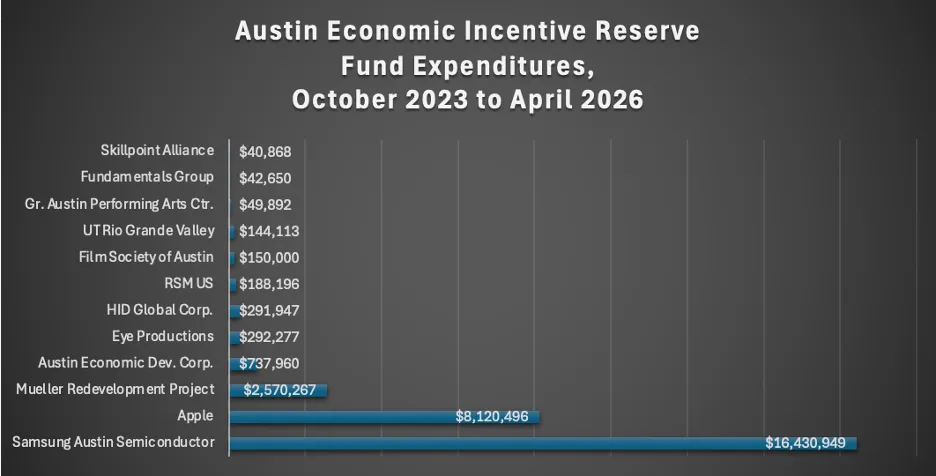
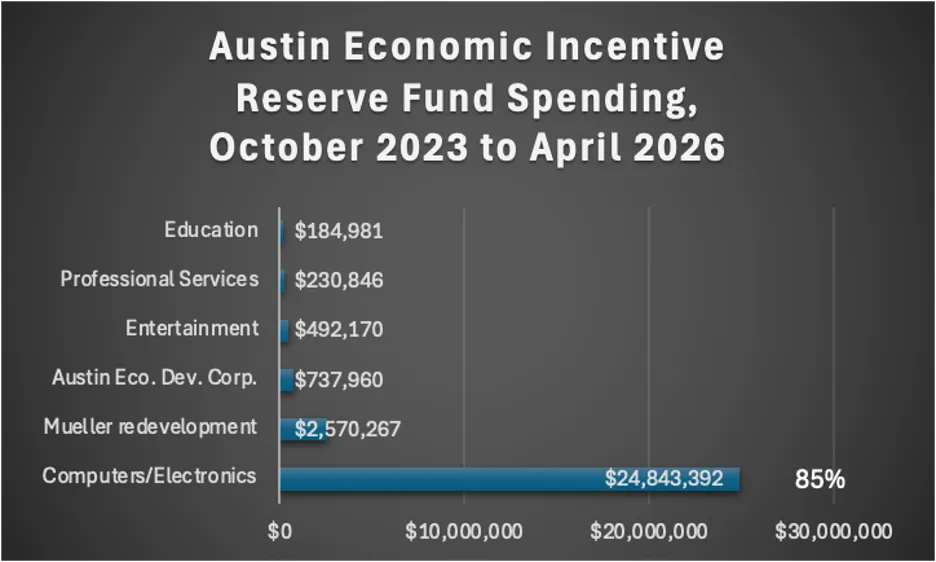
The City of Austin has paid out $29 million in economic development funds to a dozen recipients since October 2023. Almost 85 percent of that went to Samsung and Apple – among the top 30 global companies in revenues. The city also paid almost $300,000 to HID Global Corp., whose products secure access to buildings and computers.
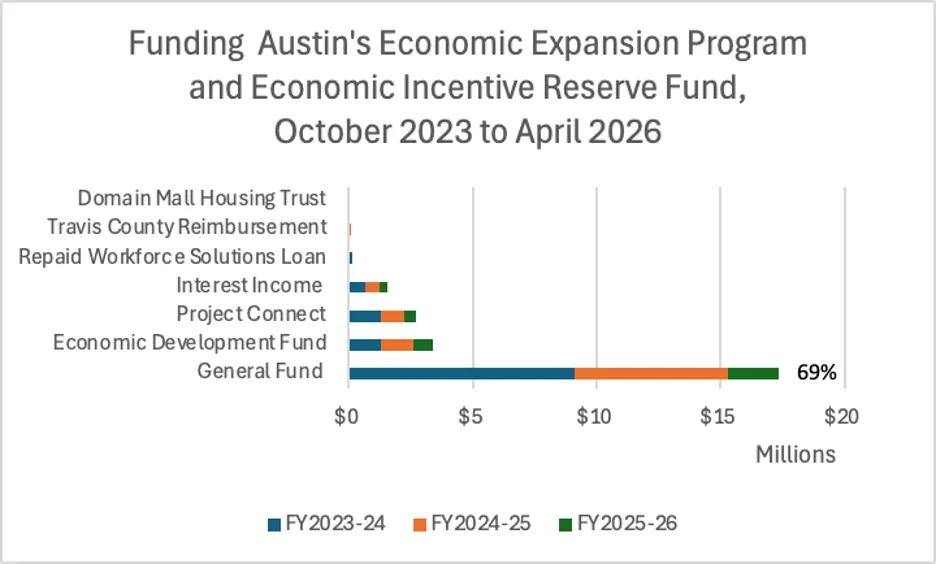
Local property taxpayers primarily finance these initiatives through the city’s General Fund, records show.
The Austin Free Press obtained this data through a Texas Public Information Act request for records of money flowing in and out of the city’s Economic Development Fund and its funding arm, the Economic Incentive Reserve Fund. The city is currently revising its controversial economic development policies.
 Source: City of Austin
The city’s only other seven-figure economic development outlay was $2.6 million paid to the Mueller redevelopment project. A Tax Increment Reinvestment Zone created by the city in 2004 allows Mueller’s developer, Catellus Development Corp., to reinvest Mueller’s increasing property taxes onsite.
 Carlos Soto
City “payments associated with the Mueller redevelopment are tied to the City’s contractual obligations” as part of that deal, city spokesperson Carlos Soto wrote in response to Austin Free Press questions about the payment.
Smaller investments
Apart from those expenditures, the city’s development payouts are something of a grab bag, records show.
The city paid almost $500,000 to three entertainment entities. More than half of that went to California-based Eye Productions, which produced the now-canceled TV show “Walker” around Austin. The city also paid $150,000 to the Austin Film Society and almost $50,000 to the Greater Austin Performing Arts Center.
 Source: City of Austin
Two education institutions, the University of Texas Rio Grande Valley and the local nonprofit Skillpoint Alliance, received a modest total of $185,000. The UT Rio Grande Valley payments supported programs for “employee-owned businesses” or cooperatives, as well as “cooperative community land trusts,” a city statement said.
Some development deals are ending as others are starting. The city’s FY2025-26 Budget states that its Economic Incentive Reserve Fund is “servicing agreements with the Domain, Samsung, HID Global, Apple and L’Oca d’Oro,” an Italian restaurant in the Mueller neighborhood.
In February, the city announced that South Korea-based 3billion US Inc. would open a northeast Austin AI genetic testing center for rare diseases. The company has pledged to hire up to 200 people over 10 years. The city agreed to pay the company $1,000 per eligible job through its Business Expansion Program.
Who pays?
Records from the city track $29 million in funding to the Economic Expansion Program and Economic Incentive Reserve Fund from October 2023 through April 20, 2026. The property-tax reliant General Fund that the city uses for most city services supplies 69% of that development money, records show.
 Source: City of Austin
Another $2.7 million in economic development funding (11%) came from Project Connect, which is partially funded by local property taxes. Contractually, Project Connect pays part of the property-tax rebates the city has awarded to incentivize companies to hire in Austin, a city statement to the Austin Free Press stated.
The city’s economic development fund also raked in $1.5 million in interest income, as the Economic Incentive Reserve Fund sat on annual reserves ranging from $6 million to $13 million in recent years.
 Kirk Watson
Against that backdrop, Austin Mayor Kirk Watson is urging a major shift in the city’s economic development strategy, warning that Austin risks falling behind as growth increasingly occurs outside its borders and competing cities strengthen their competitive edge.
Writing in his April 30 “The Watson Wire” newsletter, the mayor proposed a “progressive economic development policy” that “defines explicitly” what kind of companies Austin will recruit. “They pay living wages and invest in Austin’s workforce,” he wrote. “They bring career pathways, not just jobs. They operate as stewards of Austin’s public resources — its water, its energy, its land.”
Watson did not explicitly say how he would change Austin’s development recruiting. The current top recipient of Austin economic development funds, for example, is Samsung Austin Semiconductor. It’s also the Austin Water utility’s largest customer, consuming 2.2 million gallons in 2025, according to city documents.
A development resolution that the Austin City Council passed a week following the mayor’s April endorsement of a new development approach directs City Manager T.C. Broadnax to draft new development policies within six months.
A resolution attachment states this strategy should focus “on high growth industry clusters… where Austin has a comparative advantage” and “with a nexus to Austin’s research institutions.” It adds that the city will recruit “supply chain companies — the vendors, component manufacturers, and service providers” that add depth to “Austin’s industrial clusters.” It also calls for a “permitting concierge service” to fast-track development permits.
Policy critiques
City incentive deals have long focused on attracting high-tech big fish such as Intel, Computer Sciences Corp., Samsung and Apple. Critics say this creates higher-paying jobs for some while making the city less affordable for others.
 Rich Heyman
, who’s challenging District 9 City Council Member Zo Qadri in November, says that Austin’s wooing of high-wage tech companies boosts those kinds of jobs while indirectly increasing lower-wage jobs that service high-income people. Meanwhile, middle-income Austin jobs have decreased, he told the Austin Free Press. “What we need to do is flip that model on its head, make the local and small business the bulk of what we do.”
Heyman pointed to New York City initiatives that “help create worker-owned and employee-owned businesses.” He said that such businesses invest more locally, are better insulated from stock market gyrations and are “less likely to do things that would adversely affect the local community.”
The city council began retooling its economic development policies in 2018 to promote job training and include small businesses that hire workers without advanced degrees, the Austin Monitor reported. Although the city announced in March that it had completed those changes, most of its development funds still go to a few global corporations, with a tiny share benefiting small businesses and worker training.
“Many of those agreements were established before the City’s current economic incentive policies were adopted,” according to a city statement to the Austin Free Press. “The economic development policies currently under development are expected to create “more opportunities to support small businesses, workforce development, and place-based investments.”
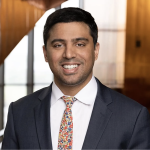 Zo Qadri
Council Member Zo Qadri told the Austin Free Press that Austin’s development plans require more than one focus. “As we continue to navigate a challenging fiscal environment shaped in part by state and federal limitations, we need an economic development strategy that supports neighborhood businesses while also ensuring that larger investments provide meaningful benefits for our community,” he said.
Andrew Wheat is the Data, Information and Enterprise Editor of the Austin Free Press.