
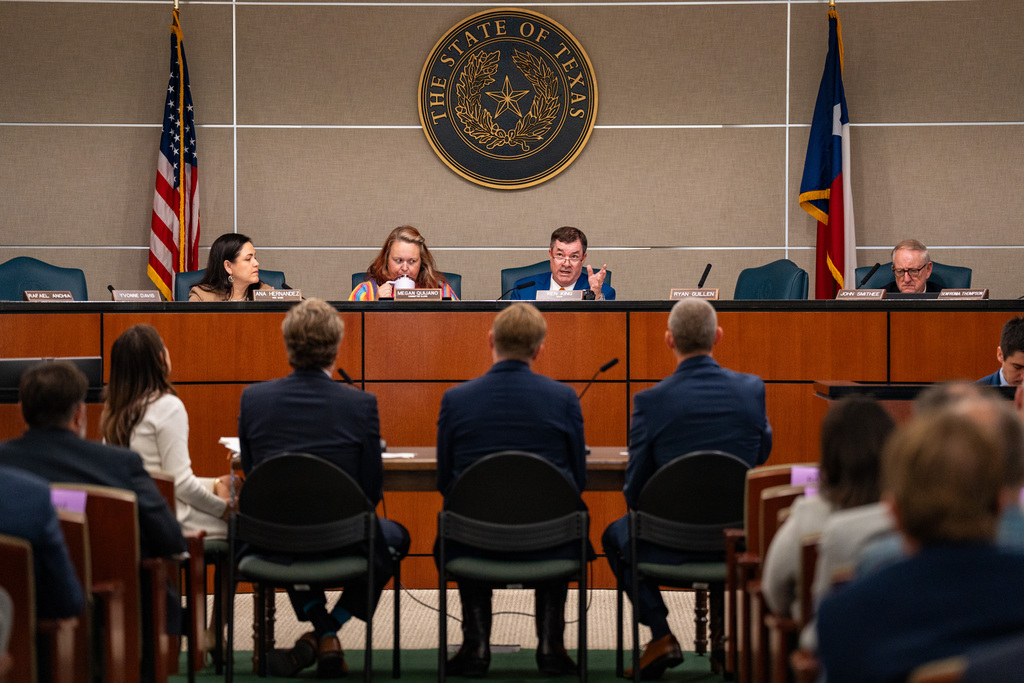
The House State Affairs Committee held a hearing Wednesday on data centers and the 765-kilovolt line at the John H. Reagan building in Austin.
Mikala Compton/Austin American-Statesman
Texas lawmakers signaled Wednesday that data centers could face greater scrutiny in the next legislative session, including the possible loss of state tax exemptions and new rules governing their water and power use.

Developers faced questions about their water and power use during a House State Affairs Committee hearing at the John H. Reagan Building in Austin.
Article continues below this ad
“What happens when we take your sales tax exemptions away, which is probably going to happen?” asked state Rep. Charlie Geren, a Fort Worth Republican. “You still want to be here? Realistically, that’s going to go away. You’ve heard the governor say it, so it’s going to go away. Does that affect y’all’s decision to stay in Texas?”
With more than 500 data centers across Texas and more than 500 gigawatts of capacity requested on the state’s grid, data centers are becoming a hot-button issue heading into the 90th Texas Legislature in January. Committees in both chambers have called hearings to better understand the rapidly expanding industry and its effects on the state’s water and electric systems.
Gov. Greg Abbott, in a change of tune from months ago, has directed state utility regulators to audit data center developers before allowing them to connect to the state grid. The directive, while imposing no direct regulation, seeks greater transparency from an industry that has historically kept quiet about its water and power usage and the users of its facilities.
Over more than six hours of testimony, lawmakers confronted gaps in available water-use data and continued questions over local control.
Article continues below this ad
“We support guardrails, there should be some,” said Skybox Datacenters Chief Development Office Haynes Strader.
Haynes Strader, chief development officer at Skybox Datacenters, attends a House State Affairs Committee hearing on data centers and the 765-kilovolt line at the John H. Reagan Building in Austin on Wednesday.
Mikala Compton/Austin American-Statesman
Water, power usage
Much of Wednesday’s hearing focused on data centers’ impacts effects on local resources and communities.
Article continues below this ad
Representatives from the Texas Water Development Board and Texas Commission on Environmental Quality both testified that their offices didn’t have that information. Water usage reporting is largely voluntary.
“When they apply, we have no idea? Nobody has any idea, so the numbers we get out there are just made up?” asked state Rep. Richard Peña Raymond, a Democrat from Laredo. “Somebody has an idea of how much water they’re going to require.”
Temple McKinnon, planning director for the Texas Water Development Board, said the response rate for its most recent water usage survey was less than 30%.
That question of water usage is at the top of Abbott’s audit directive for data centers. The Public Utility Commission of Texas and Electric Reliability Council of Texas are asking developers to disclose their proposed water usage, power usage, conservation efforts and other information for a report to be delivered to Abbott by Dec. 1.
Article continues below this ad
Lawmakers also wanted to know whether data centers are increasing Texans’ power bills. They are driving a surge in demand on the state’s main power grid, operated by ERCOT.
A recent push from lawmakers and residents who oppose the developments is for data centers to supply their own power generation and pay the costs of serving them. On Wednesday, lawmakers pressed ERCOT CEO Pablo Vegas, PUC Chairman Thomas Gleeson and Office of Public Utility Counsel CEO Ben Barkley about how the three organizations aim to protect ratepayers as Texas becomes the nation’s largest data center market.
Vegas and Gleeson, the regulator overseeing ERCOT, both said they plan to change their cost-allocation program for large electricity consumers.
Ryan Kuithe, Senior Vice President of Facility Operations at QTS Data Centers, attends a House Committee on State Affairs hearing regarding data centers and the 765-kilovolt line at the John H. Reagan building in Austin on Wednesday.
Mikala Compton/Austin American-Statesman
OPINION: Data centers need water. Texas should draw on this untapped source
Article continues below this ad
Several data center developers testified in the meeting that their industry, for the most part, is willing to pay their way.
The developers who testified included Lancium, which is behind the Abilene Stargate data center and centers in Childress and Turkey; Skybox Datacenters, which is building large data centers in Hutto, Pflugerville and Round Rock as well as in the Houston area; and QTS Data Centers, which has data centers in the Dallas-Fort Worth and San Antonio metros as well as in West Texas.
The developers largely said they supported guardrails on the industry, including requiring closed-loop water cooling systems and noise limits for data center facilities.
“When it comes to power, I’ll put it plain and simple. We want to pay,” Ryan Kuithe, senior vice president of operations for QTS Data Centers, said. “We pay for what we consume, and we pay for the infrastructure required for our projects. We do not believe that residential customers should subsidize our growth or this industry.”
Article continues below this ad
Local control or state oversight?
The hearing also brought a long-running local dispute to the Capitol, one that San Marcos City Council Member Amanda Rodriguez has been involved in: How much authority should cities and counties have over data centers?
Rodriguez, who represents Place 6, led an effort to ban data centers in San Marcos after significant community opposition to proposed projects. On Wednesday, she urged lawmakers to preserve city zoning authority.
“Our experience in San Marcos helped us identify questions that the state is now appropriately asking on a much larger scale,” Rodriguez testified. “That to me is an argument for preserving local authority, not further eliminating it. Because when new issues appear, the communities experiencing it firsthand are the first ones to understand how to respond.”
Article continues below this ad
Riot Platforms is developing a data center campus at the former Alcoa Corp. smelting site near Rockdale, seen here on Friday. The company has announced deals with AMD and an unnamed AI company tied by Bloomberg to Anthropic.
Jay Janner/Austin American-Statesman
City and county officials are on the front lines of the data center boom, facing packed city halls and courthouses, hours of public comment and meetings with developers as communities decide whether to approve projects. Now, as local governments try to manage the rapidly growing industry, state lawmakers are weighing how much authority cities and counties should have.
And as local governments attempt to wrangle the rapidly growing industry, state legislators may change how much authority Texas cities and counties have over data center development. Many counties, which have little to no zoning authority, have urged the state to grant them more authority over data center development.
“Our counties, they have zero authority when it comes to this,” said Rick Thompson, program director for the County Judges & Commissioners Association of Texas. “So how are we supposed to explain to our constituents that there may not be water in the next five years?”
Article continues below this ad
But lawmakers did not agree that expanding county authority was the answer.
Committee Chairman state Rep. Ken King, R-Canadian, whose district includes part of the rural Texas Panhandle, said it didn’t make sense to grant counties sweeping zoning and regulatory authority.
“If you go out there and start zoning a bunch of ranchers, they’re not going to be happy,” King said. “They’re going to get into their private property rights real quick. So I’m not sure that’s the answer.”
Article continues below this ad