
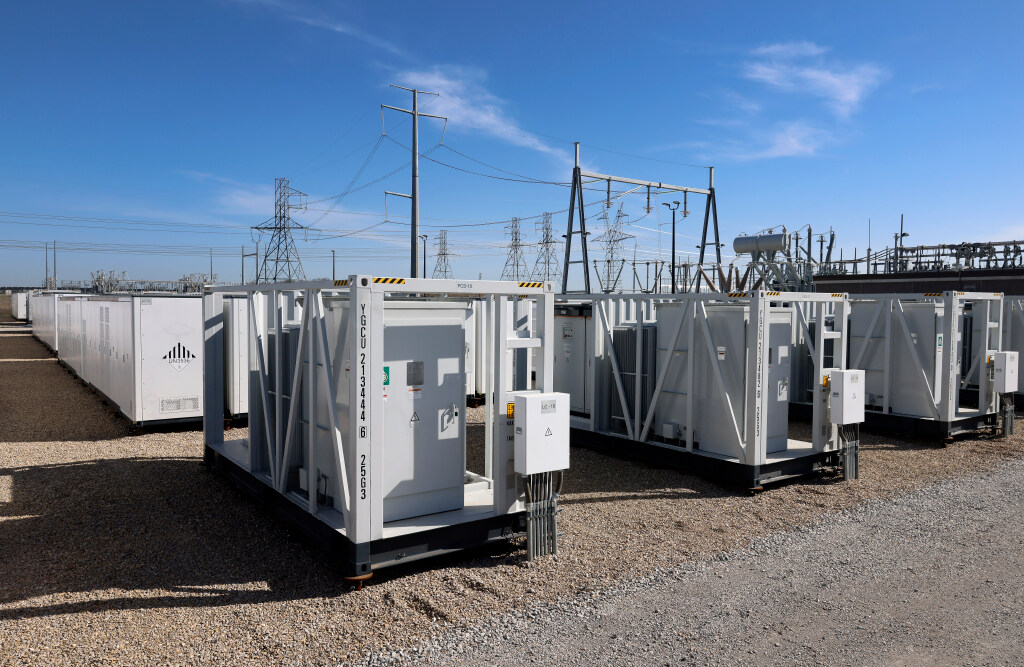
Texas should encourage greater use of secure, domestically manufactured energy-storage technologies whenever feasible, writes Joe Pancrazio. Pictured here, a row of power inverters, foreground, are tied to 5 MW Battery Energy Storage System (BESS) units, behind, at Key Capture Energy’s Hummingbird Battery Storage Facility near Krum, Texas.
Tom Fox/Dallas Morning News
Our state has an important role to play in powering and protecting the digital support structures we now depend on across government, business and our most basic societal transactions. This has become a matter of national security.
Texas is a massive hub for digital technology and AI innovation, supporting everything from advanced manufacturing to communications. Because China makes most of the rechargeable batteries that keep these electrical systems running smoothly, these services and industries are vulnerable to disruption.
Texas has an opportunity to lead not only in these digitally dependent industries, but also in providing a domestic source for the battery technology that protects them. Public discussion often focuses on the energy requirements of digital infrastructure, but the resilience and security of the technologies that keep these systems operating during power disruptions is just as important.
Article continues below this ad
The power supplies for these networks and industries, which include data centers, hospitals, finance and research facilities and defense installations, must be extremely stable. Even tiny fluctuations in the electrical supply can corrupt data, crash servers, disrupt transactions or scramble AI-enabled data processing. That’s why these facilities rely on backup battery power, most commonly the lithium-ion type found in your smartphone and laptop, which brings us back to China’s dominance in the market.
China makes 80% of the world’s lithium-ion batteries and mines or processes up to 90% of the materials they’re made from. Chinese firms are scaling production rapidly, exporting tens of billions of dollars in batteries annually and supplying the backbone of energy storage systems worldwide. Consequently, the United States, and Texas in particular, does not control the supply chain for the very batteries it depends on.
The irony is that Texas has deep ties to the development of lithium-ion technology, which dates back to the 1980s. Having forfeited the lead in battery manufacturing, the U.S. must now import large volumes of batteries and battery materials, often at prices that domestic manufacturers struggle to match. The dependence on foreign batteries is not just an economic gamble, it is a national security risk.
This is the kind of power we’re talking about: For a typical rechargeable drill used at home, the battery pack may consist of only four to eight battery cells, whereas the uninterruptible power source for a medium-sized cloud computing infrastructure facility may require the equivalent of over 100,000 such batteries. And the exponential growth of AI is creating its own challenges, prompting spikes in power load that can exceed the ability of backup power systems to respond.
Lithium-ion batteries are different from the disposable alkaline batteries that power a flashlight, requiring a combination of embedded software and sensors called a battery management system (BMS) to control charging and discharging. BMS security is a growing concern for imported lithium-ion batteries and the facilities they protect, as noted in a recent RAND analysis, particularly in areas of operational dependence, data sovereignty and cybersecurity exposure.
Article continues below this ad
Worst-case scenario? Countries that might have adversarial intent could access a BMS to manipulate charging cycles, disable safety systems or trigger cascading failures resulting in sudden loss of backup power, equipment damage or even fires. Imagine how those events could damage financial systems, cloud platforms and national security networks.
At the University of Texas at Dallas, researchers are helping strengthen America’s energy future. Supported by the U.S. Department of Defense, our Batteries and Energy Storage to Advance Commercialization and National Security (BEACONS) program is advancing next-generation battery technologies, accelerating commercialization and developing the skilled workforce needed to support secure domestic energy-storage manufacturing. Our new battery prototyping facility will help small and midsize companies translate innovative ideas into technologies that serve both commercial and national security needs.
This is a start, but not nearly enough. Texas should encourage greater use of secure, domestically manufactured energy-storage technologies whenever feasible. Our state needs to create incentive programs to support the growth of Texas-based battery manufacturing capacity to meet current and future needs.
It’s easy to imagine the positive economic impact of expanding our techno-industrial base in Texas, already the eighth-largest economy in the world. Like the Taiwanese companies building semiconductor facilities in North Texas, international companies that are concerned about Chinese dominance in the supply chain would likely find it very attractive to invest in U.S.-based battery manufacturing.
At its heart, this is an issue of digital sovereignty. Texas cannot afford to treat batteries as an import commodity because secure batteries are critical for a resilient and robust digital infrastructure. If Texas is to wisely lead the country in a digital economy, it must also lead in securing the systems that power it.
Article continues below this ad
Joe Pancrazio is the vice president for research and innovation at the University of Texas at Dallas.
Have thoughts about this? Send a letter to the editor using our letters form or email letters@dallasnews.com. Letters should be no more than 200 words and include the first and last name of the writer and city of residence.