
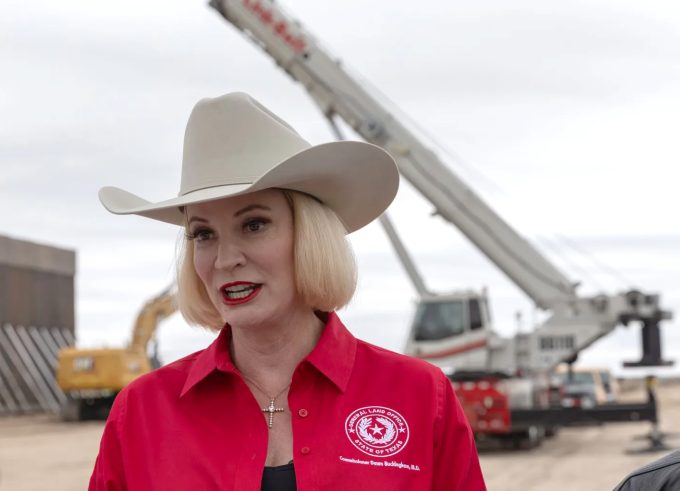
MARSHALL – Texas General Land Commissioner Dawn Buckingham said she wants to continue protecting the state’s natural resources and one of its greatest historical sites, the Alamo.
Buckingham stopped this week in Marshall while on the campaign trail and sat down to discuss her first year in office and what she hopes to do if reelected. She also talked about environmental concerns shared by many Texans, such as water resources.
Buckingham, a Republican, is finishing her first term in office and is running for reelection against Democrat Benjamin Flores in November. She is the first woman to be Texas land commissioner and said she wants to “keep delivering for Texas.”
The General Land Office manages millions of acres of public lands and mineral rights that fund public education. The office also is in charge of preserving the Alamo in San Antonio, running veterans cemeteries and caring for beaches.
Buckingham’s responses have been edited for length and clarity.
QUESTION: What are some projects or policies you have accomplished in your first term that you feel really proud of?
Email newsletter signup

ANSWER: We could go on for a long time. We’ve been an integral part of fighting against the cartels and human trafficking. We’ve been a major funder for education and helping people with their property taxes. We’ve helped small businesses. We’ve helped Texans recover from disaster. We roll up our sleeves, and we positively impact Texans’ lives, and they didn’t even know that we existed. So, it’s fun running around the state and talking about all of that, but really more just delivering for Texans.
Q: The General Land Office kind of has a lot of different hats. How would you describe it to someone that probably doesn’t know what that office does?
A: We are the largest mineral owner in the state, 13 million acres, which puts us in a really unique position to stand up for individual property owner rights and defend oil and gas and the Texas economy. We fund education, K through 12, and then also through the Permanent University Fund — I chair their Board for Lease. We love the fact that, for example, on the coast, we’re starting the largest beach renourishment project, putting sand back on our beaches, protecting those homes. We’re working on the safety of the coast, health of our bays and being sure that our fishing stays wonderful. Our veterans, we serve them in so many ways. I think the most important thing we’re doing is being sure that the Alamo stands for another 500 years to tell our loud and proud Texas history.
Q: If reelected, what are key points or projects you’d like to accomplish?
A: We’re going to keep delivering for Texas. We have brought new revenue streams into the state. We’re about to bust China’s monopoly on rare earth minerals, bringing billions of dollars to public education.We’re also looking at new ways to be helpful. Produced water, water that comes up with oil and gas, is dirty and doesn’t have a ton of use, but we’re working to get it to agricultural levels for the same price as reinjection. We might be delivering millions of barrels of fresh, clean water a day to Texas, which will be transformational. We’re going to continue to steward the land and the coast, and we’re going to continue to serve our veterans in new and unique ways.
Q: Texas has had a lot of controversy surrounding data centers and some opposing views within the Republican Party. What are your views on data centers?
A: I think there are legitimate concerns about water and electricity and occupying productive land, and until those concerns are met, we shouldn’t build more data centers.
Q: Northeast Texans have been concerned for decades with the possible construction of the Marvin Nichols Reservoir in this region, and eminent domain could be used to take the private property for construction. What are your views on that?
A: I’m not a big fan of eminent domain. So, I’m a country girl by how I was raised, a farming and ranching family, and sometimes eminent domain has to be taken, but you want the property owners treated fairly. Inter-basin transfer of water is a highly contentious issue, to say the least. But we really hope some of the transformational projects that we’re doing with produced water — we might be delivering millions of barrels a day to Texas of good, clean water, and if we can do that, and we can support desalination efforts and some other things, maybe we can solve these problems without people’s land having to be taken.
Q: Border wall construction has paused at Big Bend National Park. What are your thoughts on everything that’s happening?
A: We think there are a lot of places where a virtual (border) wall makes more sense than a physical wall. In our history, we have purchased property to build the wall on in the past. We have declared islands in the Rio Grande as Texas land, taking them away from cartel safe havens. So, we are very strong on border security, but we feel like in a lot of places, especially in Big Bend where you’ve got 1,000-foot cliffs, a virtual wall makes more sense than a physical wall.
Q: What does a virtual wall entail?
A: Virtual walls can actually detect people from miles that are coming across the border. We need to do vegetation control where the people crossing illegally hide. And then we need to have road access so when they do come across, we can go and grab them.
Q: Let’s talk about the Alamo. How is the restoration going, and why is caring for this place special to you?
A: What we are really doing at the Alamo is making a visit to the site worthy of the significance of the events that happened there for the very first time. So, it’s a $550 million project. We are building a 160,000-square-foot museum that is really going to tell the story of our history. To understand the story of the battle, you have to understand why Native Americans settled there initially. You have to understand who built the missions, because the Alamo was a mission before it was a fort. And then you have to understand the events leading up to the battle, and then that last gallery in the museum is going to talk about how the Alamo continues to affect pop culture. In the middle of that museum is going to be a 4D theater. It’s going to be phenomenal. But when you’re sitting in that seat, you’re going to have an entire view like you’re standing in the center of the fort, and you’re going to feel those cannonballs hit, and you’re going to smell that gun smoke and fire, and you’re going to really be able to immerse in our story in the battle unlike any other time.
But the big thing is the Alamo’s roof needs to be changed. It’s past its useful life. It’s causing active damage to the building. The walls have been wicking saltwater up out of the ground. Saltwater and limestone don’t go too well together, so we have some structural integrity issues. So, to be sure that our beloved Alamo stands for another 500 years, we need to fix those wall integrity issues and we need to get a new roof on it.
And that should be done in the next couple of years. Whenever you’re dealing with a 300-year-old building, it’s really important to do it right, not fast. And so, we’re going to take the time that it needs to get it done right.
Q: Could you give an update on the East Texas State Veterans Cemetery near Hallsville?
A: We’re going through the final legal hoops to get the land donated. We’ve asked for the federal Veterans Affairs for over $20 million to build the cemetery. It’s going to be on over 6 acres, I believe, and there’s an adjacent property owner who might toss in a few other acres, which might be amazing.
We know that East Texas is very strong in military service, and we want to serve those veterans who aren’t currently being served by a cemetery. Our cemeteries are gorgeous. They are really special places, and we do some really special things with them.
Q: How many veterans will it serve approximately?
A: Over 60 acres, it’s going to have a columbarium, and it’s going to have burial plots. It is going to be thousands and thousands of veterans that it will serve.
Q: Is there a specific timeline of when construction’s going to begin?
A: Not really. So, first, there’s certain hoops that the land donation has to go through. They’re clearing up some title issues. I think it’s a family property that there’s several title owners to it, so they’re working on that. Once that and the environmental report is completed, then we get in line with the federal VA for the money to actually build the cemetery. It’s a cooperation between the federal VA and the state. So, we’ll get it done as soon as we can get it done.