
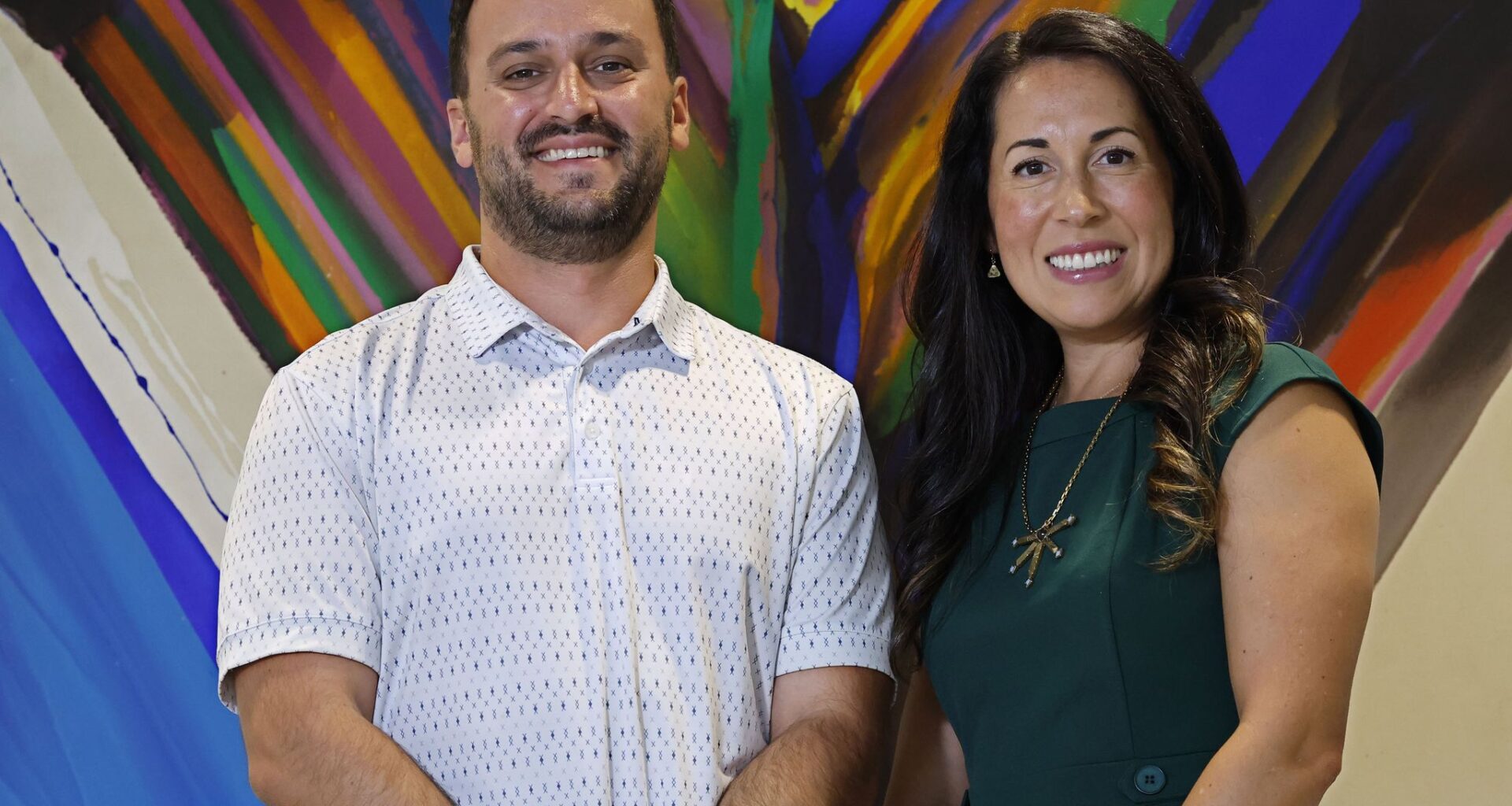
Robert Taylor, board chair of The Educator Collective and managing principal of The Apartment Group poses for a photo with Alejandra Barbosa, CEO of The Educator Collective, Monday, Aug. 17, 2026, in Dallas.
Chitose Suzuki/The Dallas Morning News
At a moment when funding for nonprofits is tight, a longtime strategy in philanthropic circles is getting a national boost: mergers.

Better Together Fund, created in 2017 to facilitate nonprofit mergers and collaborations, is reupping those conversations in Texas.
“Over the past nine years, it’s become a little bit more normalized, which was the intent of the Better Together Fund,” said Margaret Black, managing director at LH Capital and Lyda Hill Philanthropies, one of the four founding funders overseeing the nonprofit. “We used to whisper the word ‘merger.’”
Article continues below this ad
There are more than 2 million nonprofits nationwide. In Texas, there are more than 259,092 nonprofits, according to Guidestar/Candid data analyzed by the Communities Foundation of Texas.
Conversations about merging gained their first wave of traction in the early 2000s, Ben Gose, a senior editor at the Chronicle of Philanthropy, said. The idea was there were too many nonprofits working on similar issues that could make better use of limited funding by merging.
Related: North Texas Giving Day sees record participation as nonprofits face funding challenges
Funding is particularly limited today as the federal government has pulled back on grants and philanthropic grants are in higher demand. Seventy percent of nonprofits in a report from the Center for Effective Philanthropy surveyed in 2025 had their funding reduced from at least one source.
Better Together Fund hosted more than 100 North Texas nonprofit CEO’s and board chairs in May for an event about nonprofit mergers as a strategy to tackle the financial challenges faced by nonprofits.
Article continues below this ad
The Better Together Fund provides foundation-backed counseling and grants to nonprofits that want to merge, as merging can be a heavy lift that comes with a host of challenges and expenses.
Teachers participate in The Educator Collective’s Well U session, which includes conference style workshops and sessions. The Educator Collective is a nonprofit merger that was facilitated by Better Together Fund.
The Educator Collective
“Better Together grew out of a conviction that nonprofit collaboration should really be treated as a strategic growth tool, not about a sign of weakness or limited resources,” Black said. “This is not a story of funders thinking there’s too many nonprofits and everybody needs to merge.”
Better Together Fund has supported more than 85 collaborations involving more than 320 organizations since 2017, with $7.1 million awarded in grants. Thirty-four of those collaborations were mergers.
Nonprofits are initiating
When nonprofit mergers first became a trend, foundations often pushed for them, Gose said. That at times created a power imbalance that made mergers less appealing, he said.
Article continues below this ad
After the COVID-19 pandemic, he said, the topic became popular again. It is now common for nonprofits themselves to initiate mergers.
That’s how it worked with The Educator Collective, a nonprofit that develops resources and leadership programs for teachers and principals at all grade levels.
Related: Communities Foundation of Texas dedicates $10 million to education initiatives
Previously, The Educator Collective only provided support for North Texas teachers. Principal Impact Collaborative at University of North Texas at Dallas offered programs to help principals. Leaders from both organizations had a dilemma: in order to teach their students effectively, teachers needed good principals, and in order to run a strong school, principals needed good teachers.
In early 2025, they approached Better Together about becoming one nonprofit. By August 2025, they finished a three-step grant process and merged under The Educator Collective’s name.
Article continues below this ad
“It was a strategic decision to serve our clients more thoughtfully, but also because of the reduced federal funding and grants, having to be more efficient with our dollars,” said Alejandra Barbosa, CEO of The Educator Collective and founder of the Principal Impact Collaborative. “…How do we get clear-cut about how to provide those services in a very cost-effective way?”
Alejandra Barbosa, CEO of The Educator Collective, poses for a photo, Monday, Aug. 17, 2026, in Dallas.
Chitose Suzuki/The Dallas Morning News
Both nonprofits were small before they combined, which made the merger easier, Barbosa said. There were some operational and policy differences they had to resolve, but they did not have to lay off any staff. Instead, they shifted some of their employees’ roles.
Related: Dallas’ next-generation investor hub comes to life
Since merging, The Educator Collective has been able to serve 60% more educators and principals with the same amount of staff.
Article continues below this ad
“It is really, really hard, but it’s so worth it,” said Robert Taylor, board chair of The Educator Collective and founder of the original organization. “We talk a lot about the organizational nuts and bolts, but ultimately the reason we did it is because we were convinced it would make us better at serving the people we’ve been called to serve.”
Robert Taylor, board chair of The Educator Collective and managing principal of The Apartment Group, poses for a photo, Monday, Aug. 17, 2026, in Dallas.
Chitose Suzuki/The Dallas Morning News
Not always easy
The process for Healthy Futures of Texas, a three-way merger, was more challenging.
Healthy Futures of Texas promotes access to sex education and sexual health resources. Its current form is the result of a merger between San Antonio-based Healthy Futures of Texas, Austin-based The Texas Campaign to Prevent Teen Pregnancy and Dallas-based North Texas Alliance to Reduce Unintended Pregnancy in Teens.
Article continues below this ad
Related: Dallas has a health disparity problem. Fixing it could boost the economy
With shared goals and employees that got along, they approached Better Together because combining seemed organic, Terry Greenberg, chair of Healthy Futures of Texas, said. Still, they needed help — there were a lot of questions they needed to iron out with consultants.
“Three organizations is a pretty heavy lift,” Greenberg said.
For starters, Healthy Futures had to determine where its leadership would be based since the organizations spanned the state. They landed in San Antonio but have a major office in Dallas and another in the Rio Grande Valley.
Greenberg went from leading a staff of 11 at North Texas Alliance to Reduce Unintended Pregnancy in Teens to 50 at the merged Healthy Futures of Texas, so the nonprofit had to figure out how to combine the teams. Each of the nonprofits handled their money differently, a matter that was made even more complicated by the fact that two of the organizations were federal contractors and one of them was not.
Terry Greenberg, chair of Healthy Futures of North Texas and Chris Kroeger, past chair of Healthy Futures of North Texas.
Healthy Futures
“There was a lot of work to combine those three budgets and three pots of money and the accounting,” Greenberg said. “We created a back office expertise that nobody really had.”
The challenges that come with merging aren’t just logistical, Black said. They’re also emotional, which is why Better Together encourages boards to weigh in on how they can align each organization’s operations and finances.
“There’s identity, there’s legacy, there’s brand and pride and control, and all sorts of grief that goes through it,” said Black.
Combining was more than worth it, Greenberg said. With a wider range of knowledge that each group picked up before combining, the organization’s educators now specialize in more topics. Becoming a statewide organization also opened the door to more funding.
The federal government recently discontinued a $2 million grant aimed at teen pregnancy prevention for Healthy Futures.
With three organizations now under one umbrella, it will be easier for Healthy Futures to figure out how to pivot compared to when they “had all their eggs in one basket,” said Greenberg.
Meeting the moment
Major national foundations are encouraging mergers.
For example, the Ford Foundation and the MacArthur Foundation are backing the Sorenson Impact Institute’s $1 million Collaboration Fund that will support the consolidation of nonprofits focused on impact investing.
Better Together is sponsored by Lyda Hill Philanthropies, Communities Foundation of Texas, The Dallas Foundation, Hoblitzelle Foundation, The Meadows Foundation, NexPoint Philanthropies and United Way of Metropolitan Dallas.
Related: Communities Foundation of Texas donates $2 million to boost local news and civic engagement
Black stressed that even at a time when nonprofits are facing funding challenges, merging isn’t for everyone. Better Together looks for mergers that allow nonprofits to do more than they could do on their own.
“We exist because collaboration in nonprofit land is very easy to praise but very hard to do,” Black said.
When Better Together first started, the merger conversation was in a lull, Black said. She said Better Together’s success helped change that.