
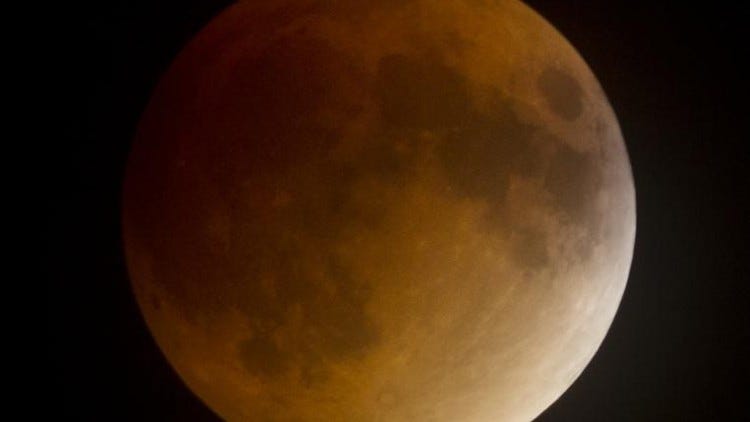
Texans who stay up late next week could catch the moon turning red.
A partial lunar eclipse will be visible across the Lone Star State late Thursday, Aug. 27, into early Friday, Aug. 28, with nearly all of the moon expected to pass through Earth’s shadow.
The eclipse will begin at 8:23 p.m. Thursday, but the show won’t become obvious right away. The moon will begin noticeably darkening around 9:33 p.m. as Earth’s shadow moves across its surface.
The best time to look up will be around 11:12 p.m., when the eclipse reaches its peak. At that point about 94% of the moon will be obscured by Earth’s shadow, leaving only a small portion brightly lit.
Most of the eclipse will be over by 12:51 a.m. Friday, although its final stage will continue until about 2 a.m.
Despite the nickname “blood moon,” there’s nothing unusual happening to the moon itself.
A lunar eclipse happens when Earth passes between the sun and the full moon. Earth blocks most of the sunlight that would normally illuminate the moon, but in a partial eclipse, some light still passes through the planet’s atmosphere.
Earth’s atmosphere filters out much of the blue light while allowing more red and orange light to reach the moon, giving it a copper or rusty appearance.
The same basic effect helps create sunrises and sunsets.
Unlike a solar eclipse, you won’t need special glasses to watch. Looking directly at a lunar eclipse is safe — no equipment necessary. Binoculars or a telescope can offer a closer view, but the eclipse will be visible with the naked eye as long as skies are clear.
In Texas, there won’t be another lunar eclipse with at least 50% of the moon obscured until 2029.