
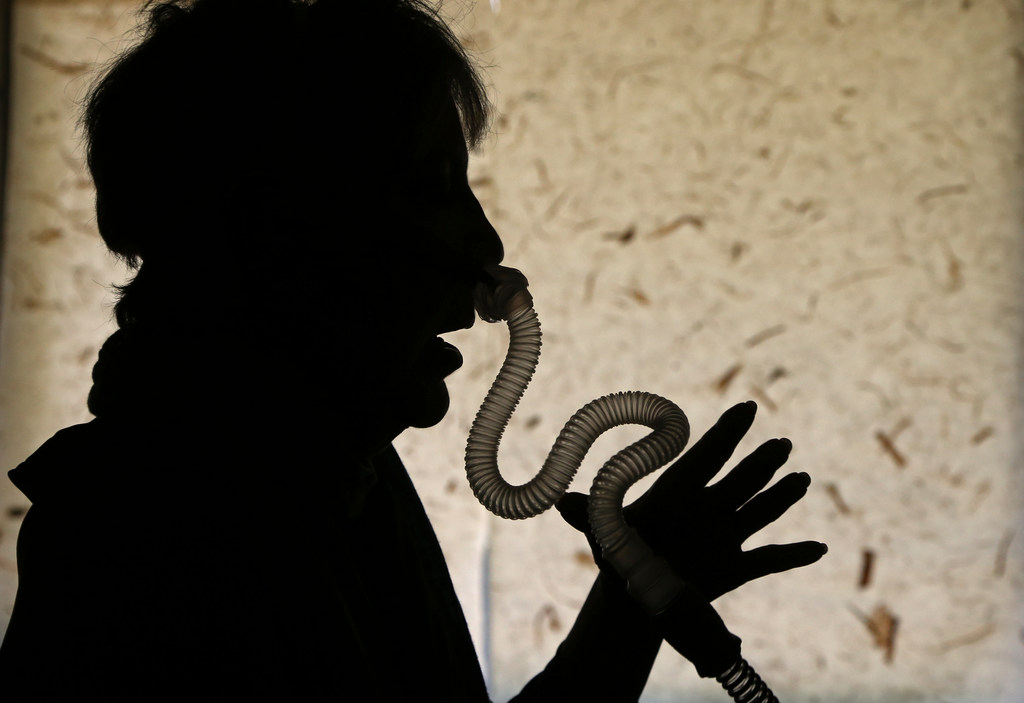
A woman demonstrates how she puts on her sleep apnea breathing device.
Reed Saxon/AP
A multinational conglomerate is set for a Texas showdown in a potential $1.3 billion case in the Netherlands.

Health technology company Philips is fighting in U.S. District Court in Austin to prevent its former director of medical affairs from being deposed by a group of foreign investors who say they will sue for more than $1 billion over issues with its sleep apnea machines.
Article continues below this ad
Institutional investors announced last year that they intend to sue Koninklijke Philips N.V., the parent of Philips Respironics, which made millions of CPAP and BiPAP medical devices.
The planned Dutch lawsuit argues the company defrauded investors through false and misleading statements, resulting in large losses. Lawyers for the investors have asked a federal judge in Austin to force the deposition of Hisham Elzayat, an Austin area medical affairs consultant.
READ NEXT: Austin AI startup’s founder feud spirals into 5-court legal war as cash runs out
The heart surgeon, who was medical director at Philips early this decade, became a central figure in fights within the company over defective machines allegedly causing harm to patients. He pushed Philips to stop shipping the devices but it instead stepped up sales during the pandemic, boosting revenue.
Article continues below this ad
Elzayat subsequently sued as a whistleblower.
The investors say his testimony can shed light on when Philips learned the machines contained a potentially carcinogenic foam that posed a danger to users as it degraded.
“We expect Dr. Elzayat’s testimony and documents to shed light on when Philips learned of the PE-PUR foam degradation and its potential patient-safety risks, its internal testing and investigation, the escalation of safety concerns, and its decision-making regarding continued shipments of affected devices and their eventual recall,” Alice Cho Lee, an attorney for the investors, said in an emailed response to questions.
Elzayat said in court filings that the company was attempting to redesign its machines rather than immediately issue a recall. He sued in 2021 under the federal False Claims Act.
Article continues below this ad
“Philips knowingly kept the defective Devices on the market for as long as it did so that it could buy time to develop replacement versions prior to recalling the first-generation Devices — thereby avoiding any revenue gaps,” his lawsuit said. “Philips, in no uncertain terms, put profits over patients.”
The company issued a recall of 15 million devices in mid-2021 shortly before the lawsuit was filed and is no longer making CPAP and BiPAP machines for the U.S. market.
U.S. Food and Drug Administration documents showed Philips had known since late 2015 about the problems with the foam breaking down. According to the regulator,116,000 medical device reports were submitted and 560 deaths may have been linked to the foam.
ProPublica and the Pittsburgh Post-Gazette published a series of investigations that found links between the use of defective devices and cancer, asthma and organ failure.
Article continues below this ad
The recalls and subsequent publicity led to the company’s market capitalization declining by $29.5 billion, according to investor lawsuits.
Now, investors want the documents Elzayat produced. The company wants to stop that from happening, arguing investors are attempting to go around Dutch law through U.S. courts.
Philips already has paid more than $1.69 billion to U.S. consumers. The company agreed to a court-ordered consent decree blocking it from selling and manufacturing devices at three of its U.S. plants but did not admit fault in the consumer settlement.
Five institutional investors are seeking the federal court action on behalf of 50 institutional investors: Raiffeisen Kapitalanlage-Gesellschaft mbH; NLB Skladi upravljanje premozenja, d.o.o.; Capfi Delen Asset Management N.V.; Stichting Pensioenfonds Campina and Australian Ethical Investment Ltd.
Article continues below this ad
It is one of at least two major lawsuits being launched in European courts related to the issue. Another group of 100 foreign institutional investors sued the company last year making similar claims. Philips has listed six possible or current investor lawsuits.
Investors in the pre-litigation action filed an application to subpoena Elzayat in January. The application was approved in March without the involvement of the company by Judge Alan Albright of the Western District of Texas.
Koninklijke Philips N.V. and Philips RS North America subsequently filed motions to intervene and quash the subpoenas.
The companies said investors failed to follow the correct process in the Netherlands, where the lawsuit is set to be filed. They said investors should have requested the documents from the company first, as other investor lawsuits have done.
Article continues below this ad
They also note the investors have attempted to obtain documents from the Pittsburgh Post-Gazette through similar federal court actions and point to court-ordered pauses in related Amsterdam court actions.
Elzayat, for his part, is not inclined to go through further depositions. He said in court filings he already sat for two depositions and produced records for a lawsuit that are now in the hands of the companies.
Multiple depositions make him vulnerable in his whistleblower lawsuit, Elzayat said, as the passage of time may lead to inconsistencies in his responses.
Article continues below this ad
The case has been transferred from Albright, who retires this month, to Andrew B. Davis, who set an Aug. 24 hearing to determine whether the subpoenas for documents and depositions will stand.