
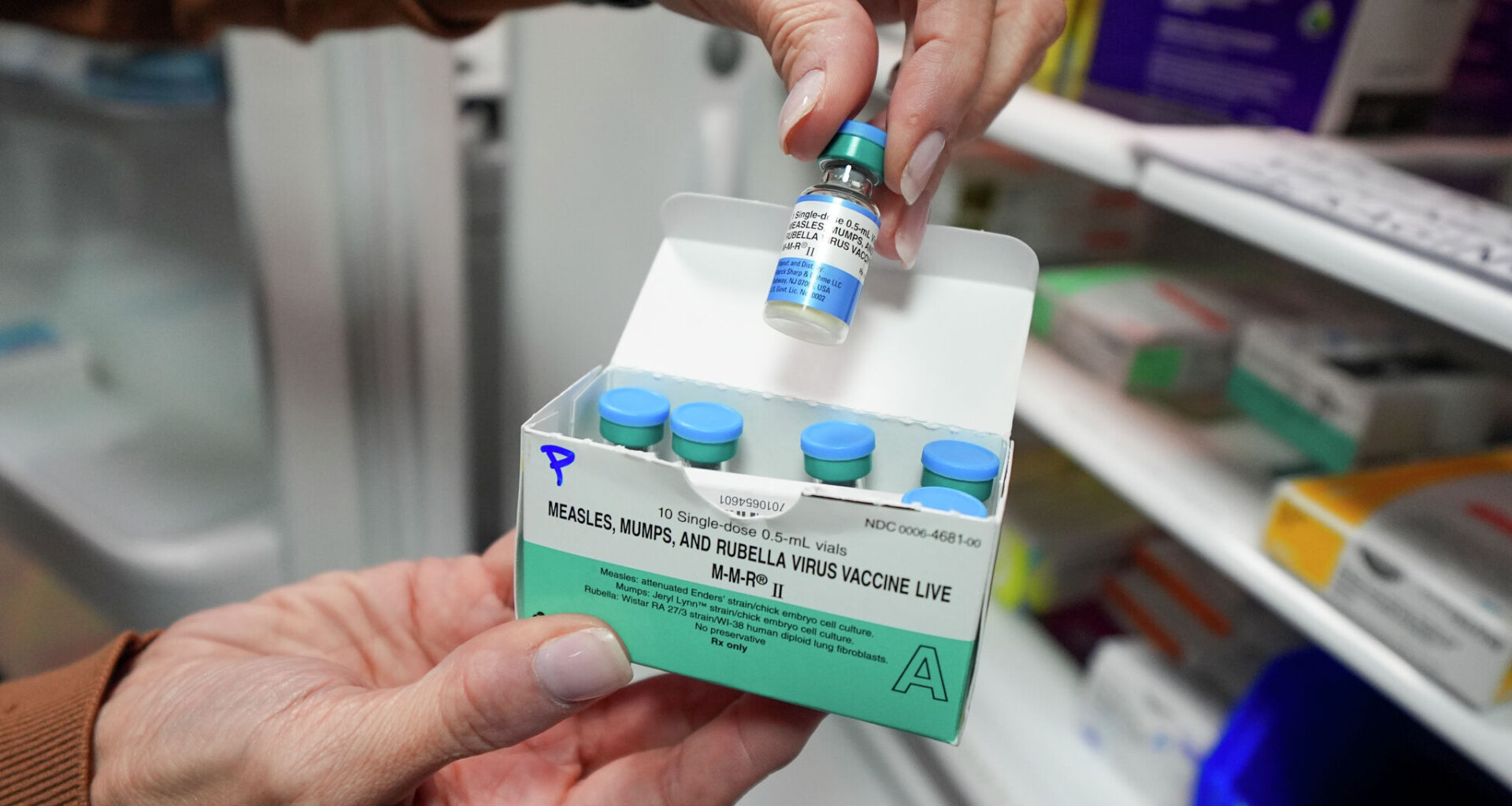
Vials of the measles, mumps and rubella vaccine are displayed in February in Lubbock, Texas.
Julio Cortez/AP
As national immunization rates trend downward, Connecticut, instead, continues to see increases in the number of schoolchildren receiving their annual shots, according to new federal and state data.

Around 98.6% of Connecticut kindergartners received the required measles, mumps and rubella (MMR) vaccine in the 2025-26 school year, a 0.4% increase from the previous year, according to the state Department of Health.
Article continues below this ad
Connecticut has the second highest MMR vaccination rate among kindergarteners in the country, according to the Centers for Disease Control.
“We’ve reached an all-time high,” said state Department of Public Health commissioner Manisha Juthani during a press briefing on Tuesday, regarding MMR vaccines.
For the United States as a whole, the opposite happened, according to new data from the CDC. National MMR immunization rates among kindergarteners dropped to 92.4%, marking the fourth year of record-breaking lows. Herd immunity is 95%.
Vaccination coverage among U.S. kindergartners also decreased for all reported vaccines from the previous year. The CDC said coverage for MMR, DTaP, polio and VAR dropped in more than half of the states.
Article continues below this ad
State experts attribute Connecticut’s higher immunization rates to strict state requirements, health department initiatives, evidence-based recommendations and community outreach. And yet, pediatricians and public experts say families continue to raise questions around vaccine safety, reflecting a hesitancy they say is in part fueled by rhetoric from the federal government.
“I don’t think any parent wants their child to catch a vaccine-preventable illness,” said Dr. Andrew Carlson, division head of primary care at Connecticut Children’s Medical Center. “I think there’s just concern about what they think is doing the right thing for their child, and making sure that that’s an informed decision is part of our job as a pediatrician.”
National vs. state exemptions
All children attending public and private schools in Connecticut, as well as preschools and childcare centers, must get various vaccinations depending on their grade level.
Article continues below this ad
The state does not allow for personal belief exemptions, and repealed religious exemptions in 2021. But students who had a valid exemption on file before the repeal were allowed to keep their exemptions for their remaining school years, through grade 12.
The percentage of Connecticut kindergartners with a religious vaccine exemption decreased from 0.02% to 0.01% during the 2025-2026 school year, according to the state Department of Health. Nationally, the non-medical exemption rate was 4% for the 2025-26 school year, according to CDC data.
Connecticut does allow medical exemptions, although typically a very small percentage of students qualify for it. Around 0.5% of Connecticut kindergartners had a medical exemption in 2025-26, a slight increase from the previous school year, according to state data.
Article continues below this ad
Across the country, vaccine exemptions for both medical and nonmedical reasons rose in 41 states and the District of Columbia, with 24 states reporting exemptions exceeding 5%, according to the new CDC data.
Immunization medical exemptions are decided between providers and their individual patients. The role of DPH, Juthani explained, is simply to catalog submitted medical exemptions, offering a report at the end of the year.
Exemption rates can vary between states and regions – and even between Connecticut schools. State data shows that some Connecticut schools have higher rates of religious exemptions compared to others.
“We do know that there are some schools who might be lower than other schools, but overall in the state, it’s a very, very high vaccination rate overall,” Juthani said.
Article continues below this ad
Among public school kindergarten students in Connecticut, the MMR coverage rate was 98.7%, while private schools reported a coverage rate of 97.1%.
Although the exemptions are a small number of the total student population, Juthani said the concern is that a continued increase, especially nationally, could create gaps in immunity and leave undervaccinated schoolchildren vulnerable to outbreaks of vaccine-preventable diseases.
Measles, in particular, continues to be a major concern for health departments nationwide heading into the new school year.
Article continues below this ad
So far in 2026, there have been 2,566 confirmed measles cases nationwide, marking the highest annual number of cases in over three decades, according to the CDC.
Connecticut has reported three measles cases, one of which was in a vaccinated adult. Juthani credits the state’s high overall immunization rates and subsequent herd immunity in preventing a full-blown outbreak.
Changing federal landscape
Vaccine hesitancy is nothing new. In the early 2000s, Carlson said a lot of the concern focused on the disproven connection between immunizations and autism.
Article continues below this ad
Nowadays parents are more concerned about potential side effects or adverse reactions to immunizations. They also have more questions about vaccine safety and how vaccines impact a person’s entire immune system, especially with changing federal guidance.
Answering questions often takes time, lengthy conversations about risks and benefits and overall trust between patient and provider.
At the end of the day, however, “when you really look at the science, there’s nothing to support those fears,” Carlson said. “But I can’t blame families for being nervous.”
Under President Donald Trump’s second term, federal officials have repeatedly questioned the efficacy of vaccines and attempted to roll back childhood vaccine requirements. The latest development includes a new executive order signed by Trump that reduces the number of recommended childhood vaccines and directs them to be administered during separate visits. It also calls on the federal health department to further improve vaccine research and offer the MMR vaccine in three different single-disease shots, instead of the typical one dose.
Article continues below this ad
Over the last 18 months, in addition, all 17 members of the CDC’s Advisory Committee on Immunization Practices were replaced, the CDC rolled back its stance that vaccines do not cause autism and it announced changes for the COVID-19 recommendations, without providing evidence.
The new committee also introduced several changes including reducing the number of diseases covered for children from 18 to 11, specifically removing its longstanding broad guidance for influenza, hepatitis A and B, meningococcal disease, rotavirus and RSV. The changes, however, are tied up in federal court.
Connecticut officials and lawmakers have been quick to clarify questions, offer resources and reaffirm the state’s support for evidence-based vaccine recommendations. Juthani said health departments across the U.S. are working to change the narrative around immunizations in a way that encourages questions and conversations with their trusted provider.
In Connecticut, for example, Juthani said they’ve launched a Schoolhouse Rock-style web series that looks into the history of vaccines, how they are developed and fight off infections, and what the safety protocols are. She explained that the series is meant to “reach people from different walks of life” and answer their questions in an informed way.
Article continues below this ad
“There are many people who believe in vaccines. They’re not necessarily against all vaccines, but they’re just not sure if all vaccines are good for their kids. They may not be sure on the timing of vaccines. They may not be sure about a number of questions that they may have,” Juthani said. “And people just want to be treated with respect. They want to be heard, and they want their questions answered.”
Patrick McCaslin contributed reporting.