

Does a trip to the grocery store leave you wondering, “How did I just spend so much?” Data analyzed by NBC 5 Investigates suggests that families in the Dallas-Fort Worth area pay some of the highest prices for groceries in the state.
In North Texas, which has long had a reputation for being an affordable place to live, explosive population growth may be driving prices higher and leaving more families squeezed for cash. Does living in a boomtown justify the higher costs of living for young families living paycheck to paycheck?
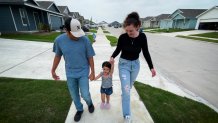
Johnny Richardson and his wife, Haley, live in Princeton with their 3-year-old daughter, Viviana.
“We need to eat every day, and how are we going to survive if the prices just keep on going up,” Johnny asked.
Edward Ayala, NBC 5 Investigates
Edward Ayala, NBC 5 Investigates
Johnny and Haley Richardson with their daughter Viviana.
With the help of parents, the Richardsons purchased a home in Princeton, one of the fastest-growing suburbs in North Texas. However, they said that each month is a struggle to make the mortgage payment and afford groceries, and they feel that the rising cost of food has impacted their budget the most.
The Richardsons agreed that despite headlines saying inflation has come down, it feels like it is headed in the opposite direction.
“You can spend $100 like nothing,” Johnny said. “It doesn’t feel like it’s coming down.”
To better understand why the Richardsons might feel that way, NBC 5 Investigates examined data showing how painful the price squeeze in DFW has been in recent years. We also examined how the population boom in North Texas can put additional pressure on families.
John Harvey, an economist at Texas Christian University in Fort Worth, said there are positives and negatives to living in a popular area.
“There are pluses and minuses to being an attractive part of the country,” Harvey said. “And the minus is increasing costs as people come in. So, two sides of the coin.”

Edward Ayala, NBC 5 Investigates
Edward Ayala, NBC 5 Investigates
John Harvey, an economist at TCU in Fort Worth.
Harvey said that people who found the low cost of living in North Texas appealing drove up housing prices when they moved into the area. Harvey said people spending more on housing means they have less to spend on groceries and other expenses and that growth can actually drive up the cost of food.
We asked industry insider Gary Huddleston, with the Texas Retailers Association, about the costs associated with operating a grocery store. Huddleston said from all standpoints, it’s a lot more expensive to build and operate a store in DFW compared to 10 or 15 years ago.
“Land has gone up, which is a big factor in building a new store besides the construction costs. You have taxes that have gone up,” Huddleston said.
Population growth and the addition of new stores mean there’s more competition for workers, making it more expensive for stores to hire staff.
“That particular employee is highly sought after, and that wage has risen dramatically over the last five years,” Huddleston said.

Edward Ayala, NBC 5 Investigates
Edward Ayala, NBC 5 Investigates
Gary Huddleston, with the Texas Retailers Association.
Huddleston said even road congestion in a growing city can increase the cost of getting products onto store shelves. Add all of that on top of worldwide inflation since the pandemic and it’s been a recipe for price pain in DFW.
“You shouldn’t expect the prices to go back to where they were before all this happened,” Harvey said. “That’s not going to happen. So that continues to be something that weighs on everybody.”
Data from the U.S. Bureau of Labor Statistics show that food prices in the DFW area have jumped by 25% over the past six years. Prices for meat, fish and eggs, combined, are up 30% in that time frame.
The data also showed that DFW families still pay less for groceries than families in other major metropolitan areas across the country. However, North Texans may have felt a bigger sting from inflation because of bigger jumps in prices. In July of last year, some national headlines reported that DFW was experiencing the second-worst inflation rate in the country. A 5% increase in the overall cost of living compared to 3% nationally, at that time.
Economists said most of that was driven by the steep rise in housing costs, which affects almost everything else.
“If I’m gonna drive up the housing prices, then I’m going to drive up how much I need to pay somebody in order for them to be able to live here. I’m gonna drive up how much it costs to build a new grocery store,” Harvey said.

Edward Ayala, NBC 5 Investigates
Edward Ayala, NBC 5 Investigates
Johnny and Haley Richardson, left, talk with NBC 5’s Senior Investigative Reporter Scott Friedman.
Some data suggested DFW families pay more for groceries than many of our Texas neighbors. Government Bureau of Labor Statistics data showed that overall food prices were just a tick higher in Houston, but the data indicated that DFW shoppers pay more for items like dairy products.
Numbeo, a platform that utilizes crowd-sourced price data, ranked DFW as the most expensive metro area in Texas to buy groceries and the 24th most expensive in the nation. That’s ahead of other growing parts of the state, where the data suggested families pay lower prices.
Huddleston said consumers in Dallas may not see those lower prices due to supply and demand. With a higher demand for products in areas where more people live, the costs for those products can increase.
Grocery store chains work hard to keep prices low, Huddleston said, and competition can benefit shoppers in large cities where there are many options for where to buy food.
But for the Richardsons, price pressures pushed them to seek help. They are one of a growing number of DFW working families who receive SNAP benefits, a form of federal government assistance to help pay for groceries.
State data obtained by NBC 5 Investigates showed that in just one year, there’s been a 12% increase in the number of people receiving benefits in Collin County, where the Richardsons live. Other DFW counties have also seen big increases — suburban Denton County is seeing an 8% increase.
The Richardsons said that many of the young families they know are struggling to make ends meet and that the assistance they receive only covers groceries for about half of the month. They said that leaves them feeling stressed and worried about unexpected expenses, such as a doctor’s visit or needing to replace a tire.
The Richardsons spoke to us about their challenges because they want other families to know they’re not alone if they’re living in a time and place where life has become pricey.
Harvey said that if it becomes increasingly expensive in North Texas, the area may eventually see a decline in the influx of new residents. That’s the typical evolution of boomtowns, Harvey said.
But for the moment, this one continues to boom. Bringing new opportunities along with new costs.
Hungry? In need of food?
If you’re hungry and need nutritious, free food, you can call 2-1-1 for the latest information on the SNAP program and find alternative food resources from area food banks, food pantries and other community resources.
If you need food and live in Bosque, Cooke, Denton, Erath, Hamilton, Hill, Hood, Johnson, Palo Pinto, Parker, Somervell, Tarrant or Wise counties, search the Tarrant Area Food Bank website for food pantries.
If you need food and live in Collin, Dallas, Delta, Ellis, Fannin, Grayson, Hopkins, Hunt, Kaufman, Lamar, Navarro, or Rockwall counties, search the North Texas Food Bank website for food pantries.
If you need food and live elsewhere in Texas, visit the Feeding Texas website to find your local food bank and food pantries.
Buy Salvage Food offers a searchable map to locate salvage grocery stores online and in your neighborhood.