
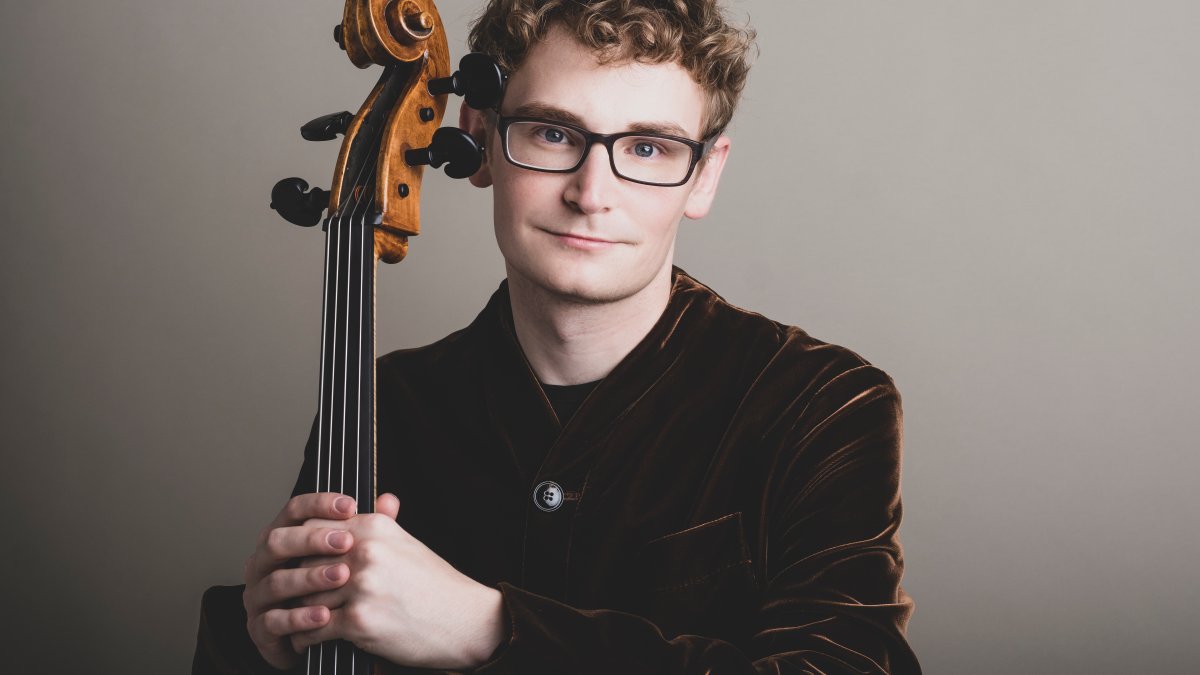
When Alexander Hersh performs with the Dallas Chamber Symphony at Moody Performance Hall on Nov. 11, the Chicago-based cellist will be following in his family’s footsteps. His great-grandparents played in the Dallas Symphony Orchestra several decades ago. His great-grandfather, Ralph Hersh, was the orchestra’s principal violist and his great-grandmother played violin.
David Shifrin was the Dallas Symphony Orchestra’s principal clarinetist when Hersh’s great-grandparents were in Dallas, and he remembers them fondly.
“Apparently, my great-grandparents were known for throwing parties within the Dallas Symphony and David Shifrin met his first wife, thanks to them at one of their iconic Dallas Symphony parties,” Hersh said.
Hersh is a fourth-generation professional string player. In addition to his great-grandparents, his grandfather is a violist and pianist, and his parents are active professional violinists.
“It’s really cool and special in that music was such a big part of the value system in my house growing up. From as long as I can remember, the world revolved around music,” Hersh said. “Even to this day, my dad and I perform together. We perform the Brahms Double Concerto for violin, cello and orchestra all over the country. That’s really special. One time we did three generations of grandpa, dad, and me – grandpa is pianist – and we did the Beethoven Triple Concerto.”
Hersh began playing cello at age five. Initially, he was interested in the string bass, but he was too small for that instrument. His first cello was a viola with a pin on the end, and he played it like a cello. He was even too small for the chairs at his early lessons.
“I would sit on phone books,” Hersh said. “I remember going to lessons and my mom would carry phone books so I could have a proper chair for my feet to touch the ground. Luckily, I grew and I never switched to double bass.”
Even at that tender age, he was determined to become a professional musician, and cello became a central focus in his life.
“There’s this cliché that the cello is most similar to the human voice, and I think that’s true, but what I love about the cello is that it can do anything. It can play this incredible range of super low, super high and everything in the middle, but it can do these extended techniques too and pushing those limits is always fun and interesting. It’s part of me and the ritual of practicing every day is a part of my life. It’s like breathing air. It’s what I need to feel normal. It’s a lifestyle,” Hersh said.
Edward Ingold
Edward Ingold
Hersh performed Dvořák Cello Concerto in B minor with the Highland Park Strings in 2023.
Hersh gave his Carnegie Hall recital debut in 2022 and won the top prize at the 2024 Naumburg International Cello Competition. He has appeared as a soloist with major orchestras, including the Houston Symphony, Baltimore Chamber Orchestra, and Boston POPS. He is devoted to chamber music.
“I love chamber music in that it is sort of a team sport in that you can create something better than the sum of its parts. You can make something very special, and everyone has to play such an important role, and it is very interconnected,” Hersh said.
He is the co-artistic director of NEXUS Chamber Music, a collective of international artists who are equally passionate about chamber music. NEXUS produces a two-week festival in Chicago every August, presenting chamber music – new and familiar – in unusual and intimate venues.
“It’s a passion project,” Hersh said. “We try to make it fun. That sounds silly, I know, but I think that’s something where chamber music often misses the mark. It is billed as this very serious thing, and it is something you either get or you don’t get it. We like to say we take the music incredibly seriously, but we don’t take ourselves terribly seriously.”
In 2023, Hersh released his debut album ABSINTHE. The album features music from the era when absinthe was banned in Europe. His album features videos that marry classical music and storytelling. The release party featured absinthe cocktails and because Hersh does not drink alcohol, some non-alcoholic cocktails too. Most of the party attendees were in their late 20s.
“It’s part of a larger mission to get new audiences interested in classical music,” Hersh said.
He will perform the original version of Tchaikovsky’s “Rococo” Variations with the Dallas Chamber Symphony. When Tchaikovsky wrote the work with eight variations, he asked German cellist Wilhelm Fitzenhagen to look at it. Fitzenhagen rearranged variations and cut the eighth variation. The Fitzenhagen version became the one most commonly performed.
“I’ve never performed the original version before,” Hersh said. “It’s such a different piece. It has the eighth variation, which is the ending. It somehow feels more Mozart-like and less Tchaikovsky, even though this is the original.”
Tchaikovsky’s original version reflects his admiration of the Classical style.
“I think it’s a light piece. It is so charming and so beautiful. It is a gem of the repertoire,” Hersh said. “It’s not quite as flashy as the one that everyone plays, but there’s something so wonderful and honest that I love.”
The Dallas Chamber Symphony concert pairs Tchaikovsky’s “Rococo” Variations with Dvořák’s Czech Suite and Mozart’s Symphony No. 38, “Prague”
“Everything is so curated and wonderfully tasteful,” Hersh said. “Everything is a gem. You’re going to like it the whole way thru,” Hersh said.
Learn more: Dallas Chamber Symphony