
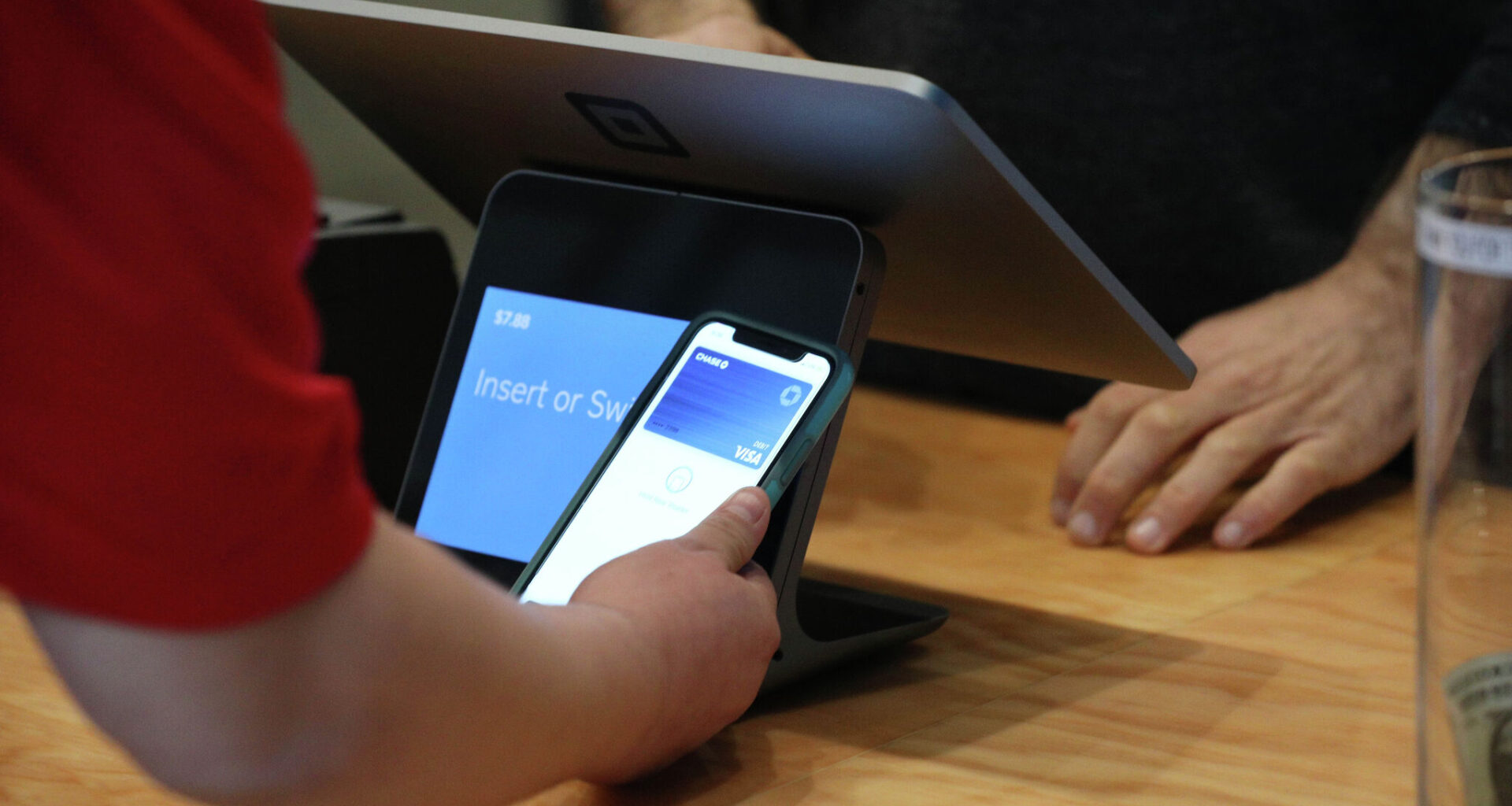
A Houston restaurant will no longer accep contactless phone payments from customers.
San Francisco Chronicle/Hearst N/San Francisco Chronicle via Gett
Tap-to-pay has become a routine way to settle restaurant bills. So when a Houston restaurant announced it would stop accepting contactless payments, customers were quick to ask why.

On Tuesday, Leighton’s at 4315 Montrose Blvd. said effective immediately, the restaurant would only accept physical credit or debit cards. The decision sparked considerable confusion for its Instagram followers.
Article continues below this ad
Some guessed correctly the culprit. Chargebacks were costing the restaurant money. Leighton’s opened its Montrose location in May—with a majority of customers using tap-to-pay instead of a debit or credit card.
In just three months of being in business, owner Leighton Dickson told Chron his namesake restaurant has been hit with about 30 or 40 of chargebacks from customers loading someone else’s card on their phone to pay for their meal.
“We’re not getting paid for the food, servers are not getting paid for their service, and we’re getting the chargebacks, which means the customer is using someone else’s card, that person finds out, and they dispute the charge,” Dickson said.
Article continues below this ad
“If the customer came in with a credit card and we had them sign their name, then they can’t dispute it … But if they dispute a tap-to-pay, no card was present, no identification was present. The signature is only on a little tablet. The server maybe didn’t request an ID so we don’t get that money back.”
And it’s not just Leighton’s. Chargebacks are an issue that several other restaurants around the city have experienced, including his fiancee’s restaurant Jordyn’s Soul Cafe next door.
“We still have a lot of overhead to pay to keep these businesses open. A lot of people depend on these jobs: servers, bartenders, bussers, barbacks, cooks. If you add up 30 chargebacks within three months, you know that’s thousands of dollars,” Dickson said.
While Leighton’s is now pushing customers to have a debit or credit card, Dickson said they will allow customers to use the tap-to-pay feature, as long as they have their card on their phone with an ID.
Article continues below this ad
“We’re not trying to make things a difficult dining experience. It’s just we we have to be able to secure the stability of the business,” Dickson said.
Rafael Nasr, owner of Craft Pita, told Chron echoed the same concerns, particularly the onus on restaurants to provide the proof to dispute chargebacks.
“The problem is, you have to have a lot of evidence to prove that the chargeback is illegitimate, right? In this case, someone is stealing their credit card and using it at my restaurant, and even if I have proof…I can’t even win a majority of these cases. Why? Because the person with the credit card did not receive the product or service,” Nasr said.
“The sad part is a lot of people know that there is some leeway with the credit card companies…I would say my success rate of challenging a chargeback is about 10 to 15 percent.”
Article continues below this ad
Nasr said there was one customer, a student at the University of Houston, who he believes had done this several times. One time, he said, the student did this with payment information from somebody out of state.
Best bites, new spots and the restaurant news people actually use.
By signing up, you agree to our Terms Of Use and acknowledge that your information will be used as described in our Privacy Policy.
“[He] would just change the name and order the same thing. Eventually, this guy from Ohio called me and goes, ‘Hey, someone used my credit card to eat at your restaurant yesterday. I just want to let you know that I’m going to tell my credit card company,'” Nasr recalled.
But even despite the financial setbacks and risks, Nasr said he’s never considered eliminating contactless payment options at his cashless restaurants.
Article continues below this ad
“Two or three grand is not worth the convenience of having a fast dining experience …This is a modern technology problem that is definitely, you know, a 2026 problem,” Nasr said. “I don’t see what the solution is … if the success rate of the challenge was 50 percent, maybe I could care less.”