
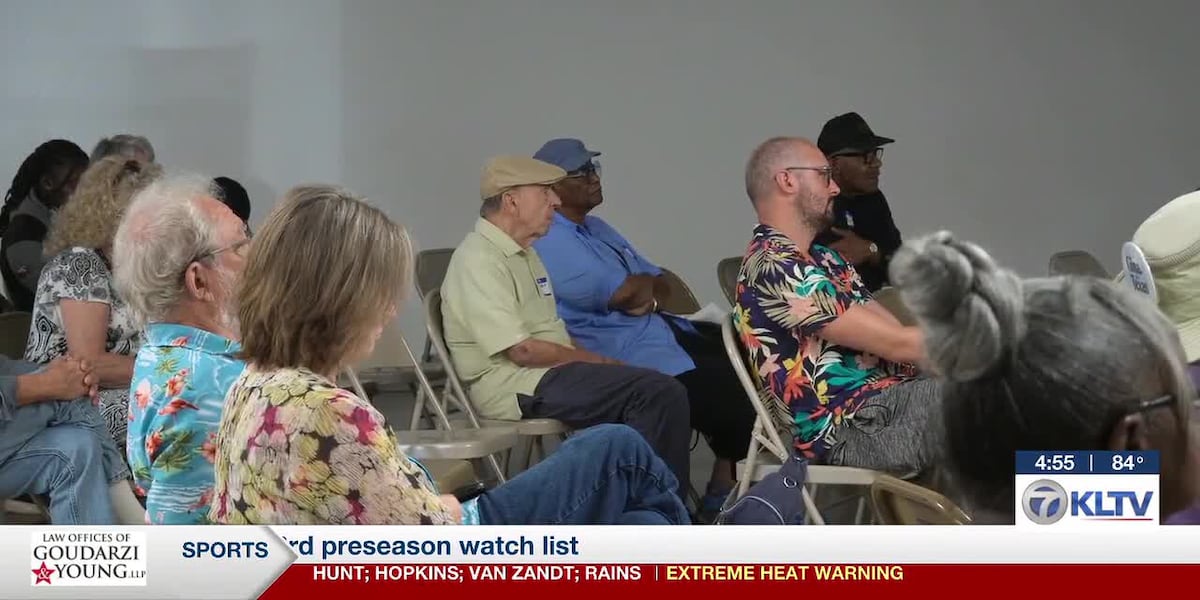
JACKSONVILLE, Texas (KLTV) – More than 500 data centers are operating or planned across Texas, and a group in Cherokee County says they do not want their town to be next.
The Cherokee County Texas Democratic Club hosted a public meeting to discuss AI data centers. Rita Beving, an environmental organizer with Public Citizen, was the featured speaker.
Beving said she is not tracking any proposed data center projects in Cherokee County, but said projects have been proposed near Lufkin, near Athens and in Tyler.
“I wanted to come out to Jacksonville because data centers are not a simple topic,” Beving said. “Some folks may not even know what a data center really is, or how they function, how much water and power they can use, and maybe what they’re not hearing from the data center industry about the amount of resources they need.”
Club president describes effects on farmers
Club president Jennifer Murphy-Vick said the event was meant to discuss how AI data centers are affecting rural Texas.
“We’re very concerned with our farm and agriculture already because of the Kyle Bass drilling,” Murphy-Vick said. “The board just met last week discussing that, and they did not accept public comment at that time. And we have to protect our water here in East Texas, and we have to protect our livestock here from the sound and the pollution that it’s going to cause.”
Murphy-Vick said the issue is not tied to a political party.
“This is not a Democrat or Republican issue,” Murphy-Vick said. “This is a nonpartisan issue that affects our whole community, whether they’re city dwellers or whether they’re rural.”
Murphy-Vick said more than 500 data centers already exist in Texas.
“It’s affecting the livestock because the sound that just comes off of those data centers sound like jet engines,” Murphy-Vick said. “And so it’s very stressful to the farm animals. It’s very stressful to the families that live there.”
Murphy-Vick said her family has farmed in Cherokee County for generations.
“I’m an 8th generation Texan from Cherokee County and a 7th generation from New Summerfield,” Murphy-Vick said. “And so my family has been in farming my whole life. And some of my friends that I consider family still run a cattle company. And it’s been just really, really, really hard just in general here in Cherokee County and across East Texas.”
Murphy-Vick said local candidates from both parties have raised concerns about the issue.
“We have multiple candidates running across the state, both Democrat and Republican, that are concerned about this,” Murphy-Vick said. “But our Democrats, as a unified party, have taken a stance against the data centers and wanting to stand with land, farm, and water conservation just because it’s such a big issue right now.”
Murphy-Vick pointed to a proposed data center in Corpus Christi.
“There’s a data center in Corpus Christi that they’re trying to build, and they’re already under water restrictions and going through not having enough water,” Murphy-Vick said. “And they’re looking at building a plant that would take the salt out of the ocean. But that’s 20 years out before they can get that built just because of everything that it takes to do that.”
Murphy-Vick said she wants residents to vote in November.
“This is just something that people need to have the conversations about, become educated about, and be able to go vote in November to protect their life,” Murphy-Vick said.
Water use raised as concern
Beving said noise is only part of the issue and described water as a larger concern.
“I’m monitoring nine projects in one county, and some of them are as big as 2,100 acres. Some of them are smaller, 350 acres,” Beving said. “But the general concern with all of them is how much water do they need to function, because we don’t have enough water in Texas for these data centers and all that want to come here.”
“I want East Texans to understand that even though there may not be a data center in your backyard, one could be coming very soon, and you have to be vigilant,” Beving said.
Beving encouraged people to stay informed about local decisions related to data centers.
“You need to monitor your county commissioner’s meetings, your local council meetings, every water source there is in the area, be it a groundwater district, a surface water district, your city, your local river authority, for the kind of permits that can roll up for these facilities, so you can be prepared and, if need be, get your neighbors and intervene,” Beving said.
Beving said organized residents have had success addressing the issue.
“What I’ve seen that worked, when citizens get together and get other neighbors, because there’s lots of permits involved, you can monitor all those permits,” Beving said. “You can contact your state rep or state senator. You can get involved with the hearings at the Capitol. But the one thing you cannot do is sit idly by, because they will be there and faster than you can count on.”
Beving said most landowners near data centers do not support them.
“I haven’t found a lot of landowners that support data centers, especially if they’re nearby because of the noise, the light pollution,” Beving said. “If they bring their own power, the kind of emissions these properties can bring. What Texas needs to do, we need to site these industries properly in industrial areas, encourage them to use recycled water and be away from residential areas. We are losing tens of thousands of agriculture land. Our state can’t afford to lose agriculture land for what could be empty buildings and stranded assets.”
Beving said most jobs promised by data centers do not go to local residents.
“Most of those jobs are out of town. They’re construction jobs. And those jobs will go away,” Beving said. “You can run a data center with as few as 20 to 40 people. But if your community builds out infrastructure like water or sewer or make big tax abatements, the lifetime of the server is three to five years. If you give them a 10-year tax abatement, they may not be here in 10 years.”
Beving said she wants residents to question candidates and officials before the November election.
“We’re now in an election year, you need to ask your candidates and your public officials, what are they going to do about these data centers?” Beving said. “What kind of guardrails are they going to put in place? Are they going to push for our counties to have more authority so they can protect our rural landowners as well? Now is the time to ask those public officials those questions and those candidates.”
Beving also asked East Texans to bring up data centers with candidates and public officials ahead of November’s election.
Copyright 2026 KLTV. All rights reserved.