
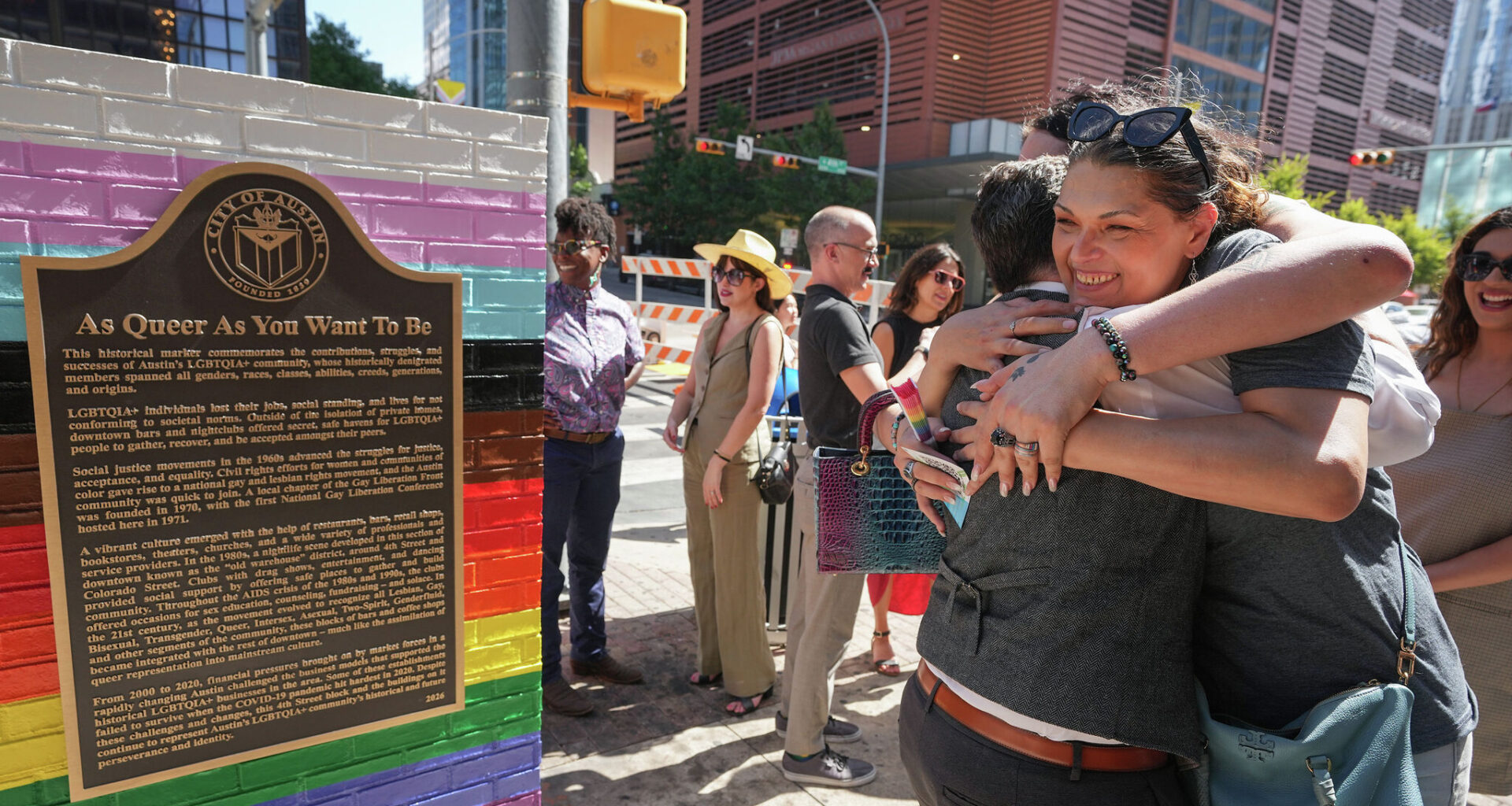
Sofia Sepulveda, right, shares a group hug with Morgan Davis, left, and Maxine LaQueene at the LGBTQIA+ historical marker dedication ceremony at West Fourth and Colorado streets in downtown Austin on Friday, Aug. 21, 2026. The city of Austin dedicated the interpretive marker to recognize the history, resilience and contributions of Austin’s LGBTQIA+ community.
Jay Janner /American-Statesman
Just days after the city of Austin agreed to abandon the rainbow crosswalk at Colorado and West Fourth streets, Mayor Kirk Watson, along with officials and community leaders, dedicated a historical marker to queer life on the block.

The mood was defiant but festive as a crowd of roughly 100 cheered Watson as he declared: “This is a big deal for Austin.”
Article continues below this ad
Jamal Crier, right, hugs Toby Tollison at the LGBTQIA+ historical marker dedication ceremony at East Fourth and Colorado streets in downtown Austin on Friday, Aug. 21, 2026. The City of Austin dedicated the interpretive marker to recognize the history, resilience and contributions of Austin’s LGBTQIA+ community.
Jay Janner/Austin American-Statesman
Sister Serena Severe listens during the LGBTQIA+ historical marker dedication ceremony at East Fourth and Colorado streets in downtown Austin on Friday, Aug. 21, 2026. The City of Austin dedicated the interpretive marker to recognize the history, resilience and contributions of Austin’s LGBTQIA+ community.
Jay Janner/Austin American-Statesman
Toby Tollison touches the LGBTQIA+ historical marker at a dedication ceremony at East Fourth and Colorado streets in downtown Austin on Friday, Aug. 21, 2026. The City of Austin dedicated the interpretive marker to recognize the history, resilience and contributions of Austin’s LGBTQIA+ community.
Jay Janner/Austin American-Statesman
People listen at the LGBTQIA+ historical marker dedication ceremony at East Fourth and Colorado streets in downtown Austin on Friday, Aug. 21, 2026. The City of Austin dedicated the interpretive marker to recognize the history, resilience and contributions of Austin’s LGBTQIA+ community.
Jay Janner/Austin American-Statesman
People applaud at the LGBTQIA+ historical marker dedication ceremony at East Fourth and Colorado streets in downtown Austin on Friday, Aug. 21, 2026. The City of Austin dedicated the interpretive marker to recognize the history, resilience and contributions of Austin’s LGBTQIA+ community.
Jay Janner/Austin American-Statesman
Morgan Davis and Austin police officer Vanessa Jimenez pose for a photo with the LGBTQIA+ historical marker during a dedication ceremony at East Fourth and Colorado streets in downtown Austin on Friday, Aug. 21, 2026. The City of Austin dedicated the interpretive marker to recognize the history, resilience and contributions of Austin’s LGBTQIA+ community.
Jay Janner/Austin American-Statesman
People listen at the LGBTQIA+ historical marker dedication ceremony at East Fourth and Colorado streets in downtown Austin on Friday, Aug. 21, 2026. The City of Austin dedicated the interpretive marker to recognize the history, resilience and contributions of Austin’s LGBTQIA+ community.
Jay Janner/Austin American-Statesman
Brigitte Bandit, left, and Sister Serena Severe pose for a photo with the LGBTQIA+ historical marker during a dedication ceremony at East Fourth and Colorado streets in downtown Austin on Friday, Aug. 21, 2026. The City of Austin dedicated the interpretive marker to recognize the history, resilience and contributions of Austin’s LGBTQIA+ community.
Jay Janner/Austin American-Statesman
The mayor reminded folks that the block was already named in honor of Bettie Naylor, a trailblazing advocate for women and the LGBTQ community, as well as the first openly gay state lobbyist.
Rainbow flags, banners, hand fans and blazers reminded observers of the lost crosswalk, a symbol obliterated on July 20 after Gov. Greg Abbott directed the Texas Department of Transportation to remove roadway art and symbols that he associated with “political agendas” or “ideologies.”
Watson thanked the quick and thorough work of the city’s Historic Preservation Office and Office of Equity and Inclusion, which made the marker possible on the southwest corner of the intersection.
Article continues below this ad
‘Live and let live’: How West Fourth became a ‘gayborhood’
Austin Mayor Kirk Watson, second from left, cheers with the crowd as Garry Brown, commissioner of the LGBTQIA Quality of Life Commission, cuts the ribbon during the LGBTQIA+ historical marker dedication ceremony at West Fourth and Colorado streets in downtown Austin on Friday, Aug. 21, 2026. The city of Austin dedicated the interpretive marker to recognize the history, resilience and contributions of Austin’s LGBTQIA+ community.
Jay Janner/American-Statesman
Austin is rare among big American cities in that no traditional “gayborhood” — with residents, churches, community centers, restaurants, bars, clubs and other businesses — has grown up as a refuge for oppressed queer people.
True, the Warehouse District, especially along the stretch of Fourth Street just west of Congress Avenue, has been home to gay bars and eateries for more than 40 years.
Article continues below this ad
Decades ago, the same could be said about the Red River District between East Sixth and Seventh streets.
In addition, bars and gathering spots popped up near the University of Texas campus and Texas Capitol. The first documented gay bar, a back room of the Manhattan Deli on Congress Avenue, has already been honored with a Texas Historical Marker.
As for Fourth Street, longtime watering holes like Rain on Fourth and Oilcan Harry’s thrived, but few gay people lived nearby.
Austin — which ranked high in the past two U.S. census surveys for its concentration of same-sex couples — could point to gay shadings in Travis Heights, Wilshire Woods or North Campus, but not anywhere that would be visible as a gayborhood.
Article continues below this ad
“Thinking back over my 30 years here, my gay brothers and sisters have not been concentrated in one ZIP code,” business leader Kerry Tate told the American-Statesman in 2015. Tate said gay Austinites live in almost all of the city’s ZIP codes. “I’ve intuitively felt for many years that it was a good thing that Austin had no area separate or apart … that our town has long been a ‘live-and-let-live’ gay-tolerant place within which LGBTQ citizens selected addresses using the same criteria as others choose neighborhoods.”
In the Warehouse District, day and nighttime gay socializing started with clubs like Hall’s and the Boathouse on Colorado Street, then anchored on West Fourth by the 1980s.
What about the new queer historical marker?
The LGBTQIA+ historical marker is seen at the dedication ceremony at East Fourth and Colorado streets in downtown Austin on Friday, Aug. 21, 2026. The City of Austin dedicated the interpretive marker to recognize the history, resilience and contributions of Austin’s LGBTQIA+ community.
Jay Janner/Austin American-Statesman
Embellished with the traditional city of Austin seal, the metal marker reads: “As Queer As You Want To Be.”
Article continues below this ad
It chronicles the historical isolation of gay individuals and their vulnerability to arrest in any gathering place, as well as the early civil rights protests during the 1960s and Austin’s place as the host of the first National Gay and Lesbian Conference in 1971.
The marker acknowledges the evolution of social sensibilities during the intervening years, as well as the changing meanings of queer life and the pressures of downtown development on what was once a half-abandoned, partly industrial district when the first gay businesses arrived.
The speakers went further to address the recent return of anti-queer rhetoric and legal restrictions to Texas.
Article continues below this ad
“We will not be deterred,” proclaimed Garry Brown, longtime community advocate, political leader and 2026 male-identified grand marshall for Austin Pride. “We will not be erased. We will not shut up!”