
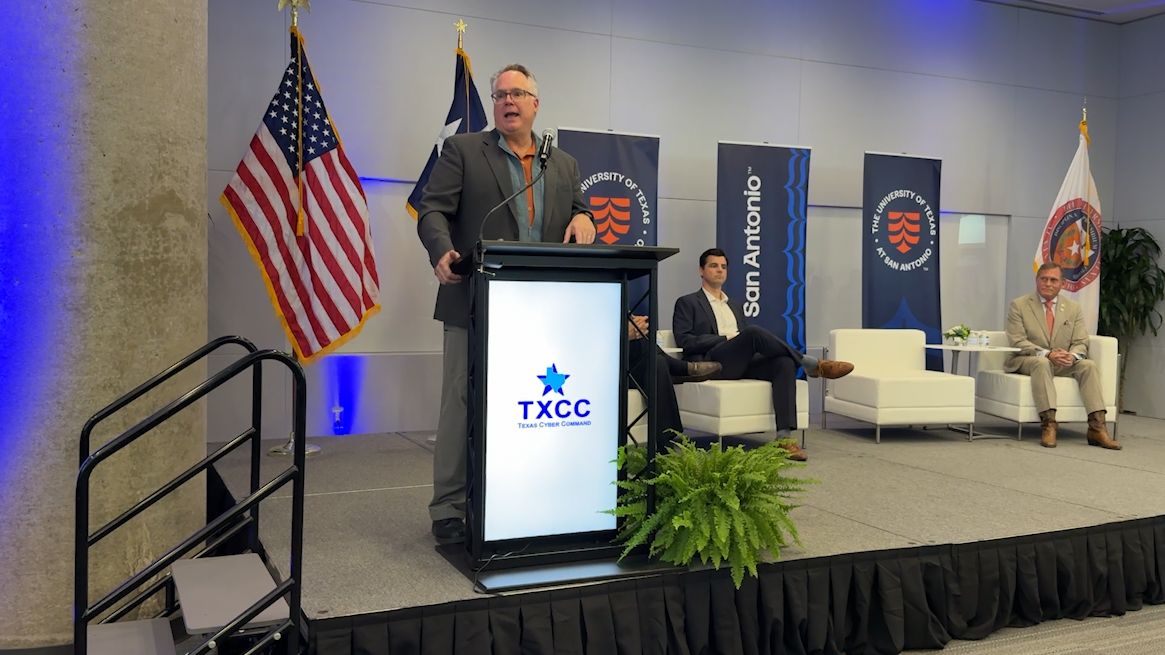
SAN ANTONIO — Future cyber professionals are being trained in San Antonio — a key to sustaining Texas Cyber Command for years to come.
“Governor Abbott signed this legislation into law to establish the largest state-run cybersecurity agency in the nation,” said University of Texas at San Antonio President Taylor Eighmy.
UT San Antonio’s downtown campus is now officially home to Texas Cyber Command, the first state agency housed outside of the capital in Austin.
“The command will protect critical infrastructure and develop the next generation of cyber leaders,” said Eighmy.
In September, Gov. Greg Abbott appointed retired U.S. Navy Vice Admiral TJ White to lead the command.
“It’s about Texas and Texans,” said White. “Their data and their privacy. It is that simple.”
The command is fighting back against growing cyber attacks across the state.
“Big actors in this space,” White said. “State, nation actors in this space. Criminal organizations in this space. They’re coming for Texas.”
White says the goal is to secure, protect and defend. The state has invested $135 million not only into the command center, but also future cyber professionals.
“We have an incredible treasure in of capability in Texas higher education,” White said.
Inside UT San Antonio’s Cybersecurity Manufacturing Innovation Institute, students are going through cyber attack simulations.
“Every server here plays a role,” said Joe Mallen, assistant director of Experiential Learning & Cyber Range.
They’re valuable trainings for students like Chloe Bruno, who aspires to work in the cyber field for a government agency.
“[I] feel like the biggest problems cyber security students or professionals who are trying to get into professions is, do I really know what I’m talking about?” said Texas A&M-San Antonio student Chloe Bruno. “I’m reading a book, I’m learning all these concepts. But can I apply them to real world scenarios?”
She’s a part of San Antonio’s Ready to Work program, which sponsored trainees’ membership in UTSA Cyber Range. The program has given them hands on trainings and connected them with professionals already in the industry.
“So influential in having us promote ourselves,” Bruno said. “Whether that’s providing us resources like this [or] getting exposure to a live cyber attack simulation — which is something you probably won’t do until you’re actually on the job and working.”