
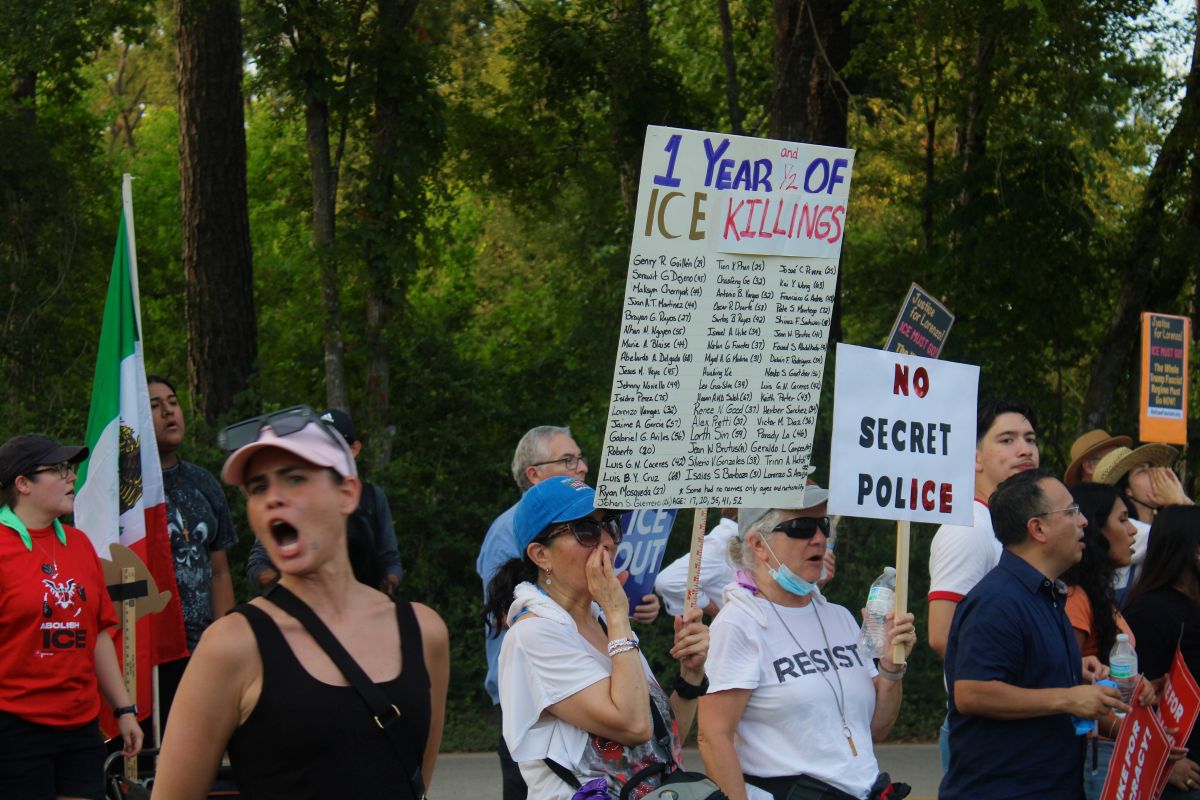
Protesters rally outside the Montgomery ICE Processing Center in Conroe on Aug. 8 to demand the release of two witnesses in the fatal shooting of Lorenzo Salgado Araujo in Houston.
Daniella Jiménez/Houston Chronicle
The crowd gathered outside the GEO Group-owned Montgomery Processing Center in Conroe on Aug. 8.
Daniella Jiménez/Houston Chronicle
Protesters carrying signs calling for justice for Lorenzo Salgado march along North Loop 336 in Conroe.
Daniella Jiménez/Houston Chronicle
Organizers and community members marched with signs while chanting, ‘Justice for Lorenzo’ on Aug. 8.
Daniella Jiménez/Houston Chronicle
Demonstrators march through downtown Houston during the “ICE Out of Texas / Marchamos Por Lorenzo” rally on Saturday, July 25, 2026. The march called for accountability in the death of Lorenzo Salgado Araujo and reforms to federal and state immigration policies.
Raquel Natalicchio/Houston Chronicle
Protestors march from Hidalgo Park to the memorial site for Lorenzo Salgado Araujo, a man killed by Immigration and Customs Enforcement, to find justice for his death in Houston, Friday, July 24, 2026.
Jacob Lujan/Houston Chronicle
Protestors march from Hidalgo Park to the memorial site for Lorenzo Salgado Araujo, a man killed by Immigration and Customs Enforcement, to find justice for his death in Houston, Friday, July 24, 2026.
Jacob Lujan/Houston Chronicle
Protestors march from Hidalgo Park to the memorial site for Lorenzo Salgado Araujo, a man killed by Immigration and Customs Enforcement, to find justice for his death in Houston, Friday, July 24, 2026.
Jacob Lujan/Houston Chronicle
Demonstrators march through downtown Houston during the “ICE Out of Texas / Marchamos Por Lorenzo” rally on Saturday, July 25, 2026. The march called for accountability in the death of Lorenzo Salgado Araujo and reforms to federal and state immigration policies.
Raquel Natalicchio/Houston Chronicle
Protesters chant and bang on trash cans as they stand behind a makeshift barricade during a protest in response to the death of 37-year-old Alex Pretti, who was fatally shot by a U.S. Border Patrol officer earlier in the day, Saturday, Jan. 24, 2026, in Minneapolis. (AP Photo/Adam Gray)
Adam Gray/AP
About 50 protesters carrying decorated signs and umbrellas marched toward an immigration detention facility in Conroe two weeks ago. “Show me what community looks like!” they chanted. “This is what community looks like!”
They were headed toward the Montgomery ICE Processing Center to demand the release of two witnesses in the fatal ICE shooting of Lorenzo Salgado Araujo in Houston. The demonstration was one of several held in the Houston area since Salgado’s July 7 death.
The protesters made themselves heard along the busy highway, where some passing drivers honked in support. But the protest organizer acknowledged that the crowd was relatively small, especially for a shooting that garnered nationwide attention.
Article continues below this ad
READ MORE: How Trump’s immigration crackdown reshaped Houston’s immigrant landscape
U.S. Rep. Sylvia Garcia, who has called for a full investigation into the ICE shooting, said low turnout at Houston-area ICE protests in the weeks since Salgado was killed has disappointed her.
“I just feel like the whole Houston community didn’t really come together as Minneapolis and Chicago and LA,” she said in an interview with the Houston Chronicle’s editorial board on Aug. 5.
More than a month after Salgado’s death, some community leaders are reevaluating how they organize, looking for ways to draw larger crowds to protests and turn public outrage into sustained calls for reform. They pointed to several barriers: fear of ICE surveillance and retaliation, limited transportation, divisions among advocacy groups and conservative, statewide leadership that restricts some protests.
Article continues below this ad
ICE shootings in Los Angeles, Chicago and the Twin Cities have drawn far wider public outrage in the streets, with thousands attending rallies to protest the violence. Organizers in those communities have been able to rely on labor and immigrant-rights networks built over decades, while Houston is still developing much of that infrastructure now.
“Unfortunately, it’s not enough. It’s not enough for what we’re fighting for, and I do believe that it’s going to take all of us to work together,” said Frida Adame, founder of We The Lucha, a grassroots organization that launched immediately after the shooting.
Marchers gather at City Hall on Saturday, Jan. 21, 2017, in Houston.
Elizabeth Conley/Houston Chronicle
Houston has rallied before. Why not now?
Houston is no stranger to mass protests. Thousands rallied after the Moody Park Riot of 1978, while more recent demonstrations have packed streets around City Hall over George Floyd’s killing, the 2017 Women’s March , and most recently for No Kings demonstrations against President Donald Trump.
Article continues below this ad
That history has made the smaller turnout at protests over Salgado’s killing more striking. In Minneapolis, neighbors responded to enforcement beyond street protests, building rapid response hotlines, monitoring ICE activity from their cars and turning local businesses into organizing hubs after the deaths of Renee Good and Alex Pretti.
“ I was very sad,” Adame said, recalling the first vigil held for Salgado and his family. “It was mixed feelings because I was happy to see that there were people there, but it was sad to see how there was not a lot of people just comparing it to what we’ve seen in other states.”
People light candles at a memorial for Lorenzo Salgado Araujo during a candlelight vigil following his shooting by a federal agent during a federal immigration enforcement operation in Houston on Wednesday, July 8, 2026. The shooting occurred the previous day and is under investigation by the Federal Bureau of Investigation.
Raquel Natalicchio/Houston Chronicle
That contrast has left Garcia, D-Houston, and other advocates questioning whether Salgado’s race or immigration status played a role in the shooting’s failure to spark broader outrage locally and nationally. The muted response is particularly striking in Houston, where Census data shows foreign-born residents make up about 29% of the population, more than twice the 14% share in Minneapolis.
WHAT SALGADO’S FAMILY SAID: ‘I recognized him immediately’: Son recounts frantic search for father killed in Houston ICE shooting
Article continues below this ad
“There hasn’t been the outrage for the Salgado killing and the Maine killing like the way there was for two, to be blunt, white citizens,” Garcia said.
Garcia said the community’s response to the killing of U.S. Army soldier and Houston native Vanessa Guillen in 2020 reflected Houston’s diversity. That’s not the case now, she said.
“There was a huge rally at our City Hall with thousands of thousands of people,” she said. “But this time, it just seems like it’s been very, very Latino at most of the vigils.”
She has also pointed to divisions among local immigrant rights groups, saying organizations often held separate rallies instead of pooling joint efforts. Adame acknowledged those tensions.
“How can we as organizers ask people to unite if we among organizations can’t even get along?” she said.
Article continues below this ad
Still, Adame said those tensions have started to ease, with leaders putting aside questions over who should lead and uniting behind the same goal: keeping ICE out of Houston.
“ We had maybe, like, 28 organizations that joined in the same fight,” she said, recalling one of the first joint protests organized after Salgado’s vigil. “It was very beautiful to see because there were many organizations there, some that don’t necessarily work with one another.”
Fear of ICE shapes who shows up
Even as groups have begun working closely together, fear continues to keep some people away.
Norma Gonzalez, an organizer with immigrant-rights group Woori Juntos, said some immigrants worry that attending a protest could put them at risk of surveillance — or worse, deportation.
“ I feel like everything that has happened before in Minnesota, it was a warning to all of us to not stand up, to not be with one another,” she said. “They’re afraid that if they show up somewhere, someone is going to come after them, most likely ICE.”
While Minnesota Gov. Tim Walz generally supported protesters in his state after Pretti and Good were killed, Texas’ Republican leadership has opposed recent ICE protests.
Thousands of people protest ICE and Operation Metro Surge by marching through downtown Minneapolis on Jan. 23.
Alex Kormann/TNS
In 2025, the Texas Legislature passed a bill limiting how students can protest on some university campuses. In 2024, the city of Houston under Mayor John Whitmire tried to limit protests in residential areas, a response to pro-Palestinian activists who held rallies near his home and the homes of other public officials.
The city also lacks sanctuary policies found in Los Angeles, Chicago and Minneapolis that limit how local law enforcement and other city employees assist federal immigration enforcement.
“We are in a red state, and we don’t have support from the government — at many levels — to be able to do things,” said Cesar Espinosa, the co-founder and executive director of FIEL Houston, a civil rights organization.
Espinosa and FIEL have led the immigrant community’s efforts to end the Houston Police Department’s cooperation with ICE. Espinosa said FIEL organizes activities in a way that minimizes interaction with local and federal law enforcement, but the fear of immigration enforcement is ever-present.
“It’s not to say that ICE couldn’t show up or that we couldn’t have a run-in with the police, but we try to mitigate that by trying to be as well organized as possible,” he said. “But the perception that protesting could be very dangerous has hurt in terms of turnout.”
Houston’s size makes protesting harder
Fear isn’t the only barrier organizers point to. Simply getting to a protest can be difficult in a city as sprawling as Houston. Gonzalez explained that traffic, limited public transportation, and parking can all hinder residents from attending.
“There’s also very little parking anywhere,” she said. “Sometimes people will want to go to an event, get there, and leave because they can’t find where to park.”
Katy Murdza, a senior organizer with the Immigrant Legal Resource Center and Houston Leads, said that some immigrants who have access to a car are also limiting how often they drive because of fear of law enforcement. The Chronicle reported that Houston police officers spent nearly six times longer, on average, on traffic stops involving ICE than on other stops after President Donald Trump took office last year.
United States Representative for Texas’ ninth district Al Green, middle, joins other protestors as they march through Canal Street to protest Immigration and Customs Enforcement after an agent shot and killed Lorenzo Salgado Araujo, a Mexican citizen.
Jacob Lujan/Houston Chronicle
DID THE CITY COOPERATE?: Houston vowed to curb ICE cooperation. Police still waited hours for agents.
“ Even people who could drive are now limiting driving as much as possible because of the risk,” Murdza said.
Espinosa said Houston’s size is another deterrent.
“People have to make a decision to spend — if they have limited time — three hours (at a protest) and then about half an hour to an hour in traffic,” he said.
Despite the challenges, Espinosa sees momentum building. He favors more gatherings, no matter the size, and says he welcomes any group that wants to advocate for a cause.
“I think we do the best with what we have. At the end of the day, I’ve been very clear in telling everybody we should be doing more,” he said. “If there are six events in one day, that’s better. I don’t think anybody should try to monopolize what happens with any given issue.”
Part of his optimism stems from younger Houstonians becoming more engaged.
“We had a march in Montrose, and I asked a young lady why she had two flags. She had a Mexican and a Salvadorian flag,” he said. “She said, ‘(my parents) can’t come to this, but I’m a U.S. citizen and I can. So, I’m literally carrying my parents on my back.’ I thought that was a really deep and very emotional response.”
Community leaders also see the demonstrations as a way to bring new protesters into the movement.
A mother, left, and her daughter carry decorated umbrellas during a protest in Conroe calling for justice for Lorenzo Salgado on Aug. 8.
Daniella Jiménez/Houston Chronicle
At the Conroe protest, a young woman marched alongside her mother. They both carried umbrellas they had decorated. One read “ICE OUT,” and the other said “Justicia por Lorenzo” in blue and red marker.
It was the daughter’s first protest.
Together, they joined the crowd’s chant: “This is what community looks like.”