
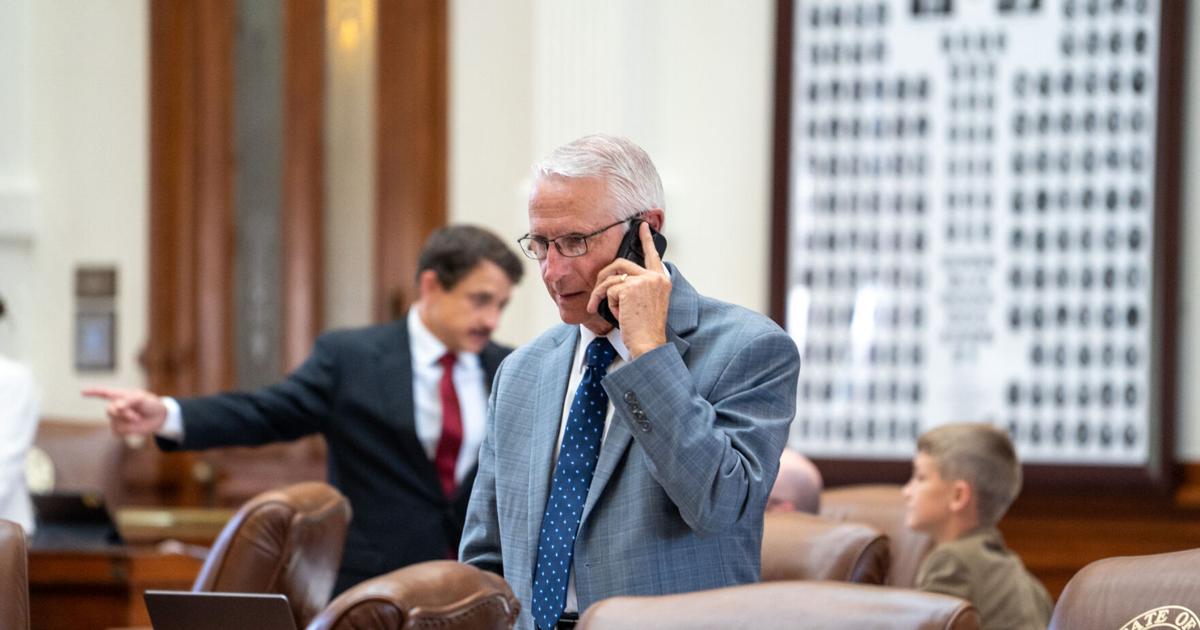
It took nearly all day Thursday for the Texas House Committee on Public Health to discuss a plethora of interim charges, including social media’s impact on youth and infant mortality prevention — while also establishing a new subcommittee on women’s health.
The committee kicked off with Chairman Gary VanDeaver (R-New Boston) formally establishing the new Subcommittee on Maternal Health, Menopause and Access to Evidence-Based Medicine, which will focus on issues related to women’s hormonal health.
The subcommittee’s chairwoman, state Rep. Katrina Pierson (R-Rockwall), commented on its establishment, “For more than two decades, women’s healthcare was shaped by a flawed interpretation of hormone therapy research and the misguided federal framework that followed.
“This raises an extremely important question for Texas: Have our policies kept up with the medical evidence? And this committee is charged to find that out … We will hear directly from health care providers and women across Texas,” she said.
As lawmakers discussed one of the interim charges, the impact of social media on youth, individuals on both sides of the aisle expressed similar levels of concern over social media algorithms and minors’ access to and heavy consumption of content on such platforms.
Dr. Daniel Flint, a pediatric psychologist at Texas Children’s Hospital and assistant professor of pediatrics at Baylor College of Medicine, shared with the lawmakers his experience in counseling teenagers with copious amounts of screen time. Flint, who specializes in aiding teens, specifically with eating disorders, shared how their own “self-reported estimates” of screen time were almost always inaccurate, and that both the estimated and real numbers would “astound” anyone.
“A patient that I saw just a couple of weeks ago, I asked her to estimate her screen time. She said, 10 hours. I thought that must be accurate. She pulled out her phone, and it was 14,” Flint shared.
“She later told me … that she has absolutely nothing to be proud of in her life, and how could she? She’s increasingly consumed by an artificial environment while she further withdraws from a real environment.”
He also shared details on the graphic material depicting self-harm pushed to his patients on various social media platforms.
While Flint shared his hands-on experience counseling teens suffering from excessive social media use and screen time, Texas Public Policy Foundation Associate Vice President of Campaigns David Dunmoyer spoke more on the practical policy side of the issue.
He referenced several pieces of legislation at both the state and federal levels, including the App Store Accountability Act, which was recently brought before the U.S. Supreme Court in a lawsuit challenging its constitutionality.
Senate Bill 2420, authored by state Sen. Angela Paxton (R-McKinney) and sponsored by Dunmoyer’s wife, state Rep. Caroline Fairly (R-Amarillo), in the Texas House last year, requires operators to verify the age of consumers and also mandates parental consent for app store purchases and downloads for those under the age of 18.
Several committee members expressed dismay as Dunmoyer detailed the various methods by which social media algorithms are believed to be shaped, including “by pupil dilation, how you’re engaging with the content, and whether it gets your heart rate activated.”
While the general consensus among lawmakers on the committee appeared to be that it’s “going to take an act of Congress” to fully address the issue, as Pierson stated, several lawmakers and witnesses alike pushed for exploration into how the state could increase accountability for such harms caused by the platforms — while concluding that further discussion will be needed.
The issue will once again bring the subject of the government’s role in regulating private companies, intersecting with parental responsibility and the corresponding legislation’s odds in court, back to the Texas Legislature’s attention.
Among the more contentious subjects broached during the hearing on Thursday was the prevention of infant mortality, which brought up the state’s handling of abortion and the reasons behind certain demographics’ higher rates of infant and maternal mortality.
The health of the mother when the child was conceived, as well as preterm birth before 37 weeks gestation, were listed as the primary contributors to excess infant mortality, per Dr. Kelly Fegan-Bohm, associate deputy commissioner at the Texas Department of State Health Services (DSHS). She also shared that DSHS has updated its data on the subject to include the years through 2025 and offered a few suggestions for programs that could be created in the state to address the issue.
“To address very low birth weight, it could focus on early consistent education for preconception health and supporting women and families for them to be as healthy as possible before becoming pregnant and accessing prenatal care in the first trimester,” Fegan-Bohm said.
One witness, Dr. Uchenna Jones, a family physician in Freeport, Texas, criticized the state for lacking the following initiatives: a statewide Sudden Infant Death Syndrome program, infant mortality advisory council, regional infant mortality coordinators, coordinated statewide home visiting infrastructure “that reaches all high-risk families,” and a statewide perinatal grief and family support program.
In one of the more direct comments made by a Democratic lawmaker on the committee against Republican leadership, state Rep. Lauren Ashley Simmons (D-Houston) said, “Texas cannot tout itself as a pro-life state with carefully curated photo ops at the Governor’s Mansion and then scoff at opportunities to save babies because we’re worried about cost, or we want to argue with the experts and the doctors about science.”
In response to Simmons’ request for her to elaborate on the higher rate of black infant and maternal mortality, Jones said that she was “very careful” in how she laid out the data in her testimony, “knowing that we have a Republican stint in our state.” She said she didn’t want to be written off as just being concerned about one particular race of babies.
The driving question for much of the remaining conversation centered on improving related data: whether the numbers surrounding infant and closely connected maternal mortality are being collected properly, why they might not be, how to reform the process, and the necessity of such information before moving forward with the issue legislatively.
As Republican and Democratic lawmakers clashed on several points when abortion was tied back into the conversation, the struggle for the committee members in the upcoming session was laid out, promising robust future hearings — particularly as they’ll be tackling the new charge on women’s hormonal health and improved infant health policy in the coming months, with starkly different worldviews on beginning-of-life ethics.
VanDeaver was honored at the end of the nine-hour hearing, as it will be the last one he chairs due to his impending retirement.