

On her fifth day as a clinical teaching intern at Schenck Elementary, Sylvia Marquez was guiding a third grader through a math word problem.
They huddle in one of the classroom corners, heads bent over the day’s worksheet and Marquez gently correcting when the student stumbles on a problem. A colorful sign on the wall reads, “It is a good day to do math.”
“I’m so proud of you,” Marquez says after the student answers a question correctly.
“’I’ve always wanted to be a teacher,” she said later. “I’ve always known that since I was a little girl.”
Marquez, 19, only graduated from Travis Early College High School a few months ago, but she’s more than halfway to becoming a certified teacher in the same school district that taught her.
She was one of 16 students from Travis ECHS to graduate with an associate of arts in teaching — the first cohort of its kind. Graduates earned 60 college credit hours and a para-professional educator certificate, all while still young students themselves.
After leaving Travis, Marquez quickly enrolled at the University of Texas at San Antonio to complete a bachelor’s degree in education and equity and a bilingual education certificate and started working as a full-time clinical teaching intern, or instructional assistant, at Schenck Elementary in the San Antonio Independent School District.
It was a smooth transition.
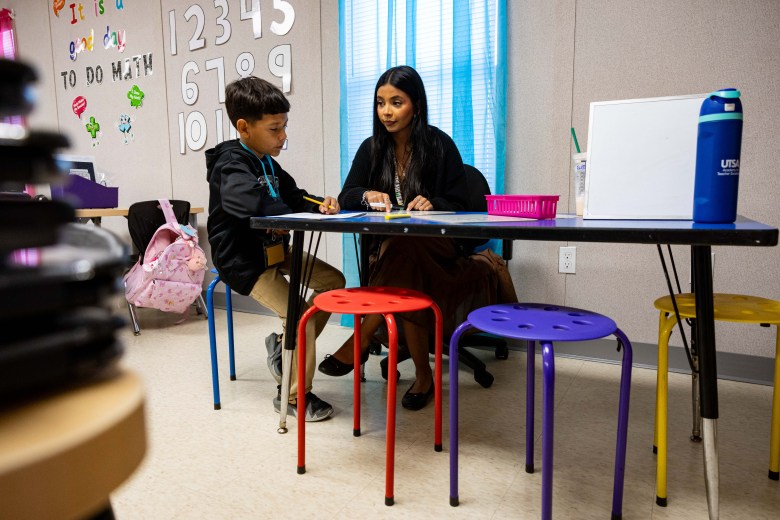 Sylvia Marquez works with a student one-on-one during her fifth day as a clinical teaching intern at Schenck Elementary. Credit: Amber Esparza / San Antonio Report
The teaching associate at Travis was designed to easily transfer credits to local higher education institutions, and SAISD, which has been investing in “grow your own” teacher pathways, welcomed Marquez back to the district with open arms.
Learning about learning
Travis has long been an early college high school, operated by SAISD and San Antonio College which is part of the Alamo Colleges District network. For several years, the school only offered students associates of arts degrees, but school officials wanted to expand and offer more specialized programming.
On their end, SAISD was looking for solutions to a teacher shortage and retention problem — one that still exists.
After a year of creating a curriculum in collaboration with UT San Antonio, Texas A&M-San Antonio and Alamo Colleges, finding rising high schoolers who might be interested in the program, and securing seed funding from City Education Partners for the first two years, Travis launched the teaching associate program for the 2022-23 school year.
“We had the opportunity to build something unique,” said Sara Mann, chief high school programs officer at Alamo Colleges.
Marquez remembers thinking a scheduling mistake had placed her in the educator program at Travis. But she stuck with it after learning more.
“It was meant to be,” she said. “I learned a lot. That program really helps you build confidence.”
At Travis, Marquez took required core academic courses with embedded education courses and weekly visits to Bonham Academy’s preschool and kindergarten classes for hands-on experience.
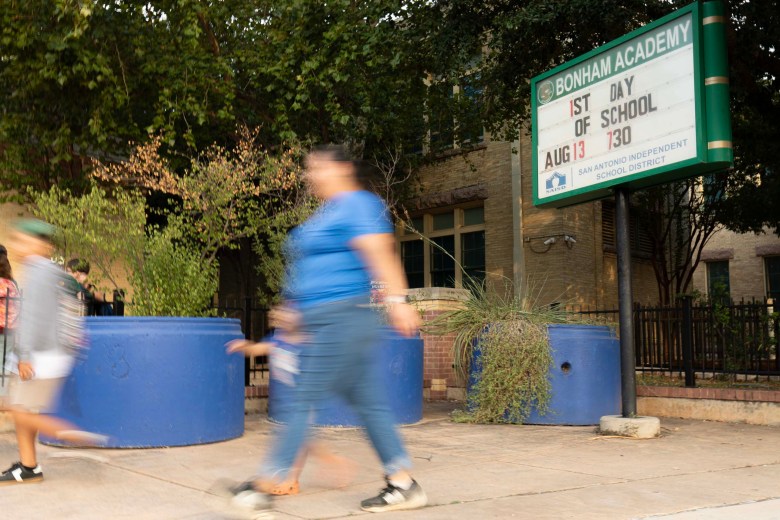 Bonham Academy families arrive to campus on the first day of a new school year. Credit: Scott Ball / San Antonio Report
“They are deeply immersed in learning while they’re learning about learning, and so it’s a unique experience for them,” said Mann.
A standard associate of arts in teaching requires about 16 hours of field experience, but the Travis program was designed to build in many more hours to make up for the students’ younger ages compared to traditional teachers in training, said Mann.
It also built in a paraprofessional certificate, allowing graduates to apply at any school district as instructional or classroom aides, a path often taken by emerging teachers who want to earn money while finishing their degrees and standard teacher certifications.
From SAISD back to SAISD
Having knocked off some major milestones on the road to becoming a certified bilingual teacher, Marquez is back at SAISD to experience working in a classroom for two school years.
She is one of six Travis graduates who returned to SAISD as clinical teaching interns, or “emergent educators,” a pathway that the district only offers for those who want to work in high need areas like dual language education and special education.
There are two emerging educators at Schenck Elementary, two at Longfellow Middle School and two at Hawthorne Academy.
In an effort to support their current teachers and improve student outcomes, SAISD spent a lot of time and resources developing teacher growth and mentorship programs.
With the help of district and campus staff, Principal Virginia Parker implemented a “high-impact demonstration” system at Schenck, which involves finding a couple of model teachers whose classrooms become a sort of open lab for other educators to watch and learn.
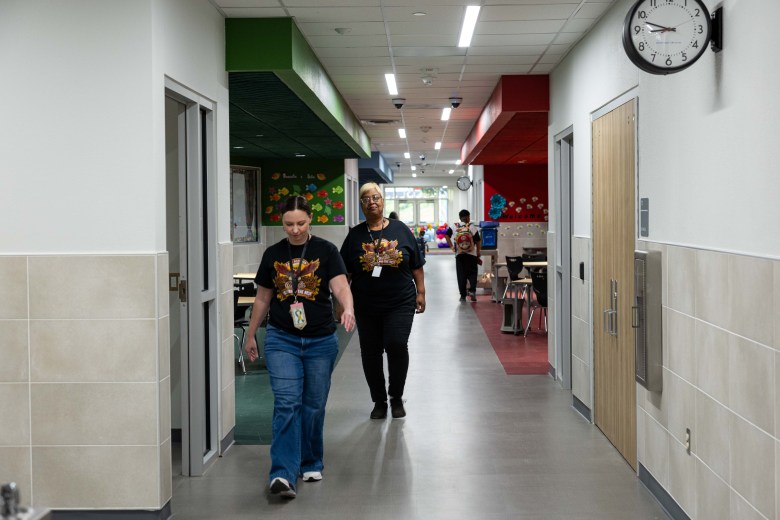 Teachers and students make their way to their classrooms on the first day of school at SAISD’s Schenck Elementary on Aug. 12, 2026. Credit: Amber Esparza / San Antonio Report
That’s why Schenck was a natural option to place teachers-in-training.
“A teacher seeing how it works in a real classroom on our campus with our students will much better be able to implement that in their class,” Parker said.
Schenck was later assigned two emergent educators from Travis, each partnered with a demonstration teacher.
Parker hopes the clinical teaching program shows Marquez and other emerging educators all facets of being a teacher, from parent drop-off to end-of-day dismissal; from decorating classrooms to whipping up lesson plans.
“Being in the classroom from the first day of school till the last for two years, I think they’ll have just a much better understanding of school, and know that this is what they want,” she said.
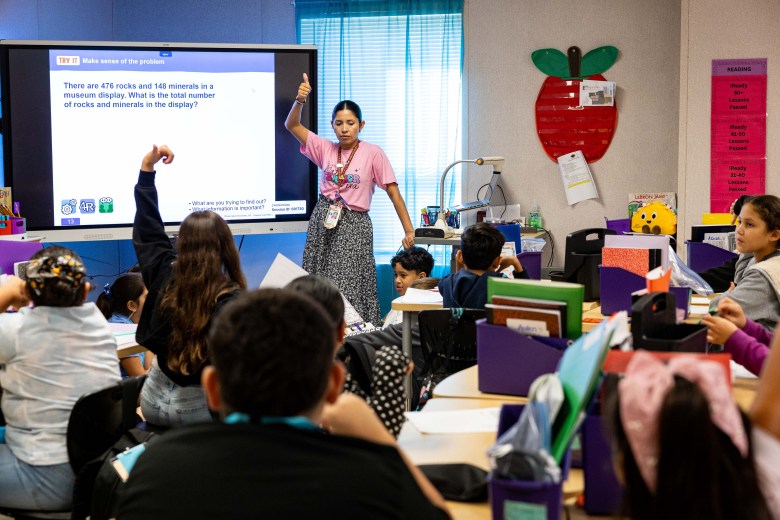 SAISD Teacher Denise Campos instructs her third grade math class during a school day at Schenck Elementary. Credit: Amber Esparza / San Antonio Report
Her first day at Schenck was hard, Marquez admitted, but she’s settling into the routines and unavoidable chaos of an elementary school. And she’s already embedding herself in the third-grade classroom she was placed in.
In her second week as an instructional assistant, Marquez was only supposed to be observing her mentor teacher Denise Campos, but she’s been regularly pulling struggling pupils aside for extra support.
“I have already seen so much progress, and it’s only been a few days,” she said. “I like to see students’ progress. I like to see the way they grow, and I like to be a part of their process.”
She’ll soon start her first semester at UT San Antonio, attending courses two days a week while working full-time at SAISD, and if all goes well with her certification tests, Marquez will likely be leading her own classroom within two years.