
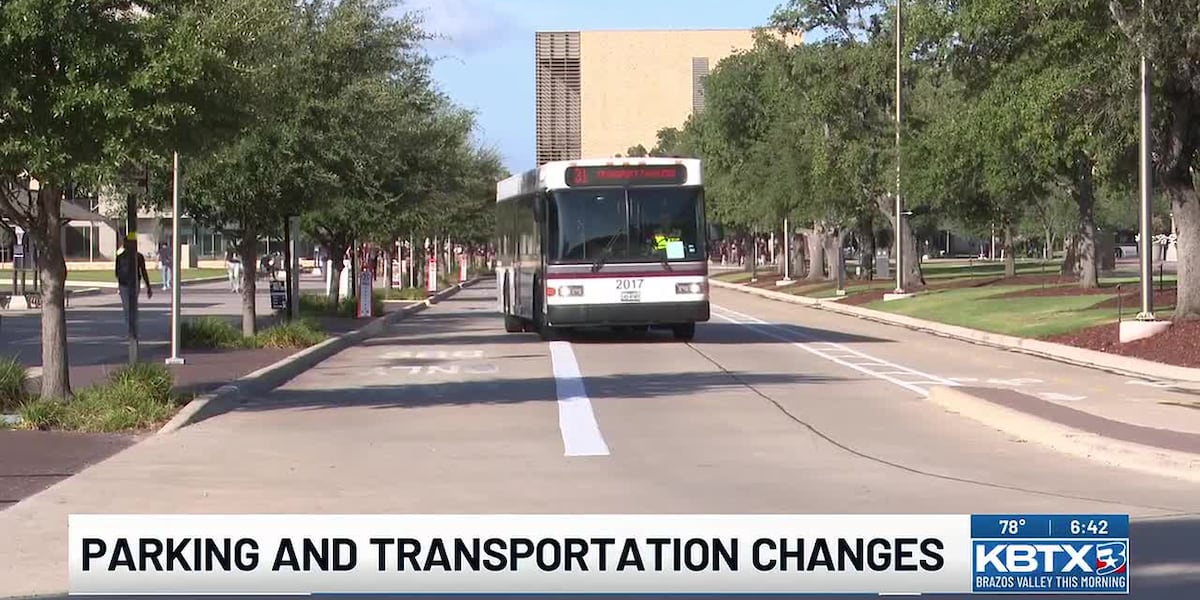
COLLEGE STATION, Texas (KBTX) – As students head back to class for the start of the fall semester at Texas A&M University, Texas A&M Transportation Services said there are some changes everyone should keep in mind.
Over the past year, Tad Fifer, the communications manager for Texas A&M Transportation Services, said the department has worked with University Police, campus administrators and traffic engineers to identify areas on campus that might benefit from some improvement projects.
One of the areas identified included campus speed limits.
Fifer said as everyone returns to campus, they are asked to pay extra attention and use extra caution as speed limits have been lowered by five to 10 miles per hour on roadways across campus.
Fifer said these changes were made with safety in mind.
“The changes are really made to ensure that whichever mode you’re using as transportation, whether you’re driving a vehicle or you’re on, let’s say, an e-scooter, that you have more time to react to road conditions and roadway hazards,” he said.
This comes on the heels of five major campus mobility improvement projects that Transportation Services completed in 2025.
Those projects were aimed at separating modes of transportation, creating dedicated pathways for bicycles, vehicles, micromobility devices and pedestrians, and generally improving safety.
Another change this year involves the lots surrounding Reed Arena.
This year, the sections of Lot 100 surrounding Reed Arena, 100a-c and 100e-g, will no longer be available for Any Valid Permit parking Monday through Friday, 6 a.m. to 5 p.m. and will require a Lot 100 permit.
All sections of Lot 100 will continue to include night and weekend parking after 5 p.m. with a valid permit. However, it will not include overnight parking from 2 a.m. to 5 a.m.
In addition to those changes, the Texas A&M Transportation Institute reminds people to be aware of their surroundings as they make their way around and near campus.
Whether you’re walking, driving, riding a bike or riding a scooter, Texas A&M Transportation Institute research engineer, Debbie Albert, said the best thing you can do to avoid getting involved in an accident is to put away anything that can be a distraction, including your phone and ear buds.
Albert said with as many crossings that take place on and around campus, she said it’s important to stay alert.
“We have a lot of pedestrian crossings, 10s of thousands of them happening each day. So again, for vehicles that are in those areas, slow down, make sure you’re paying attention, look out for each other, make eye contact with people who may be crossing your path. That way you make sure that you see each other,” Albert said.
Albert said it’s also important to wear your safety equipment such as a helmet if you plan on riding a bike or scooter around campus.
While there aren’t specific numbers for the number of crashes or wrecks on campus, Albert said a comprehensive safety action plan was completed recently for the Bryan-College Station area with data from 2017-2022.
Albert said in that time frame, there were more than 20,000 crashes in the Bryan-College Station area with a little over 100 fatalities. About 15% of those fatalities included bicyclists and pedestrians.
Copyright 2026 KBTX. All rights reserved.