
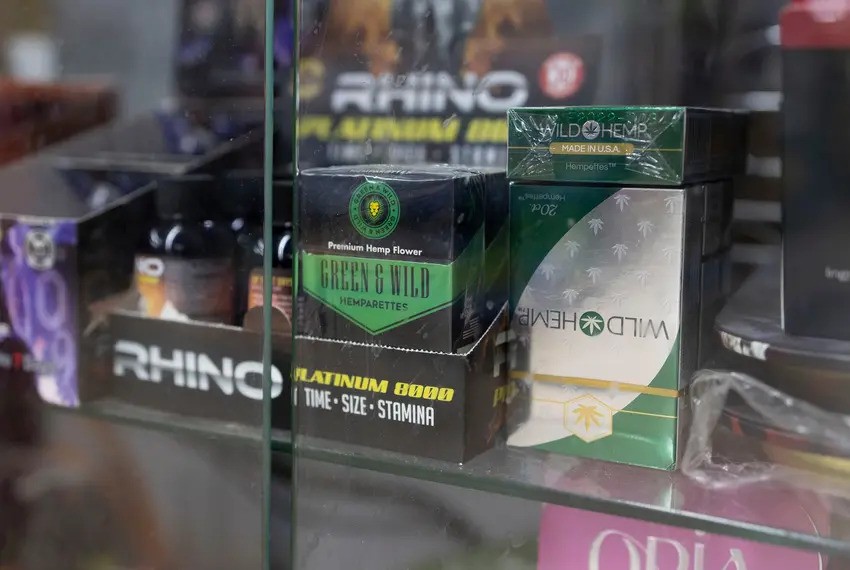
For the past seven years, since the federal government removed hemp from the Controlled Substance Act, far-right politicians in Texas have been fighting the suddenly legal sale of cannabinoids. Legislators toiled in the state capitol; educational budgets were held hostage; and Gov. Greg Abbott called a last-minute audible, halting a sweeping ban. But a series of contested policy changes to statewide departments – without direct oversight by elected officials or the public – were enacted, dealing a powerful blow to a booming Texas industry.
Now, a THC tycoon who has built an empire in San Antonio (and had big plans to take over Texas) is taking on these state leaders and organizing the industry in a challenge against state departments he says are engaging in unbridled agency overreach.
“You don’t leave it up to a department where one man, whoever is in charge of that department, gets to dictate what’s happening,” Kingpin Kush owner and founder William Hunter told MySA, calling for a public vote on the THC issue plaguing Texas.
The Texas Department of State Health Services – at the behest of Abbott and Lt. Gov. Dan Patrick – effectively killed the Texas THC industry overnight. When the Texas Supreme Court said it could recategorize THC variants as Schedule I controlled substances – barring legislative change with public input – it rendered millions of dollars’ worth of THC-based products illegal in Texas. Selling or possessing them suddenly became a felony charge.
This is one of many key points in the 300-page lawsuit filed in Travis County last week against the state department, calling on a judge to halt implementation until legislators can convene in January. In a nutshell, Hunter and his attorneys want to save an industry that’s produced hundreds of millions of dollars in sales tax for the state and has operated legally under the state framework for years.
“This is what libertarianism is all about,” David Sergi of Sergi & Associates, who is representing the hemp industry leaders in the lawsuit, told MySA. “You have a law. You enforce it. You do not use unelected bureaucrats to overturn a veto that the governor himself did. That is just beyond the pale. It’s pretty close to un-American as far as I’m concerned.
“As far as I’m concerned, Lt. Gov. Patrick, with his emphasis on banning Holocaust books by Elie Wiesel, he’s just showing himself to be a complete fascist.”
The lawsuit seeks to temporarily halt enforcement of the sweeping THC ban. The parties want this restraining order to remain in place until state leaders can debate and pass legislation regulating the industry rather than killing it.
Hunter says he and his peers support regulation, aligning with the governor’s efforts to introduce further rules. They stand behind childproof packaging, licensing rollouts and enforcement and ensuring that THC-lined shelves are kept away from schools and churches.
But an outright ban is hurting the customers he’s trying to help. He shared a sentiment similar to that of the numerous shop owners MySA has spoken with over the years, saying his customers are largely people seeking to treat ailments where medicine has failed. And Hunter says the Compassionate Care program is a mess that’s financially burdensome and too narrow to really help the people it should serve, in theory.
“[Our customers] are coming in there for a wellness aspect. They’re not coming in there to get high,” Hunter said. “Our customer comes in, they tell us their ailments, and then we steer them in the right direction.”