
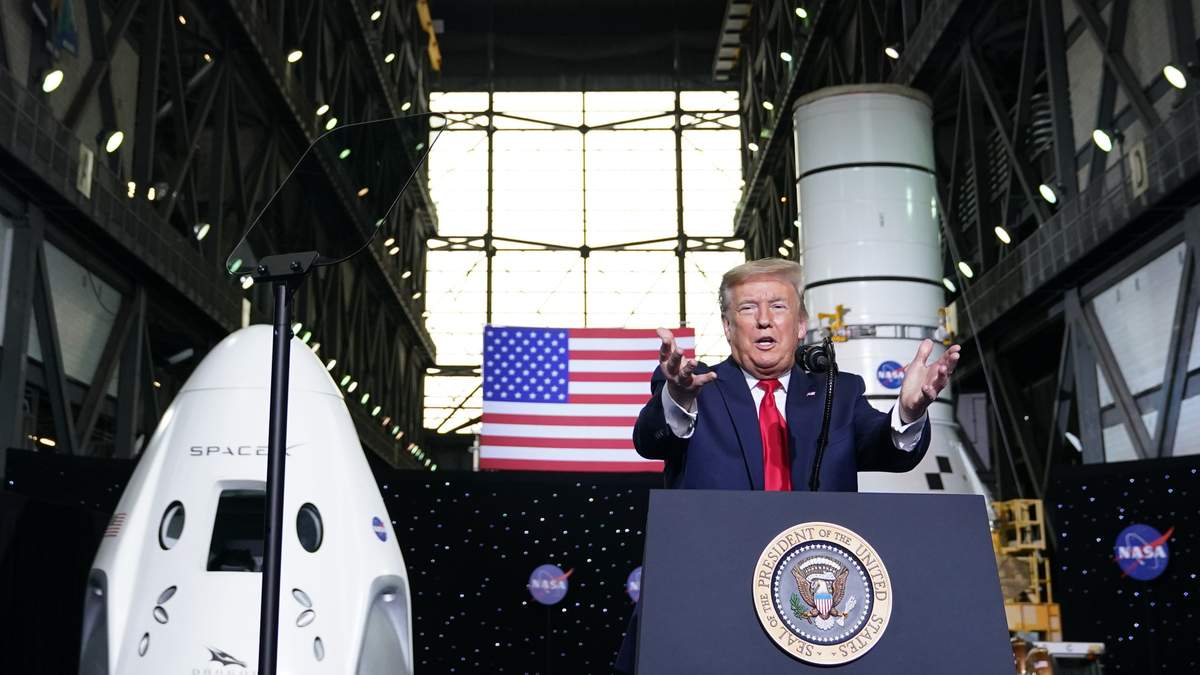
The United States since the 1950s has been at the forefront of space exploration and technology. From landing men on the moon to orbiting it again sixty years later, the U.S. continues to build upon that legacy. That in large part to President Trump’s efforts to expand the program again, after it was allowed to lie dormant for over a decade.
As part of his campaign to continue leading the U.S. to space and beyond, President Trump is taking more action to beef up the U.S. timetable in space. First, the President has said he wants to land a crew on the moon again and build a lunar base. Now, he has signed a presidential memorandum aiming to take the annual number of U.S. space launches to over 1,000 by 2030.
That number, while not impossible, is ambitious, to say the least. Former NASA test director Mike Ciannilli says this goal, while not impossible, presents quite the mountain to climb.
“We launched last year about 180 flights…and this aims to increase that by five times the amount…it is ambitious,” he says.
Ambitious is certainly a word for it. It borders on impossible, but in space travel, nothing is ever really impossible. America as a whole, throughout its history, has made a habit of making the impossible, possible. But this has a couple of logistic hurdles to clear.
Currently, we only have two major launch sites for spacecraft. The Kennedy Space Center in Cape Canaveral, Florida, and the Vandenberg Space Force Base in central California. Sure, places like Ellington Field in Houston are capable and authorized to perform such actions, but logistically, they are not quite prepared for such a venture.
Plus, this plan presents many avenues, ranging from satellites to crewed missions.
“You are looking at a lot of different options to launch payloads, and potentially crews, in different directions from different platforms,” says Ciannilli. “It is a lot of infrastructure and activity going on…to get up to 1,000 a year, we would need additional launch sites and look at additional launch providers.”
The FAA already has its hands full with the massive amount of air traffic coming into and out of U.S. airspace. Mission control in Houston, handling one spacecraft alone, takes an entire team of manpower. Handling multiple missions at a time would be chaotic.
But there are good aspects to the idea. For one, based on the latter point, it would add thousands of new jobs into the space program. But it also presents the opportunity for the U.S. to remain at the forefront of space adventure. Especially with China nipping at our heels.
If this idea were to become reality, and the logistics were worked out, it could be a huge deal for the economy and national security.
“There is a military component to make sure we have the assets in space to protect our nation and allies…but you also have the commercial sector that is really expanding the world of commercial satellites,” Ciannilli says.
Again, nothing in space travel is impossible. The U.S. has proven that time and again, doing only what other nations can think of in a pipe dream. This is quite the mountain to hike.
But if it happens, it will be another nod to the U.S. remaining the global dominant superpower.