
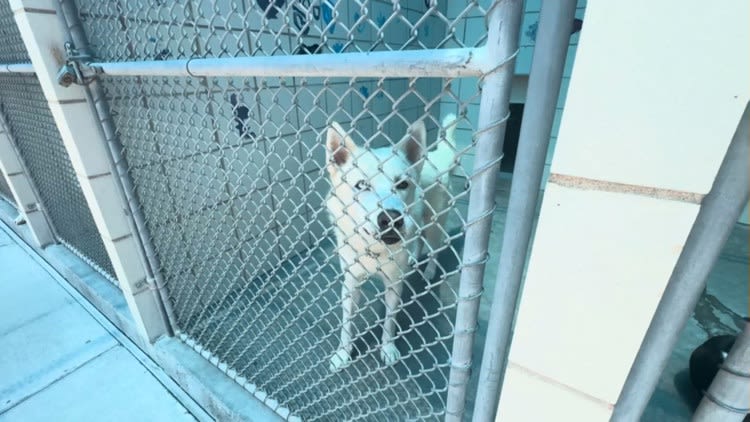
Corpus Christi City Council is set to consider a proposal Tuesday that would prohibit Animal Care Services from euthanizing healthy or treatable animals because of space, capacity or operational reasons.
The proposal comes as ACS continues to operate with limited kennel space. The shelter has 118 dog kennels and 24 cat kennels.
From October through July 31, ACS took in 3,174 animals and recorded 557 euthanasias. According to the city’s presentation, those euthanasias included medical, behavioral, rabies testing, public safety, court order and serious bodily injury cases. None were listed as space-related. In 2025 there were 28 animals euthanized because of space.
Assistant Director of Animal Care Services Cynthia Martinez said euthanasia decisions are made as a last resort.
“Anytime a euthanasia decision is made, it’s always as a last resort.”
Martinez said ACS currently turns to rescue partners when shelter capacity becomes a concern.
“When we see that capacity is an issue, we will immediately reach out to our rescue partners and ask them if they could help us by taking a certain number of animals in a certain time frame to prevent the need for euthanasia.”
She said those partnerships have helped the city avoid space-related euthanasia this year.
However, Martinez said a zero-tolerance policy could change how those partnerships work and could affect the department’s ability to respond to calls.
“If we were no longer able to focus on maybe our capacity needs, it could cause rescue partners to put their attentions elsewhere perhaps, or it could lead to decreases in our responsiveness as a department, simply based on our space.”
What would change?
If the policy passes, ACS says it would need additional resources, including more space and staffing.
“We would need more space, and we would need more volunteers, and we would need more fosters, and we would need more behavior staff, and all of those different things that help to keep animals sane and healthy while in our care.”
Martinez said the shelter currently has nine empty kennels, but all nine could be filled by Tuesday.
Mayor Pro Tem Kaylynn Paxson said she was happy to support councilman Eric Cantu’s request and efforts on this item.
“It’s really taking what was articulated to us as a very small number and making it a policy direction. So if we take the policy where we are not going to euthanize for space. I believe that’s really going to drive our efforts to make sure we are that much more working with our area shelters.”
Councilman Eric Cantu, who is spearheading the item, said he supports an outright ban on euthanasia for healthy or treatable animals because of space.
“It’s not an animal issue. It’s a city issue, and to kill animals because we need to free up space is not right. And I’m not going to stay quiet about it.”
Animal advocates say the bigger issue is overpopulation.
Cheryl Martinez with People Assisting Animal Control said reducing euthanasia is an important goal, but should not be the only measure of success.
“I don’t think that we are there yet.”
She said the city needs to look at how long animals remain in the shelter and how many animals are coming into the system.
“If the length of stay is long, that is also taking up the space of other animals.”
Cheryl Martinez also said public safety has to be considered, particularly when it comes to packs of stray dogs.
“Safety, community of our residents is number one.”
She said reducing the number of animals entering shelters should be a major part of the solution.
“The solution is target spay and neuter and being proactive.”
She also pointed to transportation, adoptions and community education as part of a broader strategy.
What happens next?
City Council is expected to discuss and take possible action on the proposed zero-tolerance policy Tuesday.
For ACS, Martinez said adoptions and fosters remain one of the most immediate ways residents can help create space.
“When an animal finds a loving home, it opens a kennel.”