
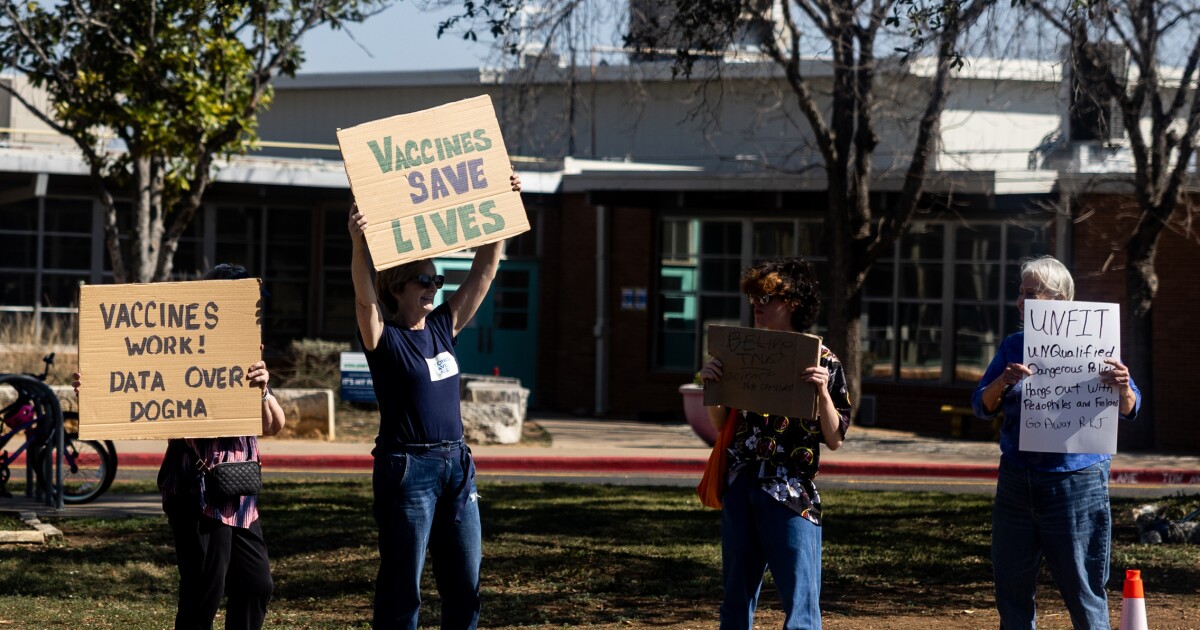
Austin ISD’s vaccination rates for incoming kindergarteners rose by more than 20% for some required shots during the last school year, bucking a national trend of dipping vaccination rates.
The district’s kindergarten vaccination rate for all state-required vaccines — including shots for polio; chickenpox; Hepatitis B; tetanus, diphtheria and pertussis; and measles, mumps and rubella — were over 97% during the 2025-26 school year, according to data reported to the Texas Department of State Health Services.
It’s a dramatic turnaround after a year of historically low vaccination rates in 2024-25. During that school year, rates for all vaccinations except Hepatitis B were below 80%, with TDAP and MMR at 74.31% and 76.81%, respectively.
Childhood vaccinations have been a topic of discussion across many communities this year amid efforts by the Trump administration and U.S. Health Secretary Robert F. Kennedy Jr., a vaccine skeptic, to curb the number of shots required for schoolchildren. After a slimmed-down childhood vaccine schedule from the Centers for Disease Control and Prevention was blocked by a judge earlier this year, President Trump issued an executive order to the same effect on Aug. 10.
The CDC also released new data this month showing that vaccination rates dipped slightly year-over-year for all shots required for U.S. kindergarteners. In the 2025-26 school year, just 92.4% of American kindergarteners were vaccinated for measles. Public health experts recommend that at least 95% of the population is vaccinated against measles in order to maintain herd immunity and prevent spread, a threshold that has not been met since 2019.
Alana Bejarano, AISD’s executive director of health services and nursing, credits a range of efforts for turning the tide in Austin ISD, which likewise saw several successive years of declining vaccination rates following the COVID-19 pandemic. She said the issue had been a focus for at least the last two and a half years, when AISD shifted towards 100% in-house nursing services rather than contracting with Ascension Seton.
“Austin has notoriously had some low rates, and so we were tasked with really turning that around,” Bejarano said.
She said the district has focused on making vaccines more accessible by making resources available at each campus and offering nighttime clinics at locations across the district for busy families. She said she and her colleagues in the health services department have also stressed the importance of vaccination as a priority to district leaders and campus principals.
“Myself and my director go and we present to the principals, and we just let them know that those students would have to be excluded [from school activities] if they don’t have shots,” Bejarano said.
She said she noticed a difference in people’s response to discussions about the district’s dropping vaccination rates after the West Texas measles outbreak of 2025. The U.S. has continued to see outbreaks of measles since then; two unvaccinated people in Pennsylvania died from measles this week.
“I do think it took everybody a little by surprise, because we tend to think of this as eradicated,” Bejarano said. “So I do think they listened. It was serious, and it was national news, and so everybody did kind of listen more closely during that time.”
State law allows students to attend school unvaccinated only if they have filed a medical or conscientious exemption. Families are allowed a 30-day grace period to either get kids vaccinated or file an exemption if they aren’t in compliance at the beginning of the school year.
The district’s exemption rate is currently 3.22%, around a point higher than it was during the previous year.
In the years post-COVID, Austin ISD had a gap between its vaccination rate and the number of students with an official exemption on file. But Bejarano acknowledged that the district has become stricter about enforcing its vaccination policies. That means making sure families have easy access to both vaccines and exemption paperwork, she said.
“It’s not magic,” Bejarano said. “It’s just some real hard work and dedication to make sure we’re following Texas law.”
Support for KUT’s reporting on health news comes from St. David’s Foundation. Sponsors do not influence KUT’s editorial decisions.