
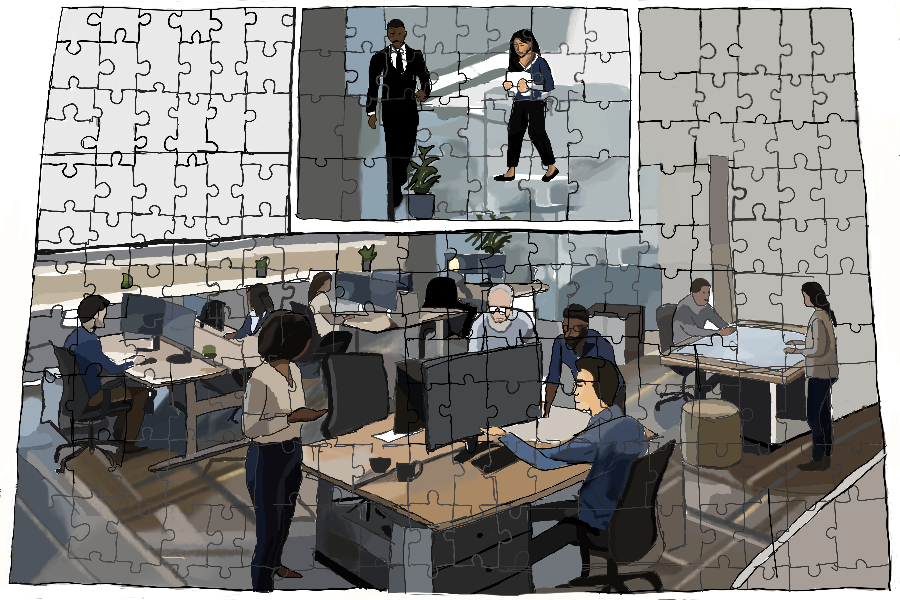
Throughout history, “divide and conquer” has been used to prevent people from turning against a higher power. Your legitimacy is unlikely to be challenged if you redirect blame toward vulnerable groups.
Today, that someone to blame is minority groups, such as Indians.
In Texas, there are over 40,000 people authorized to work under H-1B visas. H-1B visas are a competitive, non-immigrant visa that is typically granted to workers in technical and research-based industries, with Indian nationals holding 72% of them nationwide. Simultaneously, anti-Indian sentiment is on the rise. Indians are called slurs online and taken photos and videos of in public, accused of invading local communities.
Tech companies have increasingly relocated to Texas. Austin alone added 81 corporate headquarters between 2018 and 2024, including companies like Tesla, Oracle and X, promising new jobs. However, when the existing population cannot meet the labor demand an emerging industry is looking for, companies recruit workers whose skills are not widely available in the local labor force. The result is greater demand for housing and local services, which can raise costs faster than wages of current residents can match.
“A capitalist economy welcomes labor,” said Néstor Rodríguez, a sociology professor whose research focuses on international migration. “That’s why companies are hiring people from India or other places — because they need those workers. Not that nobody else will do the job, but (a U.S. worker) will do the job at a higher cost. That’s one of the laws of capitalism: control your costs.”
Public discussions often point to changing neighborhood demographics as the issue, even though economic restructuring and labor-market dynamics are the driving forces.
“Some people may see this (immigration) as a threat. They’re taking our jobs, etc.,” Rodríguez said. “They’re not looking at what’s happening in the social structure that companies are moving in. They’re the ones who are bringing in the immigrants. They’re the ones who are recruiting H-1B workers. But what’s visible to the public and supported by growing public sentiments (about) immigration is that newcomers are here (and) they’re taking over.”
Despite UT’s large Indian community, anti-Indian public sentiment has seeped into our culture and affected social dynamics.
“I feel like because I am very confident in (where) I came from, I have no problem talking about my interests with being Indian, like my culture, Bollywood, cultural traditions (and) speaking the language,” said Deeya Shah, a human dimensions of organizations junior that has noticed other Indian students wanting to distance themselves from the Indian community. “I think a lot of reasons why a lot of Indian people don’t interact outside of their race is also just because of fear of rejection, especially since recently, the way Indians are being portrayed in the media (has) caused additional scrutiny.”
There are legitimate sources of frustration some have, such as cliquiness and differences in norms. However, members of a marginalized group are less likely to be receptive to criticism when the loudest voices come from a place of contempt rather than good faith.
Whether your frustration with the rapid changes in affordability or culture comes from your experiences here at UT or back in your hometown, blaming Indians isn’t the solution. If we can recognize the shared hand behind both, then perhaps we can reject the divisions allowing us to be conquered.
Chatterjee is a government junior from Allen, Texas.