
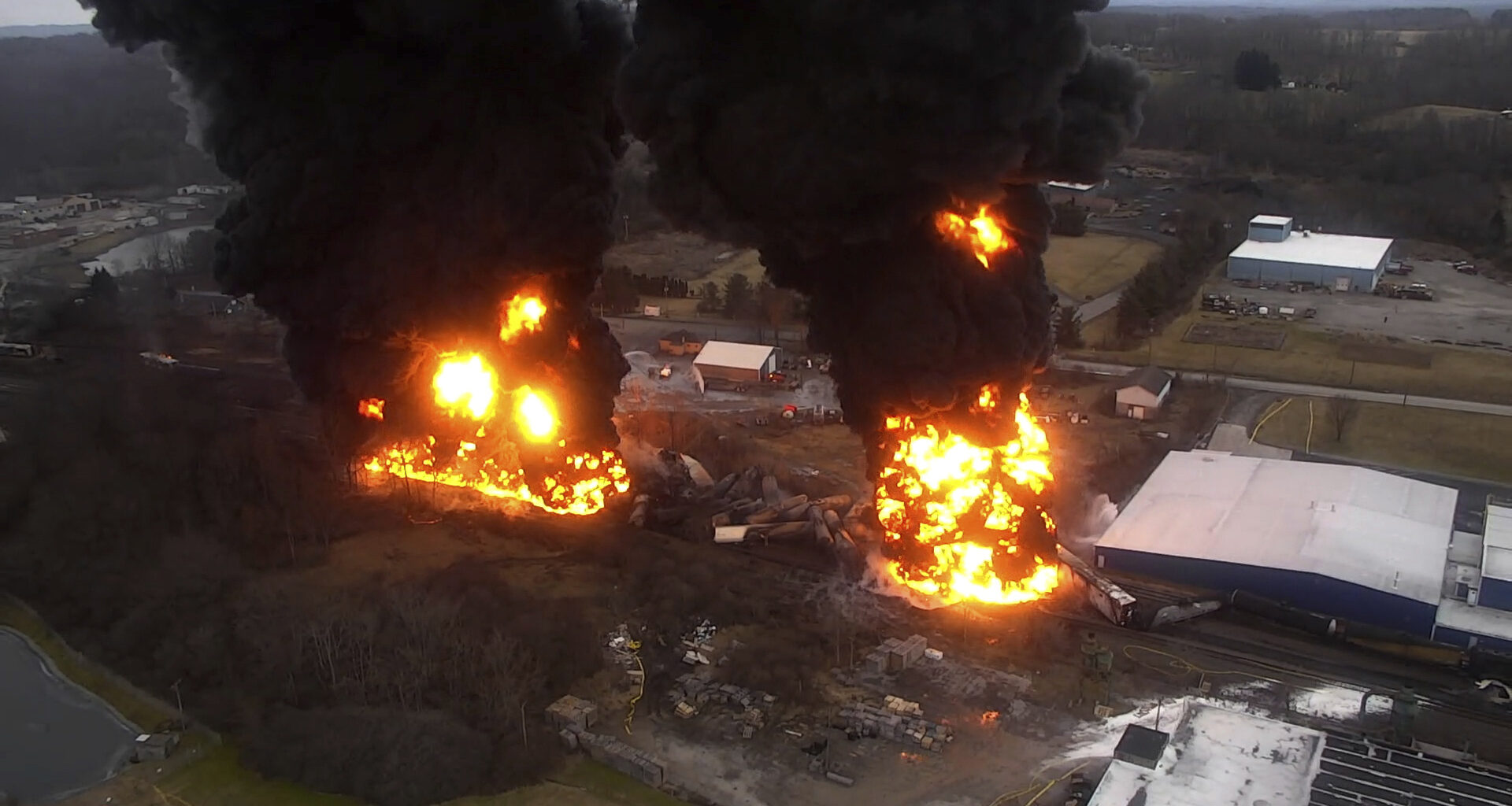
A frame grab from drone video taken by the Columbiana County Commissioner’s Office and released by the NTSB shows towering flames and columns of smoke resulting from a “vent and burn” operation following the train derailment in East Palestine, Ohio, on Feb. 6, 2023. Residents of eastern Ohio can now get an up-close view in newly released videos of the twin toxic towers of fire that forced them from their homes last February when officials decided to blow open five tank cars filled with vinyl chloride they worried might explode days after a Norfolk Southern train derailed. (Columbiana County Commissioner’s Office/NTSB via AP)
Associated Press
President Donald Trump promised a historic rollback of federal regulation, but Vice President JD Vance apparently didn’t get the memo.
The Railway Safety Act grew out of the terrible 2023 derailment in East Palestine, Ohio. Vance, then a senator from Ohio and not yet selected to be Trump’s vice president, had just won his election and was in the middle of a political pivot from traditional conservatism to an exciting new pro-labor populism. The derailment was an opportunity in his personal political project to ingratiate himself with labor unions.
It was an opportunity for another Ohio senator, too — Sherrod Brown, a wilier, more experienced Democrat. Brown used this as a chance to push through goodies for his longtime labor union supporters and treat Vance as bipartisan cover.
Article continues below this ad
The bill imposed crew size mandates to protect outdated jobs and many other new regulations designed to protect union workers against elimination by technological innovation. To preclude productivity improvements, in other words.
At Vance’s urging, Congress inserted the Railway Safety Act — a package of major new freight-rail mandates that previously failed to pass as a stand-alone bill — into the reauthorization of federal surface transportation programs. The House Transportation and Infrastructure Committee added the provisions to its BUILD America 250 Act in May, after Trump publicly urged Republicans to support them. Rail labor unions promptly thanked Trump and Vance for their “continued leadership.”
The current surface transportation authorization expires Sept. 30. Congress has not yet passed the new funding bill, which sets the stage for yet another short-term extension — the new normal from a dysfunctional Congress. And now the administration wants to shoehorn the Railway Safety Act into any short-term extension.
That would be a bad idea.
Article continues below this ad
Here’s the fun question: Would anything in the Railway Safety Act have prevented the East Palestine derailment? Turns out, no.
The National Transportation Safety Board found that the East Palestine derailment began with a failed wheel bearing and identified shortcomings in bearing-detection systems and emergency response. But the mandated size crew was already operating the train. There’s no reason to think the Railway Safety Act would have prevented the East Palestine derailment.
So why hasn’t the Railway Safety Act simply died of its own futility?
You can blame Vance’s presidential ambitions.
The vice president envisions pulling together an even Trumpier version of Donald Trump’s 2016 political coalition, which included a larger share of union voters than past Republican coalitions. That coalition didn’t re-form in either 2020 or 2024, but as the last major politician who thinks social media intensity reflects the actual electorate, Vance is doubling down on populism, of which union votes are a part.
Article continues below this ad
Problem is, these new regulations on critical rail supply chain infrastructure and other policies Vance champions to draw his fantasy political coalition together would be bad for America. That’s why promising more regulation has never been a part of American conservatism.
Conservatives like Sen. Ted Cruz, a Texas Republican, have warned that the Railway Safety Act would increase transportation and energy costs, disrupt supply chains and grant regulators power extending far beyond the actual causes of the East Palestine accident. And he’s right. It wouldn’t have prevented the East Palestine derailment, but it will discourage the adoption of new technologies designed to improve safety and productivity.
The truth is that our transportation infrastructure is quite safe already, especially rail. Human error remains the greatest risk factor. Further marginal safety improvements will involve implementing technologies that see better than humans, react faster than humans, and don’t get sleepy or use intoxicants. That don’t have bad days. That don’t get into fights with their kids or their wives. That don’t have emotions or suicidal ideations.
In other words, protecting union jobs instead of implementing advanced technology will make improvements in railway safety less likely.
And more expensive. Freight rail is a core infrastructure of the American economy. It moves energy, agricultural products, automobiles, chemicals, construction materials and manufactured goods across distances. Regulations that make rail transportation slower, more rigid and more expensive increase costs throughout the economy and can push freight onto already congested highways, making them less safe.
Article continues below this ad
If there are improvements in rail safety that can be gained through legislation, we should see them justified in a stand-alone bill, including new train crossing regulations sought by Houston representatives. Who wouldn’t want that?
But Vance wants something different.
Tom Giovanetti is president of the Institute for Policy Innovation, a conservative, free-market public policy think tank.