
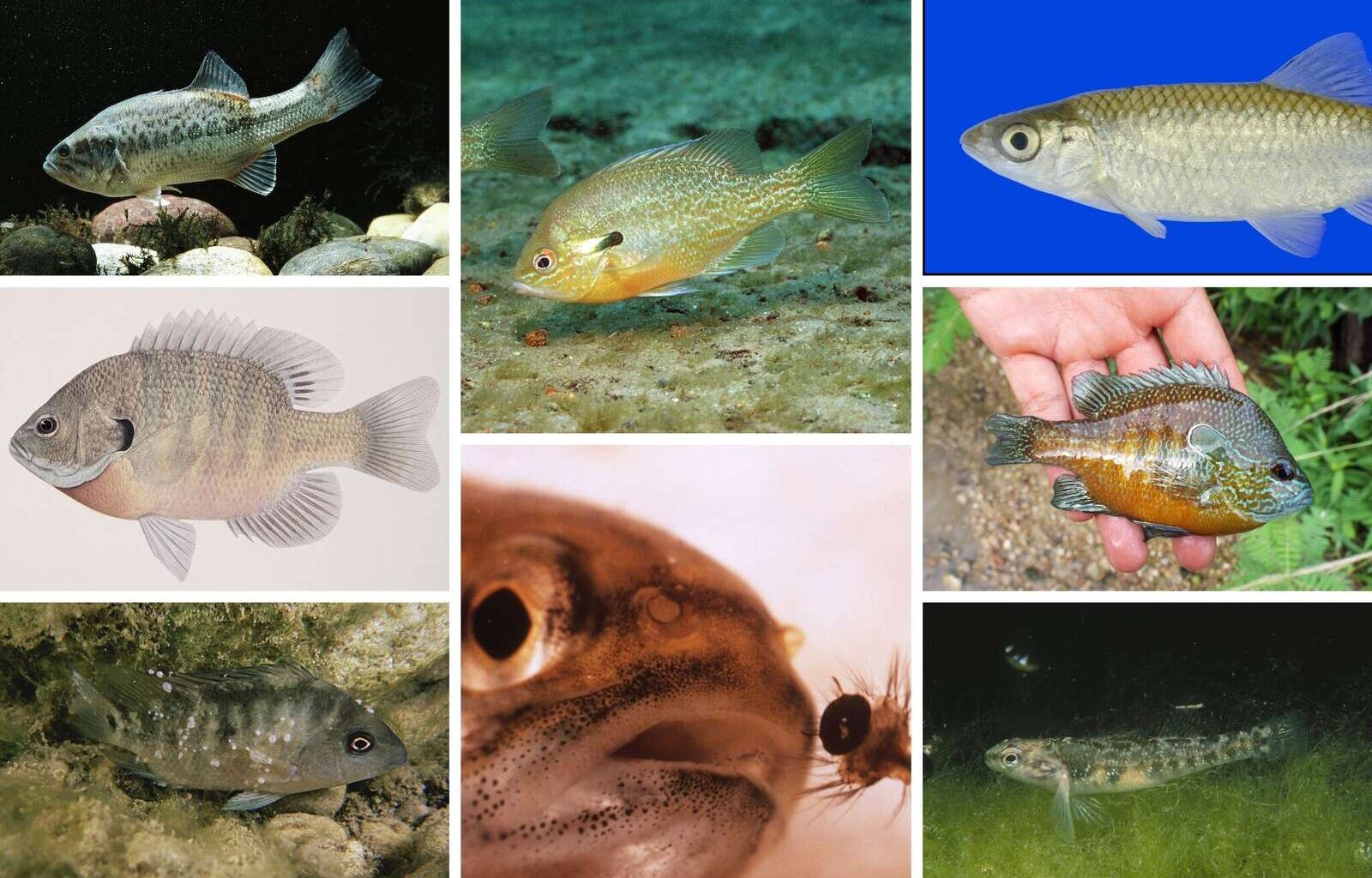
We recently reported that Patricia Bobeck, a regular Barton Springs swimmer, spotted a bluish, larger-than-usual fish in the cold pool. It is uncertain whether hydrogeologist Bobeck spied a non-native Asian grass carp — introduced to our Central Texas lakes to control invasive hydrilla — or a similarly sized native gray redhorse, or maybe a ubiquitous common carp. While the mystery remains unsolved, it piqued readers’ curiosity about aquatic life in the popular swimming hole.
Indeed, if one dives down deep with a handy mask, the refreshing pool, formed by a dam below the springs, resembles a large aquarium.
We asked a half dozen knowledgeable Austinites including credentialed biologists, naturalists and ichthyologists about the most common species found there. Dean Hendrickson, curator of ichthyology at the UT College of Natural Sciences, noted that data on the most common species of Barton Springs fish is not always available. Still, there was a good deal of consensus in the scientific and naturalist communities about which fish swimmers might encounter.
Article continues below this ad
We cross-checked various fish lists and, in a strictly nonscientific way, chose these eight to spotlight as “real fish of Barton Springs Pool.” For most of the short descriptions, we turned to “Freshwater Fishes Found in Texas” published online by the Texas Parks and Wildlife Department.
Stay tuned for future guides that cover the rare Barton Springs salamanders and nearby Lady Bird Lake turtles.

Fish of Barton Springs Pool Poster
This heirloom poster by illustrator Ken Ellis for the Austin American-Statesman features the eight fish most commonly found at Barton Springs Pool.
These sunfish “may be distinguished from other sunfish by the dark spot at the base of the dorsal fin, vertical bars on their sides, and a relatively small mouth. The spiny dorsal fin usually has 10 spines — but may have as many as 11 or as few as 9 — and is broadly connected to the soft dorsal. The anal fin has three spines. The back and upper sides are usually dark olive-green blending to lavender, brown, copper or orange on the sides, and reddish-orange or yellow on the belly. Colors are more intense in breeding males, and vertical bars may take on a reddish hue.”
Other Common Names: Bream, brim, perch, sunfish, sunperchScientific Name: Lepomis macrochirus
These popular sport fish “grow 4 to 6 inches during their first year, 8 to 12 inches in two years, 16 inches in three years. They are usually green with dark blotches that form a horizontal stripe along the middle of the fish on either side. The underside ranges in color from light green to almost white. They have a nearly divided dorsal fin with the anterior portion containing nine spines and the posterior portion containing 12 to 13 soft rays. Their upper jaw reaches far beyond the rear margin of the eye.”
Other Common Names: Black bass, green trout, bigmouth bass, lineside bassScientific Name: Micropterus salmoides
This particular sunfish “possesses a yellow belly that is sometimes an orange or a rusty color. It might have been better named the longear, as its opercle flap or ear is considerably longer than the opercle flap of the longear sunfish. In adults, the ear often reaches a length of one inch or more; it is narrow and usually not wider than the eye. The lower margin of the flap is usually pale. The redbreast is one of our larger sunfish, occasionally attaining weights of one pound or more.”
Other Common Names: Yellowbelly sunfish, redbreasted breamScientific Name: Lepomis auritus
These are “small in comparison to many other freshwater fish, with females reaching a maximum length of 2.8 inches and males a maximum length of 1.6 inches. The female can be distinguished from the male by her larger size and a gravid spot at the posterior of her abdomen. The name ‘mosquitofish’ was given because the fish eats mosquito’s larvae. (It) has been used more than any other fishes for the biological control of mosquitoes.”
Other Common Names: Gambezi, gambusiaScientific Name: Gambusia affinis
Article continues below this ad
A tiny species — 2.4 inches in length — of freshwater ray-finned fish, it’s a darter from the family that includes perches, ruffes and pikeperches. According to several sources, the greenthroat is found in the Colorado, Guadalupe and Nueces river drainages in Texas; and in Pecos River system in New Mexico.
Scientific Name: Etheostoma lepidum
“The name is derived from the fact that longear sunfish have an elongated opercle flap. This flap, always trimmed in white in adults, is unique and makes field identification relatively easy if hybridization has not occurred. Longear sunfish are quite colorful. Males are often bright orange or scarlet, and the head and fins usually have turquoise markings. Dorsal and anal fins, and their associated spines, are similar to those of redear sunfish.”
Other Common Names: Cherry breamScientific Name: Lepomis megalotis
These fish may grow to exceed 10 inches in length. A native member of the cichlid family of fishes, which also includes the exotic tilapia. “Rio Grande cichlid are distinctive in that they exhibit cream and turquoise-colored spots, giving them a speckled look. Background color varies from very dark to light olive. Lighter colored specimens usually exhibit five dark vertical bars. Both dorsal and anal fins are long and tapered extending behind the caudal peduncle (fleshy portion of the tail). Unlike tilapia and most sunfishes, which typically have three spines on the anal fin, Rio Grande cichlids are equipped with five to six anal fin spines. Adult males may also develop a pronounced ‘hump’ on the head which is not present in tilapia.”
Other Common Names: Rio Grande perch, Texas cichlidScientific Name: Herichthys cyanoguttatus
This is a somewhat slender minnow with 8 to 9 rays on the anal fin, and a prominent black spot at the base of the tail fin. The back is usually yellowish-olive, and the sides are silvery with hints of blue. Adults in Texas have reached 4.6 inches in length.
Scientific Name: Cyprinella venusta
Article continues below this ad
If, like us, you want a version of this fish list on your wall in poster form, visit our merch shop to purchase one. Your new, framed family heirloom will support the work our journalists do every day to keep you informed. Thank you.
Your weekly fix of Texas history, nostalgia, myths and more.
By signing up, you agree to our Terms Of Use and acknowledge that your information will be used as described in our Privacy Policy.
Reporting by Michael Barnes. Editing by Deborah Sengupta Stith. Production by Alice Bazerghi. Powered by the Hearst DevHub.
Aug 26, 2026
For the past 37 years, Michael Barnes has written about the people, places, culture and history of Austin and Texas. He earned his Ph.D. From the University of Texas at Austin and has spoken frequently at Central Texas colleges and universities, as well as with civic and community groups. He is the author of five volumes of “Indelible Austin,” a series of books that document community-based histories of the city. Barnes has won numerous local, regional and national journalism awards.