
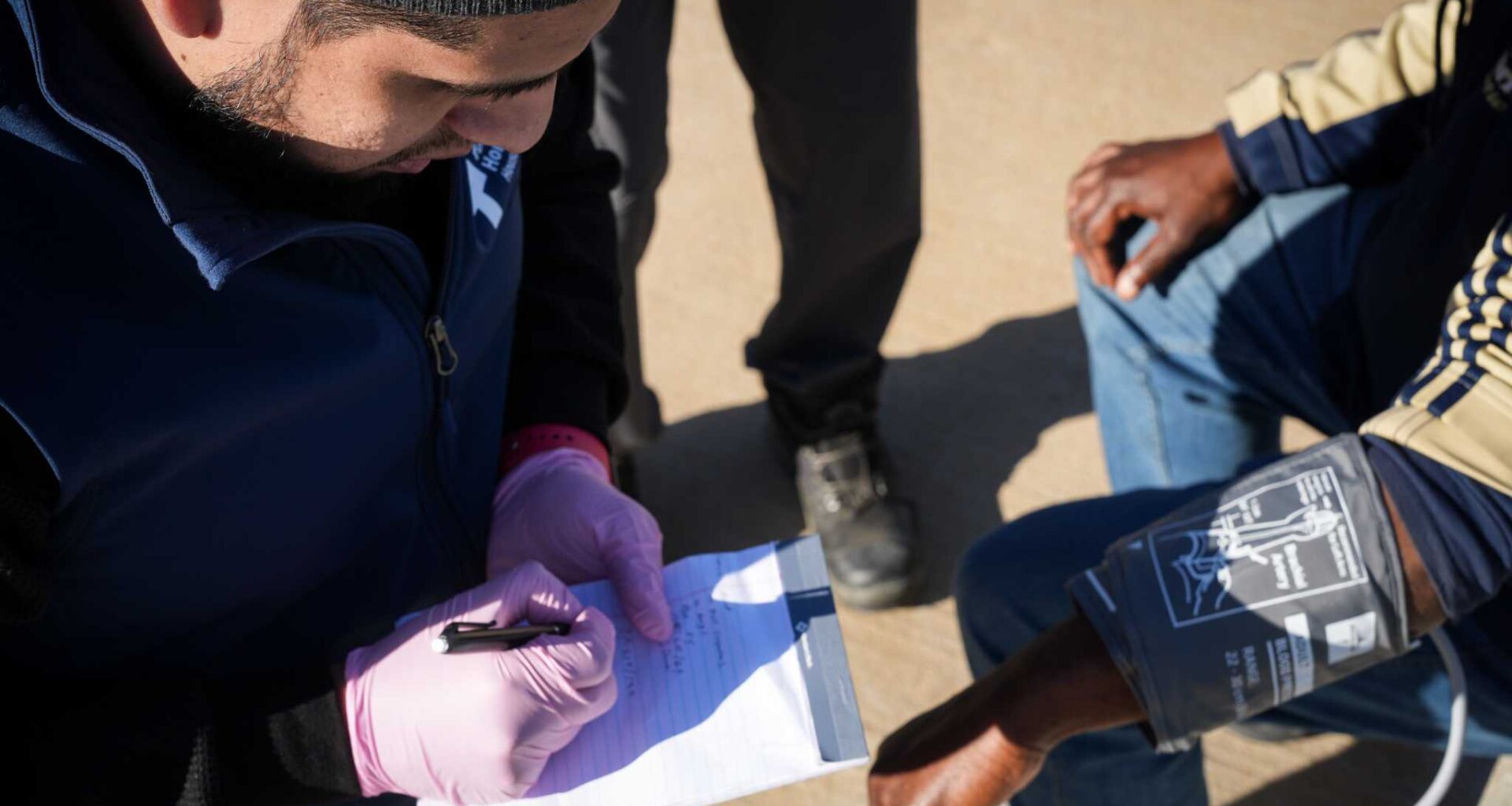
University of Houston’s Institute for Housing, Homelessness and Health plans to reach out to existing organizations tackling homelessness to discuss ways that the university’s resources could help. Here, Arturo Rodriguez, a medical assistant with Healthcare for the Homeless – Houston, takes vital signs and basic info from a man Wednesday, Jan. 10, 2024, along Brays Bayou.
Jon Shapley/Staff photographer
Could the age of machine learning offer new tools to tackle homelessness?
The University of Houston has launched the Institute for Housing, Homelessness and Health to find out.
The university announced Wednesday morning that a $5 million gift from an anonymous donor will enable staff to bring together homeless service providers, professors and students to develop potential solutions, run pilots and conduct data analysis.
Article continues below this ad
HAVEN FOR HOPE: Houston is betting on this homelessness model. We went to see it ourselves.
Take, for example, the question of the best ways to prevent people from becoming homeless in the first place.
Ben King, the institute’s founding director, envisions combining datasets that long have been separate — such as information from homeless service providers, utility debt notices, eviction courts, jails and emergency rooms — to look for patterns. The goal? Finding moments where key interventions could keep people from spending a night in a shelter or the streets.
The institute, called IH3 for short, also plans to reach out to groups tackling homelessness to listen for ways they could help.
Article continues below this ad
Houston, said King, is the ideal location for such an institute because of its cooperation between entities fighting homelessness, which has famously allowed Houston to move people into housing efficiently enough to reduce the number of people living in shelters, tents and other places not meant for habitation.
If the institute hears from the community that, say, combining data sets or using machine learning could help with a question, the institute could take that on, perhaps with faculty and students. If, on the other hand, there’s a program or intervention that homeless advocates wish they could do, the institute could help with a pilot program. It would provide short-term funding and help set up data collection; if the pilot was a success, then the group could take that data to funders.
Such pilots, King believes, will help solve a problem currently faced by homeless service providers, which often rely on funding with very strict parameters. If a use that wouldn’t have previously been allowed by a certain grant is proven to be highly effective, funders tend to respond, he said.
“It’s what I call de-risking the innovation,” King said. “The idea is to have an institute at the university that’s a resource to the community.”
SEARCH OUR MAP: As downtown homelessness declines, these Houston suburbs are seeing the biggest gains
Article continues below this ad
One illustration of such “de-risking innovation” is the Houston Recovery Center. Conceived as a place where law enforcement officers could bring intoxicated individuals who otherwise would have been taken to jail, much of its funding is tied to being a jail diversion program for law enforcement. The center also works to help people recover from addiction long-term — but, as you might imagine, clients tend to be less receptive to such resources when they’re forcibly brought into the building in the back of a cop car.
What if that relationship could begin on better footing through outreach workers, who are out in the field doing overdose prevention?
“Preventing or avoiding the unnecessary interactions with law enforcement,” said King, summing up the hypothesis, “makes law enforcement happier, it makes the clients happier, it makes the system more effective, right?” The Houston Recovery Center recently received funding from the Texas Opioid Abatement Council, and the Institute could help analyze the data collected over the next three years.
“Using the system in smarter ways, we can try to create better systems,” King said.
Article continues below this ad