
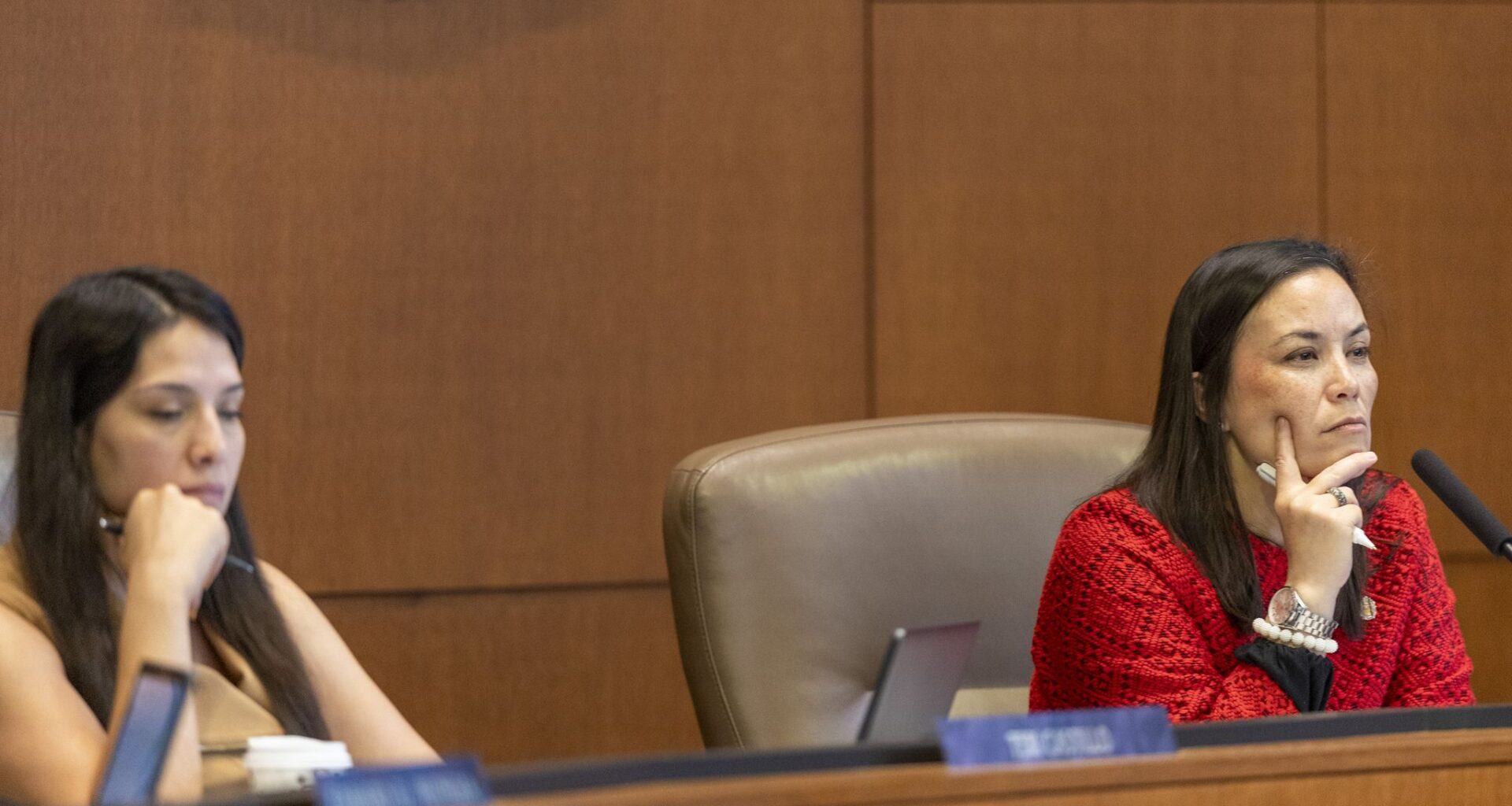
Mayor Gina Ortiz Jones said she was “not ready to commit to a moratorium,” at a specially called City Council meeting. The council decided to move forward with proposed zoning and land-use changes for data centers.
Andrew J. Whitaker/San Antonio Express-News
The City Council is moving toward tightening its rules on building data centers in San Antonio as the pushback against the facilities grows across the state.

The council is tackling the issue of data centers two weeks after Council Members Ric Galvan, Ivalis Meza Gonzalez and Teri Castillo called for a moratorium — or a freeze on plans and permits for the power-hungry facilities that have been moving into San Antonio.
Article continues below this ad
At this week’s specially called meeting, the council decided additional data was needed to understand whether a moratorium was needed. In the meantime, it’s shifting its focus to fine-tuning proposed changes to the city’s zoning and land-use codes to better manage the data center boom.
“I’m not ready to commit to a moratorium,” Mayor Gina Ortiz Jones said. “I think there’s a lot of things we can do to help ourselves.”
READ MORE: San Antonio council members push to temporarily stop new data centers
San Antonio Express News Logo
Make us a Preferred Source on Google to see more of us when you search.
Add Preferred Source
The pushback against data centers in San Antonio has been brewing since last year, when Galvan filed a policy proposal asking city staff to explore potential amendments to the city’s Unified Development Code that would better regulate the industry and its effects on communities. The comprehensive review was approved in December, and the city has hosted three stakeholder meetings since then, which led to this week’s meeting.
Article continues below this ad
San Antonio is joining a growing list of cities and counties across Texas looking for ways to control the sprawl of data centers that has sparked a public outcry from residents concerned about their power and water usage and about their effects on the environment and quality of life.
On Tuesday, Austin took its first steps to banning large-scale data centers after earlier approving water-use restrictions for large industrial users.
At the state level, Gov. Greg Abbott has called on utility regulators to audit data centers looking to connect to the state’s electric grid. The audit pauses approvals until the audit is complete. Last week, the Public Utility Commission approved a timeline pushing completion of the audit to late this year, punting a politically volatile issue until after November midterm elections.
The moves come as Texas is poised to become the world’s largest data center market — surpassing Virginia, according to a recent report from real estate firm JLL. San Antonio has been one of the areas that has proven attractive to the facilities because of its affordable power, accessible fiber networks and manageable climate.
Article continues below this ad
Council members were presented on Tuesday with the two approaches to solving the data center problem: changing the code or issuing a moratorium.
How should San Antonio City Council regulate data center development?
Changing San Antonio’s zoning and land-use codes will allow for a quicker and permanent solution to the data center problem, Development Service Director Amin Tohmaz said. Data centers can be restricted to intense commercial zones, which allow for large-scale shopping centers and auto malls, and industrial zones, like the manufacturing hub growing on the South Side.
In addition, the proposed changes call for data center developers having to follow stringent guidelines beyond standard zoning rules, such as a 500-foot buffer zone from the facilities to neighboring residents, schools and daycare. The exact distance of the buffer zone can be changed, city staff said.
Article continues below this ad
If a developer fails to meet the comprehensive set of standards, they then would be required to go to City Council to acquire a special use authorization.
The City Council also discussed adding mandatory landscape buffering and fencing to help mitigate noise and light pollution, as well as to help maintain the aesthetic appeal of the sites. Additionally, the proposed zoning and land-use changes, which were drafted by the city’s Development Services Department and presented to the City Council, plan to prohibit data centers from being developed over the Edwards Aquifer Recharge Zone.
Jones suggested adding requirements such as daytime and nighttime noise limits, as well as requiring enclosed buildings for backup generators.
RELATED: Environmental groups threaten suit over San Antonio data centers’ air pollution
Article continues below this ad
The Planning Community Development Committee now will go back and edit the proposed code amendments to take into account the feedback gathered at the City Council meeting and through the public discussions. The amendments then will be brought back to City Council to vote on them.
The process would be faster than going the moratorium route.
Before issuing a freeze, the council would first have to evaluate and provide written findings showing evidence of either a shortage of essential public facilities or a risk to resident’s safety and welfare.
That would be followed by public notices and multiple hearings. In the best-case scenario, Tohmaz said, the moratorium could be filed at the beginning of September, but not approved and voted on until the end of the year. A moratorium only lasts 90 days, though it can be extended for an additional 90 days.
Article continues below this ad
Council Member Jalen McKee-Rodriguez said a moratorium could buy the city time to figure out every mechanism necessary to regulate and mitigate the risks of the data centers, which he called “one of the largest and fastest-growing threats to our communities.”
“We have to do everything in our power to protect our access to natural resources, to preserve the land and environment that we rely on and to mitigate the impacts of these data centers in our communities,” McKee-Rodriguez said.
READ MORE: Dallas company plans $500M data center in Castroville, expanding its San Antonio-area footprint
But other council members, like Misty Spears, worried about how a pause would affect “a huge piece of our workforce,” referencing the thousands of construction jobs that can last up to 36 months.
Article continues below this ad
“Every time you pick up your phone and you use an app and use ChatGPT, you’re relying on a data center,” Spears said. “I think San Antonio needs to be the one leading in this space and not allow others, foreign or domestic, to take the lead.”
She pointed out that data centers are developing new approaches — like closed-loop cooling systems, behind-the-meter energy generation and small modular reactors — to power their operations and lessen the strain on the grid and water resources.
Castillo raised concerns that behind-the-meter generation could affect CPS Energy revenue and, in turn, the city’s general fund.
The effects on CPS Energy and San Antonio Water System were discussed during a March meeting with city-owned utilities about the energy and water required to power these operations.
Article continues below this ad
RELATED: San Antonio data center boom could strain CPS Energy
Tuesday morning marked the third public discussion related to data center development, with this meeting specifically focusing on data center zoning and land use amendments.
“We are not here to ban data centers,” said Logan Sparrow, assistant director of the city’s land development division. “We’re here to make sure we propose regulations that are predictable … making sure that they have to be located in responsibly slated areas where they’re not going to be nuisances to neighbors.”
Public Citizen advocate DeeDee Belmares pointed out that a critical stakeholder group was missing from the morning conversation — far West Side and District 6 residents who are seeing the most developments in their neighborhoods.
Article continues below this ad
“People are concerned, and their voices need to be heard,” Belmares said. “But it’s really hard when it’s in the middle of a workday downtown in San Antonio.”
Data centers house computers, servers and other equipment that are imperative to the digital world. In San Antonio, major data center owners include the federal government, Microsoft, Valero Energy Corp., Frost Bank, Christus Santa Rosa, Lowe’s and Amazon.
READ MORE: San Antonio City Council has opinions on steering local data center boom
San Antonio has become the site for companies building and leasing server farms, like Dallas-based Cyrus One, which is planning its sixth San Antonio-area facility.
Article continues below this ad
City staffers plan to obtain more data from CPS Energy and SAWS about the scale and effect of these developments so City Council members can better understand whether a moratorium is necessary.
“We look forward to follow-on discussions and certainly the answers, if not before October, certainly in October,” Jones said before concluding the meeting.