
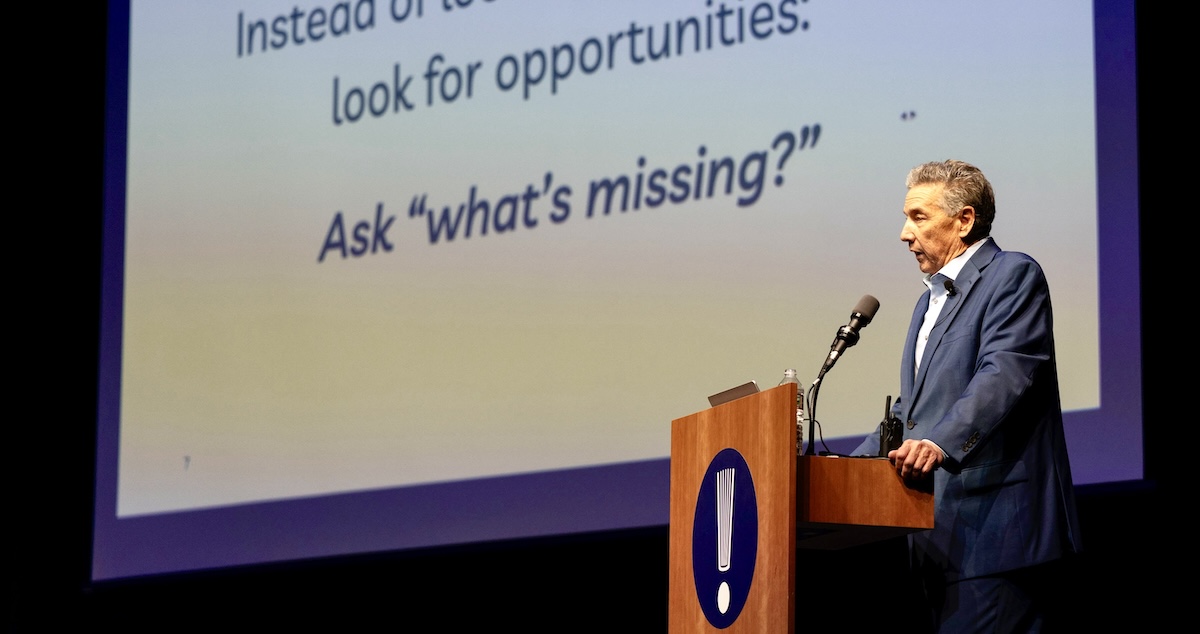
Monte Anderson, a nationally recognized developer, speaker and educator, encouraged area developers to be creative with underused neighborhood developments instead of tearing them down as available land becomes scarce.
Anderson is president of Duncanville, Texas-based real estate firm Options Real Estate Investments Inc. and founding partner of development consulting firm Neighborhood Evolution. He has spent more than 30 years renovating downtowns, commercial corridors, historic buildings and aging shopping centers.
Anderson was the featured speaker at Building Northwest Arkansas, One Project at a Time on Wednesday (Aug. 26) in Fayetteville. About 400 people registered to attend the lunch event. It was hosted by the Northwest Arkansas Council and builds on the regional growth strategy that it released earlier this year.
In the event, Anderson discussed lessons learned from the projects his company financed, owns and operates. He also talked about his town maker philosophy, which focuses on helping entrepreneurs, small developers and community leaders build stronger communities one project at a time.
“Our company does development, property management, leasing. We do our own construction,” Anderson said. “We’re like an old-fashioned, old-time developer maybe who would’ve been around 100 years ago.”
He said he’s a town maker who cares about adding value to underused places. He said a town maker is motivated by sustainable growth, solutions and making money.
“A town maker looks at an overlooked place and asks a different question: What project should go here? What is missing? What does this neighborhood already have? What does it need? Who is already here that can be part of the answer?” Anderson said.
When he started work in downtown Duncanville, he said it struggled to attract a good coffee shop. So, he asked the donut shop to serve better coffee. The shop did, and it remains in business. “And it still serves good coffee,” he added.
Anderson stressed that regions need to be creative with their available land and underused neighborhoods. They need to know what they want on the land before it’s filled. The overlooked places become more important as easily filled land is used.
SUCCESSFUL DEVELOPMENTS
One project he discussed was Tyler Station in southern Dallas. The industrial building, built in 1922 and formerly a wax paper factory, is surrounded by a residential area. The company redeveloped the two-level, 100,000-square-foot building into small spaces, allowing 70 entrepreneurs to lease space.
“We spent like $40 a square foot finishing this space out,” he said. “That included a new roof and everything.”
The building accommodates co-working and studio spaces for artists. It has barbers, a brewery, tattoo shops, retail, office and manufacturing spaces.
“The most amazing thing about it is it’s this collaborative village of creative people with no executive director and no on-site property manager,” he said. “It’s designed to self-regulate.”
The walls are made of cattle panels, allowing for visibility among the artists and throughout the building. It also created collaboration among the artists. He said the numbers worked for the development because tenants could sublet their spaces, allowing them to afford higher rent.
Another project he discussed was Wheatland Plaza, which the company bought for $3 million in 2022, and after redevelopment, was valued at $20 million. It was a 90,000-square-foot strip center built in the 1960s and 1970s in a neighborhood. The company divided the large spaces into smaller ones, allowing for a higher per-square-foot rate while keeping the lease amount within the market range.
“And if that’s the one thing that I can tell you today, that’s the key to basically areas that are getting too expensive,” Anderson said. “You’ve got to figure out how to downsize them and do them small. And it takes a lot of design to do small. It’s a lot easier to design in big bulk.”
He said his smallest restaurant is about 300 square feet. The largest is no bigger than 2,000 square feet. He said if a small restaurant goes out of business, he can easily replace it.
Wheatland Plaza also includes 12 two-story townhomes with two- and three-bedroom units. He said he partnered with Habitat for Humanity to offer income-qualified residents 30-year loans at 0% interest. The monthly payment for the $375,000 townhome is $1,750.
“It’s not a perfect urban place by far, but it’s a whole lot better than it was,” Anderson said. “And if you did like the city wanted us to do – tear it down – in a place in Duncanville, it wouldn’t get replaced for 15 or 20 years. So by keeping it – recycling – we kept from putting it in the landfill for one thing. And I don’t tear down buildings. I’ve only torn down one building in my life — we couldn’t do anything else with it.”
REGIONAL GROWTH CHALLENGE
Nelson Peacock, president and CEO of the Northwest Arkansas Council, highlighted the region’s continued growth toward 1 million people and its top ranking from the Milken Institute.
“People want to live here,” Peacock said. “Companies want to invest here. Our leaders keep making the right investments in their communities. We have great schools, arts and culture, and as you all know, it’s easy to get outdoors and enjoy recreational activities here.”
The combination of these factors has led to the region’s rapid growth, he said.
“The challenge we face right now is: can we leverage this growth to create more opportunities for regional residents, and can we also preserve the quality of life and character of this region that makes this place so special?”
He said this will happen if the region is “thoughtful in our planning, collaborative in our efforts, and we must be efficient with our resources. We need to encourage and incentivize developments, then add to the tax base to reduce pressure so that we don’t have to raise tax rates.”
Peacock said this is the goal behind the regional strategy, Growing Home NWA, which was released in April. Since then, the council has been working to implement it. A significant part of the work comprises wastewater infrastructure. The council is working with the state on a regional wastewater study. The findings are expected to be released this fall and will show the infrastructure and investment needed to support growth.
“We know, according to this study, we’re going to need $1.5 billion in additional investment in our plants going forward,” Peacock said. “That doesn’t count all the other infrastructure that we’re going to need. We also have learned that we have enough capacity right now, even as we grow, but it’s in the wrong places. And so the study’s going to help us try to be as efficient as possible as we move forward because the bottom line is the decisions we make over the next several years will shape the region that we leave for the next generation.”
Related