
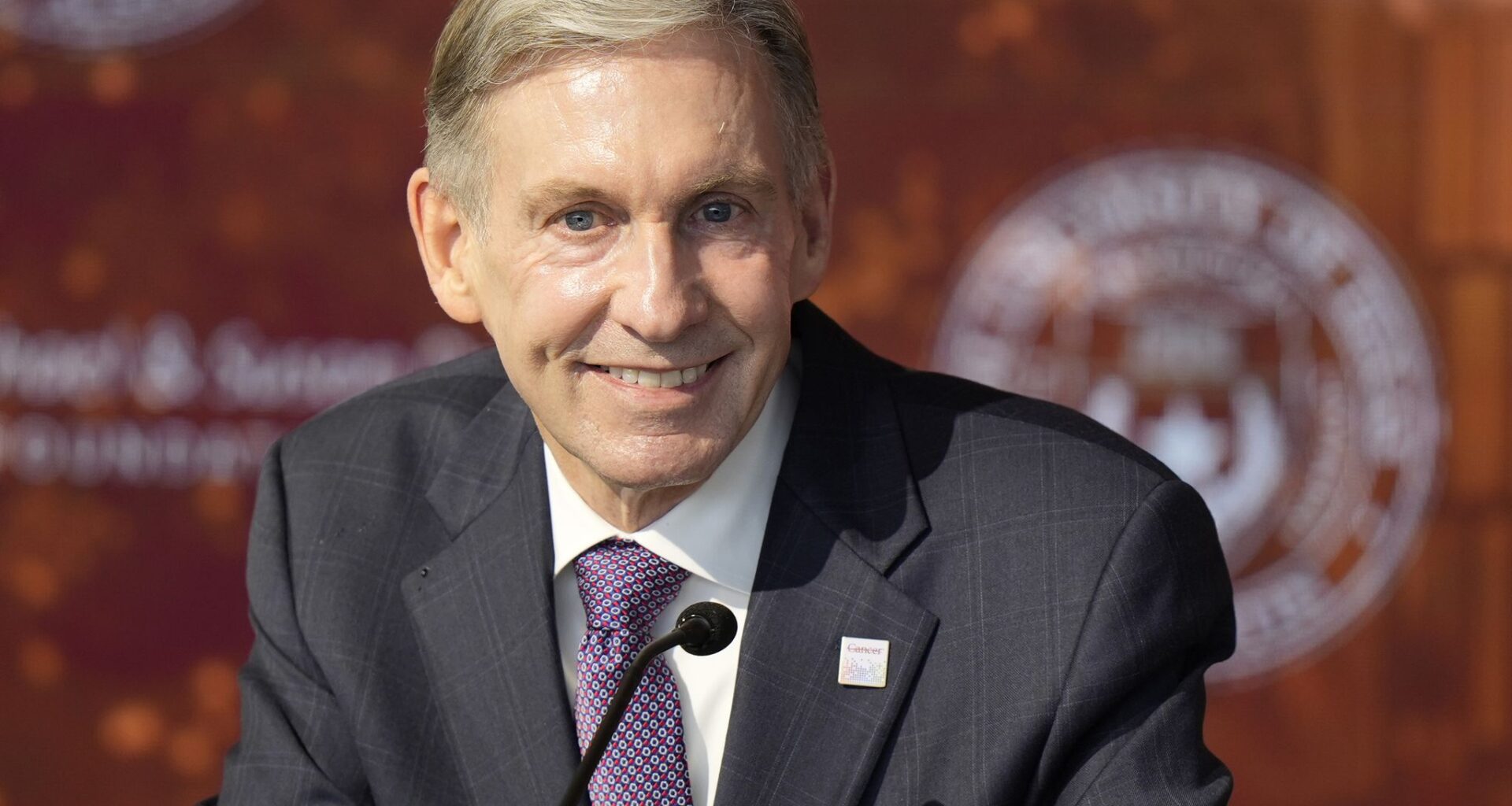
Dr. Peter Pisters, President of UT MD Anderson, speaks at an event where Michael and Susan Dell announced a gift at the West Pickle Research Campus in Austin on Tuesday, April 21, 2026.
Jay Janner/Austin American-Statesman
Dr. Peter Pisters, the longtime president of The University of Texas MD Anderson Cancer Center, is retiring from his post at the end of September, he announced Wednesday.
Pisters, 66, has been president of the elite cancer hospital since 2017. He spent much of his career there as a surgery professor and researcher, focusing on malignancies such as sarcomas and gastrointestinal cancers.
Dr. Jeffrey Lee, executive vice president and chief physician executive, has been named interim president. Pisters’ last day is Sept. 30.
Article continues below this ad
READ MORE: MD Anderson opens colorectal cancer clinic amid rising young adult cases
Pisters said in an interview with the Houston Chronicle that he had been considering retirement for “a while.” He said he wanted to step down as president at a time when the hospital is on “strong and stable footing,” noting that MD Anderson recently reported the strongest financial performance in its 85-year history.
“I’m really proud of what we’ve accomplished, and I think that this is the ideal time,” Pisters said.
MD Anderson has maintained its reputation as one of the world’s leading cancer hospitals throughout Pisters’ tenure as president. He has also been overseeing a $10 billion capital expansion project that will eventually include new facilities in the Texas Medical Center, Houston suburbs and Austin.
Article continues below this ad
MD Anderson said in the news release that Pisters is retiring to “focus on the next chapter of his career.” Pisters told the Chronicle that he does not have another job lined up, and that he will take some time off to consider his options.
“I want to take a little bit of time and do so with the freedom of a calendar that gives me the flexibility to engage in deep thinking,” he said.
Pisters was set to receive a nearly 30% raise in fiscal year 2026, which starts in September, according to state Legislative Budget Board documents. He was budgeted to receive $5.1 million in total compensation in fiscal year 2026, up from $3.9 million in 2025, budget documents show.
Pisters told UT System Chancellor John M. Zerwas several weeks ago that he planned to retire, Zerwas said in a message to MD Anderson employees that the hospital shared with the Houston Chronicle. Zerwas thanked Pisters for his leadership and for putting the hospital in position to continue to thrive moving forward.
“Great leaders leave their institutions on a new plateau for exciting opportunities ahead,” Zerwas said in the message. “That’s what President Pisters has done.”
Article continues below this ad
MD Anderson Cancer Center is seen, Wednesday, Feb. 7, 2024, in Houston.
Jason Fochtman/Staff photographer
Longtime tenure at MD Anderson
Pisters, who grew up in Canada, first joined MD Anderson in 1994 as an instructor in the department of surgical oncology.
He spent the next two decades rising through the ranks at the hospital, eventually becoming a clinical consultant for its Center for Global Oncology and then medical director of its regional care centers. He departed in 2014 to become president of University Health Network in Toronto.
READ MORE: Houston Methodist, MD Anderson lead Houston hospitals in new U.S. News rankings
Article continues below this ad
Pisters returned to Houston three years later when he was hired as president of MD Anderson. He succeeded Dr. Ron DePinho, who was forced out after years of turmoil that culminated in financial losses and layoffs.
MD Anderson’s finances began improving just before Pisters took over as president, and the hospital has continued to grow under his leadership. MD Anderson has launched five institutes during his tenure, and last year it launched a $2.5 billion philanthropic campaign that has already raised $2.16 billion.
The hospital has also maintained its reputation as one of the world’s leading cancer centers. U.S. News & World Report recently ranked MD Anderson as the nation’s best hospital for cancer care for the 12th consecutive year.
Pisters told the Chronicle that he was particularly proud of how MD Anderson’s culture has evolved during his tenure as president, and he credits each of the hospital’s 27,000 employees for that change. He pointed to a steep decline in serious safety incidents in recent years, as well as the hospital’s strong financial performance.
“That’s not one person’s track record. That’s really everyone,” Pisters said.
Article continues below this ad
Dr. Jeffrey Lee has been named interim president of the University of Texas MD Anderson Cancer Center.
Courtesy MD Anderson Cancer Center
MD Anderson’s interim leader
Lee, 69, joined the MD Anderson faculty in 1993 after completing a surgical oncology fellowship at the hospital. He has held a series of leadership roles at MD Anderson over the past two decades and was named executive vice president and chief physician executive in 2025.
Lee, an experienced researcher and surgical oncologist, currently oversees MD Anderson’s clinical divisions, its national cancer network and its relationships with international governmental and non-governmental organizations, the hospital said in the news release.
READ MORE: MD Anderson publicly announces $2.5 billion ‘Only Possible Here, The Campaign to End Cancer’
“Continuing Dr. Pisters’ exceptional legacy of leadership at this institution, where I have spent my entire career, will be among the greatest honors of my professional life,” Lee said in the news release. “I have been privileged to work alongside extraordinary teams and leaders, united by a shared commitment to providing and advancing the very best care for cancer patients.”
Pisters lauded Lee’s selection as interim president, saying that he has developed a close friendship with Lee over the years while working alongside him in operating rooms and administrative roles.
“This choice really represents a thoughtful choice, enables a smooth and seamless handoff to somebody that I have the utmost trust in,” Pisters said.