
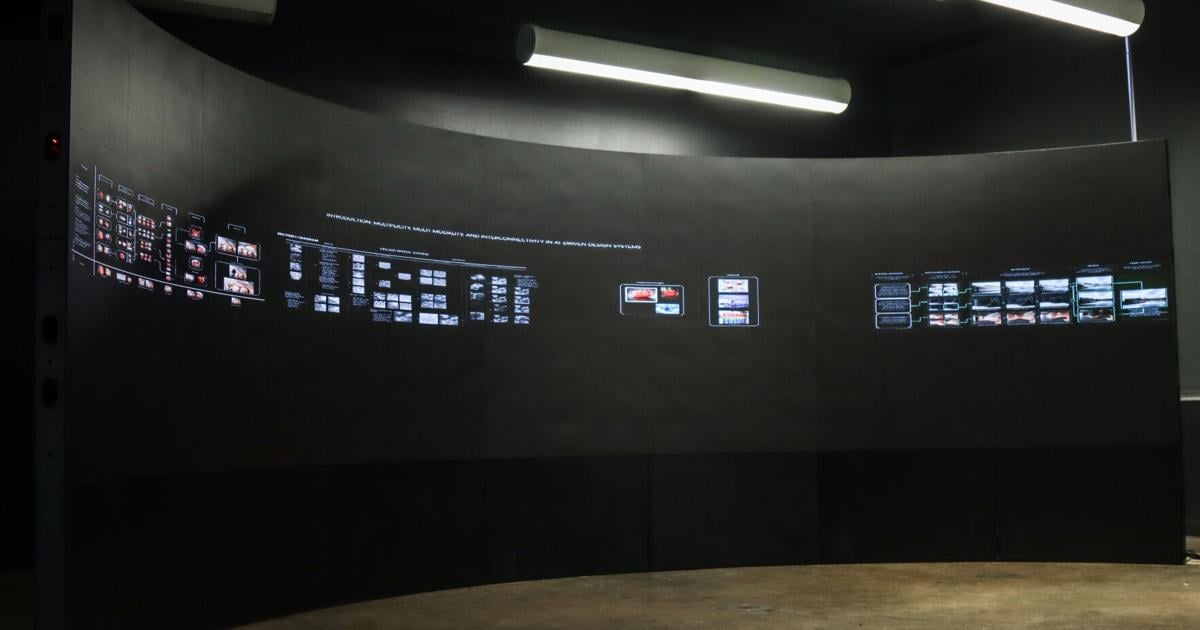

The Performative AI Lab LED screen displays a slideshow of student work Aug. 24 in the CAPPA Building. The screen is roughly 29 ½ feet wide and 6 ½ feet tall.
Architecture graduate student Melisa Ayala couldn’t hold back her excitement about the new Performative AI Lab, a new lab integrating architectural design, artificial intelligence and robotics in the College of Architecture, Planning and Public Affairs.
“I remember those sci-fi movies in the future where it’s not really possible until 50 years ahead,” Ayala said. “When it’s just happening right now, it’s just incredible.”
On Aug. 17, students were able to step into an era of innovation for UTA with the first class that was held in the lab.
The lab houses an LED screen, roughly 29 ½ feet long and 6 ½ feet tall, on which students will show models of their designs. These models will be made with multiple types of AI and will be used in place of posters to exhibit their projects, according to previous Shorthorn reporting.
Shermeen Yousif, director of the lab, said she hopes the screen will allow students to view their creations in a more immersive way.
“You can see the 3D of the building. You can enter the building,” she said in a July 22 interview. “You can have this immersive environment, and that’s hard to communicate in a still image, in a poster.”
The lab also includes a robotic arm with an interchangeable tip that allows it to grab, scan or print items on six different axes, according to previous Shorthorn reporting.
“You can mount some other end effectors, which means you open possibility for different interdisciplinary research to happen, and you can always reflect that in a bigger screen, and then you have this visualization process,” Yousif said.
Pairing the robotic arm with the LED screen will allow students to further explore architectural models made with AI, she said.
David Franco, director of the School of Architecture, said he wanted the space to be visible and welcoming for students and professors, so the lab is in the heart of the CAPPA Building.
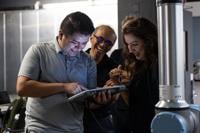
Architecture graduate student Alfredo Trejo smiles at a device in the Performative AI Lab on Aug. 26 in the CAPPA Building. Trejo said the lab’s robotic arm will eventually have a camera to scan models.
“It’s meant to be really a resource for all the college and all the school,” Franco said.
Yousif described her own excitement as overwhelming.
“I’m unable to sleep as much because I’m too excited,” she said. “This is the happiest week.”
Yousif ensures her students input only their own information or cite any outside inspiration for their designs, according to previous Shorthorn reporting.
Architecture graduate student Katherine Isakson said Yousif makes sure her students are given the right tools to ethically use AI in their designs.
“She really advocates for a designer’s agency and having some control and authorship over what you’re creating and how those tools can support it,” Isakson said.
Franco said he viewed AI as a tool that users should be careful while using.
“This is so new and is moving so fast that we really need to be careful on how to integrate it to our intellect and our way of thinking about architecture,” Franco said.
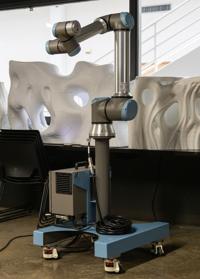
A robotic arm stands inside the Performative AI Lab on Aug. 26 in the CAPPA Building. The arm has an interchangeable tip, which will allow it to grab, scan or print items on six different axes.
Alaya, having experienced Yousif’s AI teachings, said she was amazed at how AI could change the way she designs.
“It was like a whole world just opened for us students to visualize how our models can really develop and really have a positive effect in the world,” she said.
Yousif showed pride in the excitement her students had for the new space.
Her hopes for the new lab giving students more creative freedom didn’t stop at the designing stage but included showcasing their work, as well, she said.
“This is the first time they see the work presented in a way that is actually equivalent to the level that they put,” Yousif said.
Yousif wasn’t the only one who was proud of the innovation CAPPA has welcomed to campus.
“It’s really pushing performative AI and architecture in a direction where you’re working in tandem with each other,” Isakson said.
Franco said he hopes the lab will create a dialogue between the School of Architecture and other colleges at UTA about integrating AI into higher education.
“What’s really cool about architecture is that it has a little bit of everything,” Franco said. “So maybe this is a way in which we put ourselves in the middle of the conversations and the debates about AI.”
Though the lab is just nearing completion, Yousif couldn’t help but look to what was next.
“The plan for me is to start really a rigorous process towards external funding and visibility to UTA,” Yousif said.
Franco, focusing more on the present, talked about the changes that have come to UTA as the campus continues to grow. He said he feels CAPPA’s growth is being shown in the quality and quantity of students enrolling each year.
“This comes in the perfect moment,” Franco said. “To be very well known and recognized in the campus but also to position ourselves nationally as a place of reference for architecture in AI.”
@noah_logan_little