
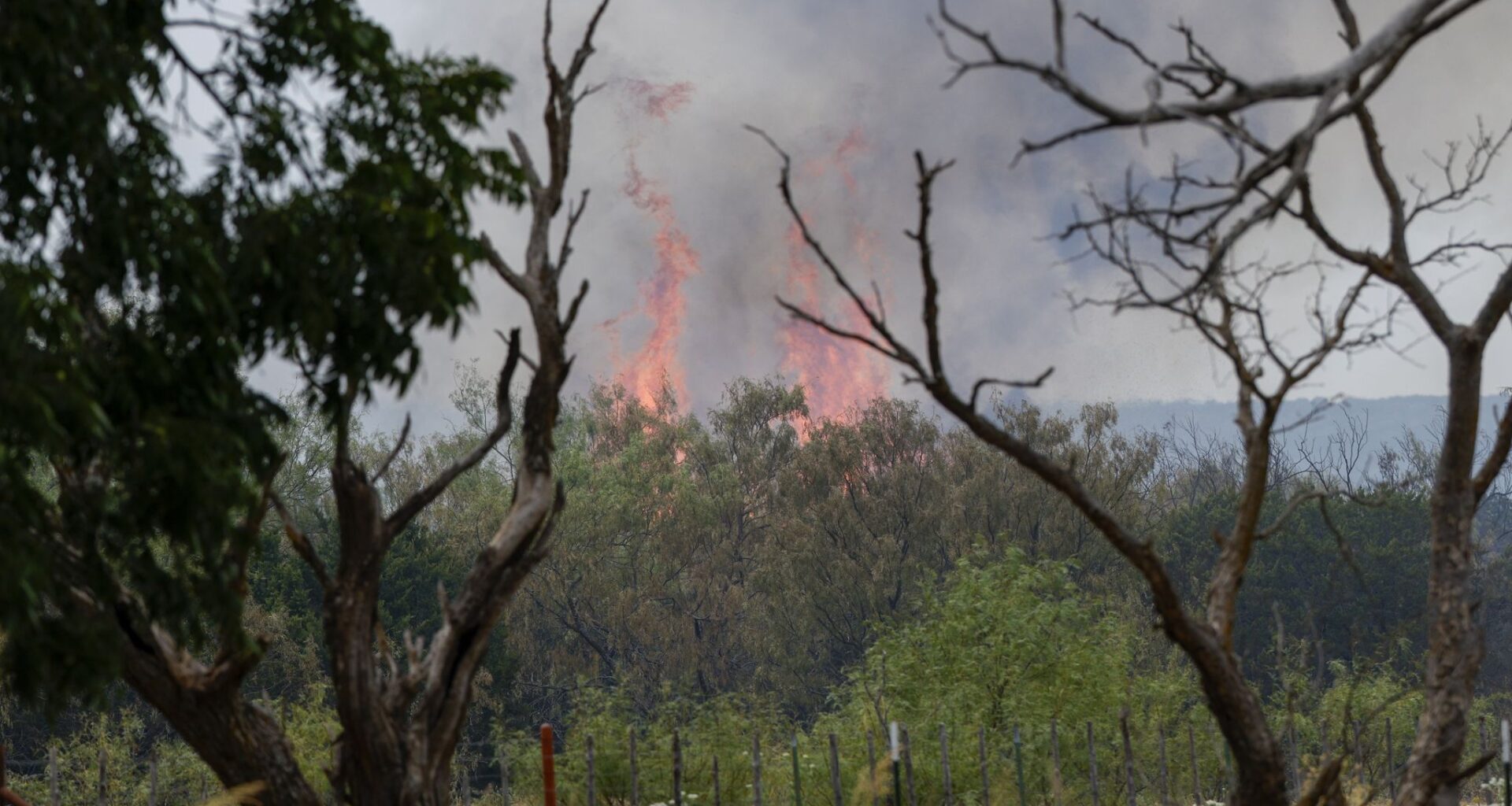
Flames from the Ross fire shoot into the air, Wednesday, Aug. 26, 2026, near Palo Pinto, Texas.
Elías Valverde II/The Dallas Morning News
When a grass fire overwhelms a local department in the Panhandle or an East Texas landowner needs help managing pine timber, the same state agency can provide assistance.

Texas A&M Forest Service is the state’s lead agency for forest conservation and wildfire response. Based in College Station, it operates within the Texas A&M University System.
Despite its name, the agency does not manage national forests, nor is it a statewide fire department. Its mission combines two responsibilities: sustaining Texas forests and helping protect people and property from wildfires and other disasters.
Article continues below this ad
Agency foresters develop management plans, distribute seedlings and monitor insects and diseases. Its wildfire personnel help local departments contain fires that exceed local capabilities. The agency also provides grants, equipment and training to volunteer fire departments, which often provide the first response to rural wildfires.
Laura Stevens, an agency public information officer, said its work ranges from statewide disaster response to forest management and assistance for landowners and communities. Its programs include grants and technical help addressing threats such as emerald ash borer and oak wilt.
Related: Palo Pinto’s Ross fire holds at 80,000 acres as crews make gains in cooler weather
Created to protect Texas forests
Texas A&M Forest Service traces its history to conservationist W. Goodrich Jones’ campaign for a state forester and conservation plan. In 1915, lawmakers created the Department of Forestry, which later became Texas Forest Service before adopting its current name.
Article continues below this ad
Texas was the first state to place its forestry agency within a land-grant college, according to Texas A&M Forest Service. That arrangement allows the agency to extend research and technical expertise to landowners, communities and fire departments.
Wildfire coordination formally joined its mission in 1993, when lawmakers directed the agency to coordinate responses to every major or potentially major wildland fire in Texas.
Most Texas forests are privately owned
Texas has about 59 million acres of forestland, more than any state except Alaska, according to Texas A&M Forest Service. About 93% is privately owned.
Article continues below this ad
The state’s forests range from commercial pine timberlands in East Texas and the Cross Timbers in North Texas to mesquite, juniper and mountain woodlands farther west.
Because most forestland belongs to individuals, families and companies, the agency primarily provides voluntary technical assistance, planning and financial incentives. Foresters can help landowners decide when to plant, thin or harvest trees, conduct prescribed burns and control destructive insects or diseases.
In 2025, the agency distributed more than 67,000 seedlings and prepared 998 forest-management plans covering more than 101,000 acres, according to its annual report. It also reported assisting more than 209,000 landowners with tree care, forest health or stewardship.
The forest sector generated an estimated $54.2 billion in economic activity and supported more than 187,000 jobs in 2024, according to an agency analysis. Most commercial timber production is concentrated in East Texas.
Related: What to know about the Texas wildfires burning thousands of acres
Article continues below this ad
Local departments respond first
Texas A&M Forest Service does not send state crews to every report of smoke.
A wildfire reported through 911 is initially handled by the paid or volunteer fire department serving that jurisdiction, including departments operated by emergency services districts, Stevens said. If the department needs help, it generally requests mutual aid from neighboring departments.
If those resources are insufficient, the department can request Texas A&M Forest Service assistance through one of the agency’s regional fire coordinators, Stevens said. The agency can then provide or coordinate firefighters, bulldozers, engines and aircraft from local, state and federal agencies.
Responders use the Incident Command System to establish a command structure, set common objectives and assign responsibilities among participating agencies. Local authorities generally issue evacuation orders and make other public-safety decisions within their jurisdictions.
Article continues below this ad
The agency also supports local departments before fires begin by awarding grants for fire engines, protective equipment and training. Much of that assistance goes to volunteer departments serving rural communities with limited tax bases.
In October 2025, Texas A&M Forest Service approved $164 million for 558 fire trucks and 321 slip-on firefighting units. The portable units contain a water tank, pump and hose and can be mounted on a pickup or similar vehicle. The record funding addressed previously unfunded equipment requests from volunteer fire departments, according to the agency.
Related: Loving animal sanctuary begins evacuating more than 50 animals as Ross fire burns nearby
Fire seasons can change dramatically
Wildfire activity can swing sharply depending on drought, rainfall, wind and the amount of dry vegetation available to burn.
Article continues below this ad
Texas A&M Forest Service reports put the acreage burned in 2025 at roughly 130,000, about one-tenth of the more than 1.3 million acres burned a year earlier. The agency described 2025 as a below-average year for wildfire activity.
The Smokehouse Creek fire alone burned more than 1 million acres in 2024, accounting for about four-fifths of the statewide total. It was the largest wildfire documented in Texas history.
The comparison illustrates why the number of fires alone does not describe a season’s severity. Location, weather, rate of spread and proximity to communities can matter more than the number of ignitions.
The agency can also help coordinate responses to floods, hurricanes and other disasters under the State Emergency Management Plan. Through the Texas Intrastate Fire Mutual Aid System, commonly known as TIFMAS, it helps mobilize local firefighters and equipment for incidents across the state.
Related: Smoke from Palo Pinto’s Ross fire worsens air quality for D-FW
Texas is building an aviation fleet
Aircraft are becoming a larger part of the state’s wildfire response.
Texas has historically depended largely on contracted aircraft, National Guard helicopters and planes obtained through federal resource-sharing agreements. Nationally shared aircraft can be reassigned when higher-priority fires develop elsewhere, according to Texas A&M Forest Service.
Lawmakers approved $257 million in 2025 for the agency to purchase, operate and maintain wildfire-suppression aircraft. The money was part of approximately $630 million in new funding above the agency’s base budget over two fiscal years.
In July 2026, Texas A&M Forest Service purchased two Subaru Bell 412EPX helicopters and acquired three fixed-wing multipurpose aircraft. The agency said the first helicopter was expected to be delivered in December 2027, with the second following three to six months later. As of July 24, 2026, four large air tankers remained in the state procurement process.
The multipurpose aircraft are intended to provide near-real-time video, mapping, heat detection and other information to help fire managers track fires and coordinate ground and air resources. The helicopters will be equipped to deliver water, protect structures and reach rugged terrain.
The agency has said federal resource-sharing agreements and its partnership with the Texas Military Department will continue as Texas develops its state-managed fleet.
From historic trees to criminal investigations
Texas A&M Forest Service manages five state forests and two arboretums. The forests demonstrate practices such as thinning, habitat restoration and prescribed burning.
The agency also documents historically significant trees through Famous Trees of Texas and recognizes the largest known specimen of each species through the Texas Big Tree Registry. Its urban foresters advise communities about tree canopies, storm damage and disease.
Agency law-enforcement officers assist with wildfire origin-and-cause investigations and investigate suspected wildland arson and timber theft.
Homeowners can use the Texas Wildfire Risk Assessment Portal to examine potential hazards. Landowners can contact a regional office for forestry assistance, while fire departments can apply for equipment and training grants.
Those responsibilities continue when wildfire activity slows. In a state where most forests are privately owned and many rural fire departments depend on volunteers, Texas A&M Forest Service’s year-round role is to help keep the land and its responders prepared.