
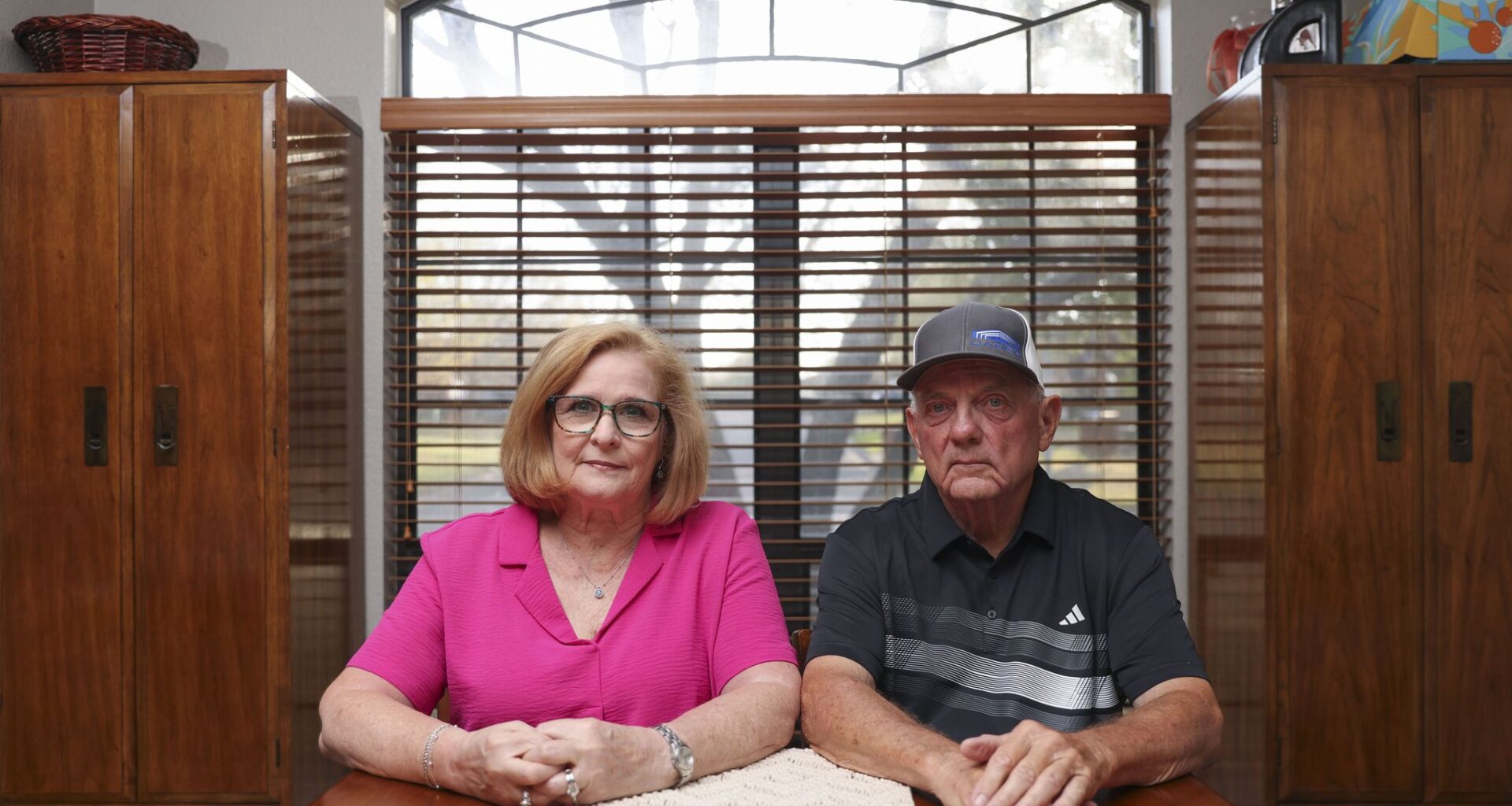
Barry Marshall, who unsuccessfully sued Dallas County Judge Clay Lewis Jenkins’ law firm for illegal solicitation, poses for a portrait with his wife Susan Gray-Frank, on Wednesday, March 26, 2025 in Stephenville. A jury on Thursday found the firm and its lead generator not liable.
Shafkat Anowar/Staff Photographer
STEPHENVILLE — Neither Loncar Lyon Jenkins nor its lead generator illegally solicited a retiree through a phone call where the law firm discussed representing him after a crash that totaled his truck, an Erath County jury concluded on Thursday.

Records show a now-disconnected number called Barry Marshall two days after the April 2024 accident before he was transferred to a representative at the law firm owned by Dallas County Judge Clay Lewis Jenkins and former state Sen. Ted Lyon.
Defense attorneys argued Marshall clicked an online link to request the call from a now-defunct legal and emergency aid website, which then transferred him to Loncar Lyon Jenkins’ lead generation screener, who then sent the call to the law firm. The defense team said his invitation of the referral negated any claim of barratry and the law firm and its lead generator had no connection to the website that made the call.
Article continues below this ad
“This is a resounding victory and vindication that Loncar Lyon Jenkins did nothing wrong,” Ryan Taylor, an attorney representing the firm said after the trial.
The jury reached its verdict after about 25 minutes of deliberation. The four-day trial was an uncommon courtroom dissection of barratry, which legal experts say is rampant across Texas but difficult to prove. Allegations rarely reach a civil or criminal jury.
Tom Carse, Marshall’s attorney, told the jury it was the law firm’s lead generation company, owned by Hollywood producer Robert Paschall, that called the crash victim without his consent. He pointed to the call transcript, which is incomplete and begins with Paschall’s screener Elle Hart thanking Marshall for holding before sending him to Loncar Lyon Jenkins.
The law firm emailed him a contract minutes later, which he did not sign.
Carse said the liftyouup.org intake form Paschall obtained from the website to confirm Marshall clicked a link and provided his cell number was “a fiction” because it has no authentication or metadata proving it to be real.
Article continues below this ad
“Where in this document does Barry Marshall say ‘I want somebody to contact me and talk to me about a lawyer?’ It’s not there,” Carse said.
In an interview after the trial, Carse said he believes liftyouup.org was created by Paschall to put degrees of separation between the contact with the crash victim and the law firm’s lead generator — but he said he could not obtain the evidence to connect those dots to the jury.
Paschall said there’s no truth to that: “I’m glad the jury saw what we’ve been seeing.”
Susan Gray-Frank shows a photo of the wreck that totaled her husband Barry Marshall’s truck last year, Wednesday, March 26, 2025 in Stephenville. Marshall unsuccessfully sued Dallas County Judge Clay Lewis Jenkins’ law firm for illegal solicitation, or barratry. A jury on Thursday found the firm not liable.
Shafkat Anowar/Staff Photographer
It’s illegal for attorneys or their intermediaries to contact a crash victim within 31 days of an accident to drum up their business. But law firms may hire lead generators to bring them potential clients who are seeking legal help.
Article continues below this ad
The state ethics commission has not issued guidance for attorneys on these referral services in 20 years, and since then social media has unlocked lead generation tactics that get entangled in allegations of barratry.
Marshall, 77, a retired welder, testified he did not click any link or ask anybody to call him on April 11, 2024 to refer him to an attorney.
The initial lawsuit Carse filed in June 2024 included Marshall’s wife as a plaintiff because she alleged she also received a solicitation call after the crash. Susan Gray-Frank was not in the accident but her name was on the truck’s title.
Her affidavit states she got a call from a man named Sean from liftyouup.org who offered to help get a larger insurance payout before she declined and hung up. Court filings included a screenshot of a text she received with a link to the website.
By the time the case got to trial this week, Erath County District Court Judge Jason Cashon had dismissed her from the complaint and the text message was not brought up in court. Cashon dismissed Paschall as an individual defendant during the trial but kept the law firm and Paschall’s lead generation business.
Article continues below this ad
Marshall’s affidavit also states he got a call two days after his crash from liftyouup.org. But while testifying this week, the Vietnam War veteran said he did not remember who exactly called him.
“That’s a 22-minute phone call he could have hung up on at any point in time but he clicked and asked to receive that information and that’s why he stayed on the phone,” Mark Torian, an attorney representing the law firm’s lead generator, told the jury. “That’s him reaching out for it, that’s not solicitation.”
It’s not clear when liftyouup.org transferred Marshall to Hart, Paschall’s screener, because there is no audio or transcript of that portion. But Paschall confirmed that five minutes into the call Hart emailed Marshall a copy of his crash report from the Texas Department of Transportation. Marshall testified he didn’t know she did so until after the call.
Asked during a deposition in 2024 why liftyouup.org would send his lead generation business a free lead when he has no connection to the website, Paschall said “I have no idea.”
On Tuesday Paschall told the jury he learned last week Sean already had Hart’s phone number to send her Marshall’s call because the two had known each other for years.
Article continues below this ad
Paschall told the jury he produces advertisements for law firms through targeted marketing on social media and Google.
After Marshall declined to sign the contract with Loncar Lyon Jenkins, Gray-Frank said she talked with an attorney trusted by a colleague. Frenkel & Frenkel then referred the couple to Carse for a potential barratry claim.
Carse lost a similar barratry lawsuit earlier this year against Paschall and Loncar Lyon Jenkins in Smith County. At least two others he filed against them in the past few years were dropped while one remains pending.
In court filings, attorneys representing the law firm have accused Carse of filing frivolous barratry lawsuits as “an extortive money grab,” which he denies.
Article continues below this ad
During closing statements, Carse said the law firm and lead generator preyed on Marshall while Taylor pointed to Carse as the predator.