
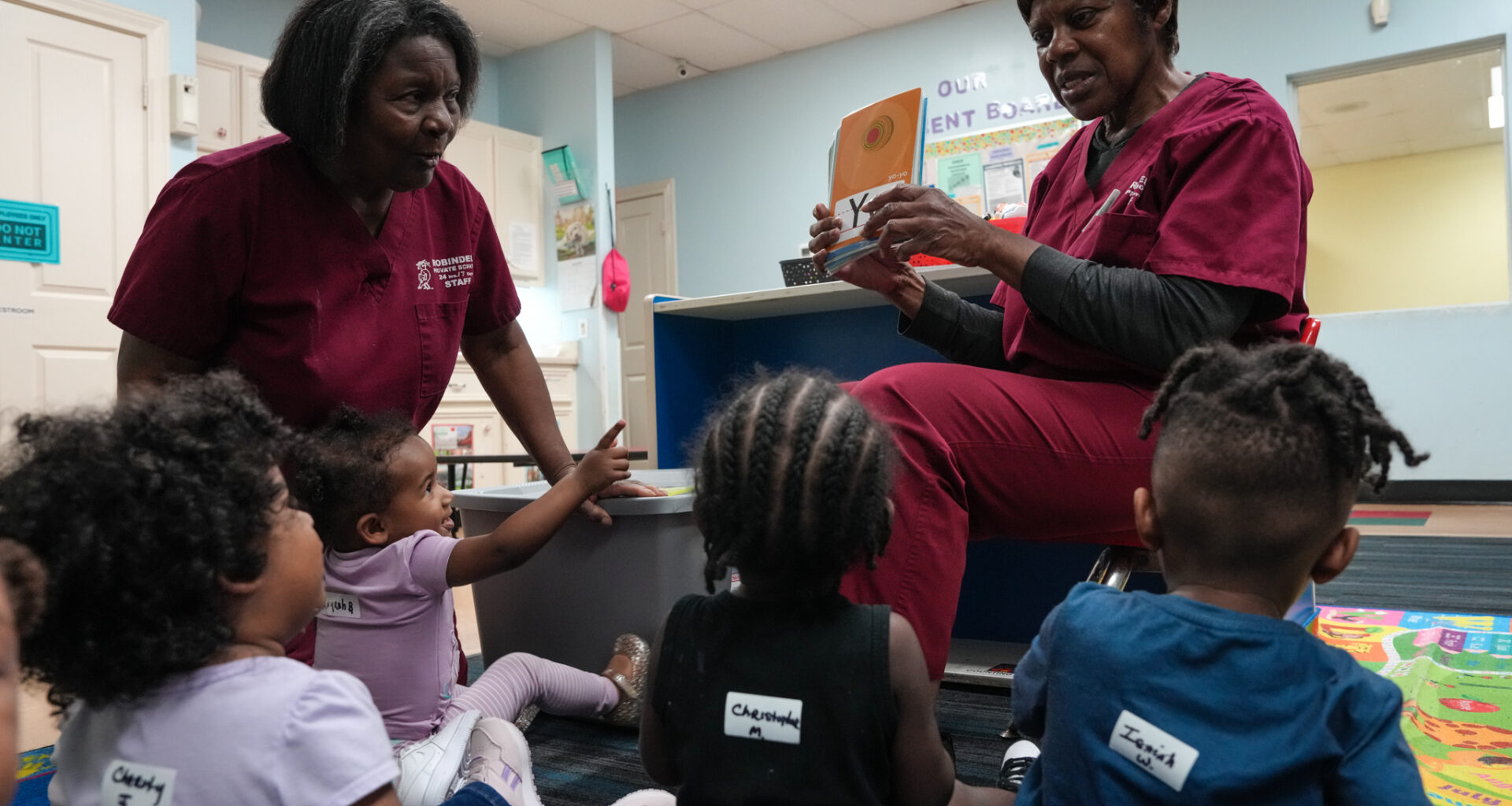
Caretakers go through vocabulary words with children at Robindell Private School, a 24/7 childcare center, in Houston, Thursday, July 30, 2026.
Jacob Lujan/Houston Chronicle
School vouchers
Regarding “25K Texas school voucher recipients opted out. Here’s why.” (Aug. 24): Gov. Greg Abbott’s golden egg, the school voucher system, has turned out to be rotten eggs. Nearly 25,000 voucher recipients did not use their vouchers; most students were from public schools. The reasons for returning the voucher are exactly what critics warned about: the total private school tuition was far beyond the voucher amount and there was a lack of private schools close to where they lived.
Plus, private schools that catered to special needs students had limited seating, and the tuition far exceeded the max $30,000 allotted. So, in the end, the voucher program hasn’t helped all the students Abbott claimed would benefit. It seems like it helped the families who had previously opted to pay for private school rather than attend public school.
Article continues below this ad
Change
Regarding “TEA tells HISD to meet with families before special education overhaul,” (July 24): As a Houston-based, doctorate-level and board-certified behavior analyst specializing in autism, I appreciate the Texas Education Agency’s directive requiring the Houston Independent School District to review students’ Individualized Education Programs and meet individually with families before moving students receiving special education services to new campuses.
For many autistic students, a change in placement is not simply a change of address. A new campus may mean different teachers, peers, transportation, routines, sensory environments, communication partners and behavioral supports.
When these variables change abruptly, some students may experience increased school refusal, elopement, aggression, emotional distress, communication difficulties or regression in previously acquired skills. These behaviors should not automatically be viewed as noncompliance; they may communicate that a student is struggling to adapt.
Article continues below this ad
Individualized transition planning should therefore consider not only where a student will receive services, but how that student will successfully transition to the new environment.
Families should be meaningful participants in that process. They often know which routines, supports, communication strategies and environmental conditions help their child succeed.
When we say special education should be individualized, that principle should apply to transitions, too.
Tranika Jefferson, Houston
Book bans
Regarding “Why Dan Patrick wants to punish schools over books,” (Aug. 22): So Lt. Gov. Dan Patrick has threatened to effectively downgrade school ratings based upon his personal assessment of the merits of books in a school library. While we could debate the subjective worth of any given book ad nauseam, why on earth would this be a factor in determining a school’s grade?
Article continues below this ad
These grades are, ostensibly, based upon objective scores resulting from standardized testing as outlined by the state. Holding these ratings hostage based upon subjective opinions of book content is yet another example of Patrick’s governance by temper tantrum.
Randy Richard, San Marcos
Underground data centers
Regarding “Inside Amazon’s nearly 3,000-acre data center project near Houston,” (Aug. 14): I wonder if any thought has been given to the placement of data centers underground? A lot of site work already goes into building a data center, and burying the facility would probably entail a somewhat greater expense. However, much of the opposition in rural communities might be mitigated if the surface property could still be cultivated or preserved as a wildlife refuge, and the emitted sound could be somewhat muffled. Use of electricity might be lessened due to the reduced demand for air conditioning since the facility would be surrounded by insulation.
Article continues below this ad
I’ve heard much talk about burying electrical lines in the city for beautification purposes, but no talk (that I know of) about burying data centers, which seems to my mind more practical and could mitigate quality of life issues. We need the data centers, but at what cost?