
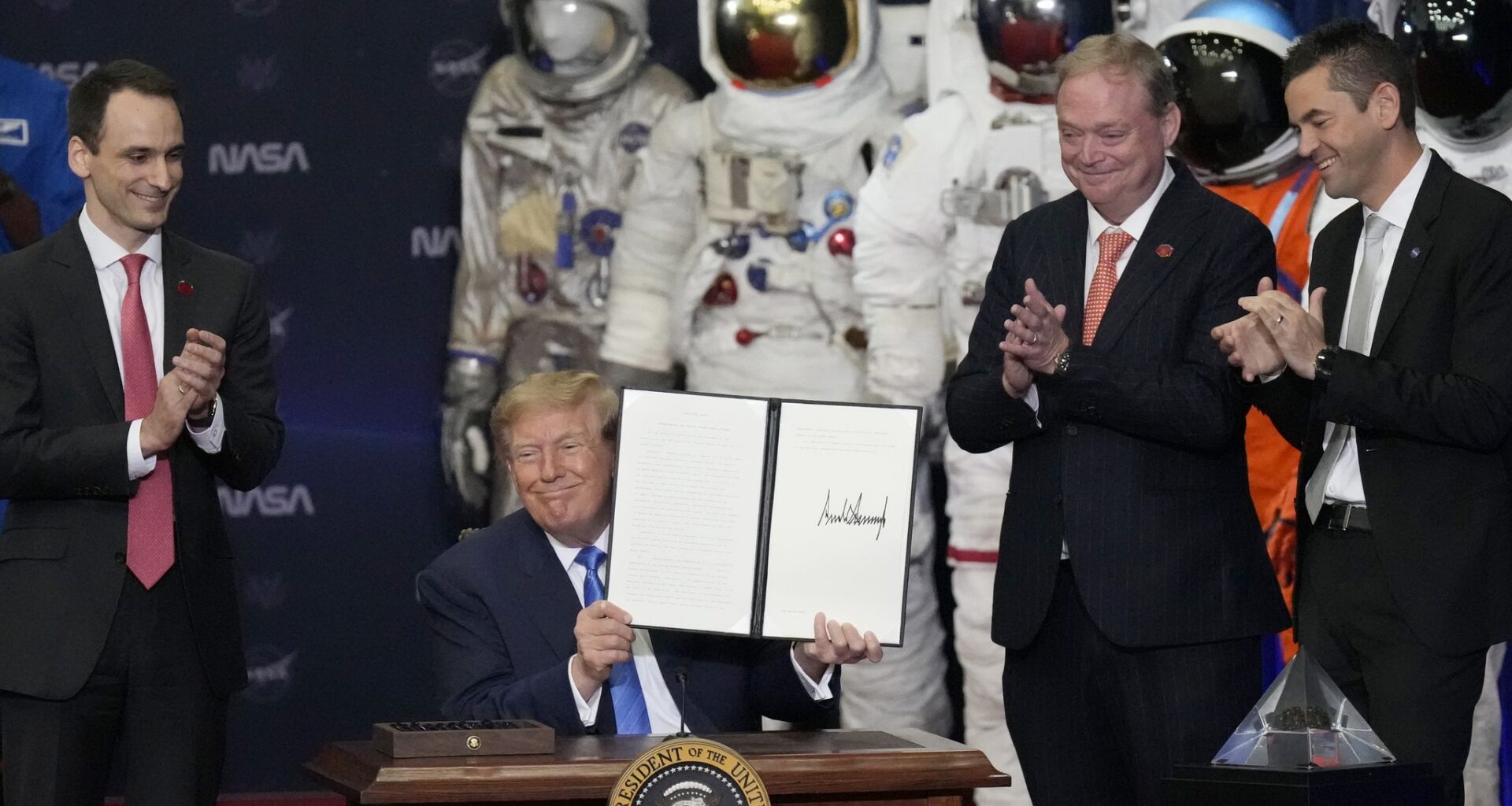
President Donald Trump signs an executive order to begin creating a U.S. Space Academy during the Congressional Space Medal of Honor ceremony at NASA’s Johnson Space Center in Houston on Friday, Aug. 28, 2026. Shown from left are Michael Kratsios, national science and technology adviser; Kevin Hassett, director of the National Economic Council; and NASA Administrator Jared Isaacman.
Melissa Phillip/Houston Chronicle
President Donald Trump takes the stage during the Congressional Space Medal of Honor ceremony at NASA’s Johnson Space Center in Houston on Friday, Aug. 28, 2026. Trump awarded the Congressional Space Medal of Honor to Artemis II astronauts Reid Wiseman, Victor Glover, Christina Koch and Jeremy Hansen.
Melissa Phillip/Houston Chronicle
Artemis II crew members Jeremy Hansen, left, Christina Koch, Victor Glover, and Reid Wiseman, right, take the stage during the Congressional Space Medal of Honor ceremony at NASA’s Johnson Space Center in Houston Friday, Aug. 28, 2026. President Donald Trump will award the Congressional Space Medal of Honor to the Artemis II astronauts.
Melissa Phillip/Houston Chronicle
President Donald Trump signed an executive order to begin creating a U.S. Space Academy during the Congressional Space Medal of Honor ceremony at NASA’s Johnson Space Center in Houston Friday, Aug. 28, 2026.
Melissa Phillip/Houston Chronicle
President Donald Trump takes the stage during the Congressional Space Medal of Honor ceremony at NASA’s Johnson Space Center in Houston on Friday, Aug. 28, 2026. Trump awarded the Congressional Space Medal of Honor to Artemis II astronauts Reid Wiseman, Victor Glover, Christina Koch and Jeremy Hansen.
Melissa Phillip/Houston Chronicle
Harrison “Jack” Schmitt, Apollo NASA astronaut, throws a moon ball to the audience as he speaks during the Congressional Space Medal of Honor ceremony at NASA’s Johnson Space Center in Houston Friday, Aug. 28, 2026. President Donald Trump will award the Congressional Space Medal of Honor to the Artemis II astronauts Reid Wiseman, Victor Glover, Christina Koch and Jeremy Hansen.
Melissa Phillip/Houston Chronicle
NASA Astronaut Corps take the stage during the Congressional Space Medal of Honor ceremony at NASA’s Johnson Space Center in Houston Friday, Aug. 28, 2026. President Donald Trump will award the Congressional Space Medal of Honor to the Artemis II astronauts Reid Wiseman, Victor Glover, Christina Koch and Jeremy Hansen.
Melissa Phillip/Houston Chronicle
NASA Astronaut Corps take the stage during the Congressional Space Medal of Honor ceremony at NASA’s Johnson Space Center in Houston Friday, Aug. 28, 2026. President Donald Trump will award the Congressional Space Medal of Honor to the Artemis II astronauts Reid Wiseman, Victor Glover, Christina Koch and Jeremy Hansen.
Melissa Phillip/Houston Chronicle
U.S. Senator Ted Cruz speaks during the Congressional Space Medal of Honor ceremony at NASA’s Johnson Space Center in Houston Friday, Aug. 28, 2026. President Donald Trump will award the Congressional Space Medal of Honor to the Artemis II astronauts Reid Wiseman, Victor Glover, Christina Koch and Jeremy Hansen.
Melissa Phillip/Houston Chronicle
U.S. Congressman Brian Babin speaks during the Congressional Space Medal of Honor ceremony at NASA’s Johnson Space Center in Houston Friday, Aug. 28, 2026. President Donald Trump will award the Congressional Space Medal of Honor to the Artemis II astronauts Reid Wiseman, Victor Glover, Christina Koch and Jeremy Hansen.
Melissa Phillip/Houston Chronicle
Harrison “Jack” Schmitt, Apollo NASA astronaut, speaks during the Congressional Space Medal of Honor ceremony at NASA’s Johnson Space Center in Houston Friday, Aug. 28, 2026. President Donald Trump will award the Congressional Space Medal of Honor to the Artemis II astronauts Reid Wiseman, Victor Glover, Christina Koch and Jeremy Hansen.
Melissa Phillip/Houston Chronicle
Artemis II crew members Jeremy Hansen, left, Christina Koch, Victor Glover, and Reid Wiseman, right, take the stage during the Congressional Space Medal of Honor ceremony at NASA’s Johnson Space Center in Houston Friday, Aug. 28, 2026. President Donald Trump will award the Congressional Space Medal of Honor to the Artemis II astronauts.
Melissa Phillip/Houston Chronicle
People prepare for the Congressional Space Medal of Honor ceremony at NASA’s Johnson Space Center in Houston Friday, Aug. 28, 2026. President Donald Trump will award the Artemis II crew the Congressional Space Medal of Honor to astronauts Reid Wiseman, Victor Glover, Christina Koch and Jeremy Hansen.
Melissa Phillip/Houston Chronicle
President Donald Trump arrives on Air Force One at Ellington Field Joint Reserve Base in Houston on Thursday, Aug. 27, 2026. President Trump is spending two days in Houston attending a fundraiser and an event at NASA.
Elizabeth Conley/Houston Chronicle
Air Force One taxis on the runway at Ellington Field Joint Reserve Base in Houston on Thursday, Aug. 27, 2026. President Trump is spending two days in Houston attending a fundraiser and an event at NASA.
Elizabeth Conley/Houston Chronicle
President Donald Trump arrives on Air Force One at Ellington Field Joint Reserve Base in Houston on Thursday, Aug. 27, 2026. President Trump is spending two days in Houston attending a fundraiser and an event at NASA.
Elizabeth Conley/Houston Chronicle
President Donald Trump arrives on Air Force One at Ellington Field Joint Reserve Base in Houston on Thursday, Aug. 27, 2026. President Trump is spending two days in Houston attending a fundraiser and an event at NASA.
Elizabeth Conley/Houston Chronicle
President Donald Trump appeared Friday at NASA’s Johnson Space Center to honor Artemis II astronauts Reid Wiseman, Christina Koch, Victor Glover and Jeremy Hansen.
Trump, who raised money for Republicans Thursday in Houston, presented each member of the Artemis II crew with the Congressional Space Medal of Honor — a prestigious award for astronauts who make “exceptionally meritorious efforts and contributions to the welfare of the nation and of mankind,” according to NASA. Wiseman, Koch, Glover and Hansen, a Canadian Space Agency astronaut, completed a 9-day mission around the moon in April as part of NASA’s program to eventually return humans to the lunar surface.
Thirty astronauts, including Neil Armstrong, John Glenn and the crews who died on the Challenger and Columbia space shuttle missions, have received the Congressional Space Medal of Honor since 1978. The president awards the medal based on recommendations from NASA’s administrator.
Article continues below this ad
Jared Isaacman, who heads up the agency in that role, was present at the ceremony in Houston.
Wiseman, Glover, Koch and Hansen were the first people to fly to the moon since Apollo 17 astronauts landed there in 1972, and their Artemis II mission broke the record for the farthest distance humans have traveled from Earth. Glover was the first Black man to fly around the moon, Koch was the first woman and Hansen was the first Canadian.
Here are the updates from Chronicle journalists at the event.
Wiseman and Glover gave Trump several forms of thanks after the Artemis II crew received their Space Medals of Honor.
Article continues below this ad
In a brief speech after the distinction, Wiseman thanked Trump for the award, for his appearance at the Johnson Space Center and for his call after the astronauts rounded the far side of the moon. Glover presented Trump with a blue NASA flight jacket after mentioning the gifts and time he gave them in the Oval Office.
But the crew’s gratitude did not stop there.
“It is not pride for ourselves that we feel, and I truly mean that,” Wiseman said. “It is pride for the grit that our families had when we left this planet. It is pride for that team, this NASA team that sent us on this mission. And it is pride for the international community that stood alongside us, got this vehicle ready, operated it and cheered us on.”
One by one, Trump decorated each member of the Artemis II crew with the Congressional Space Medal of Honor while the audience listened to their contributions to the mission.
Article continues below this ad
Cheers and applause erupted with each medal Trump placed around their neck.
President Donald Trump signed an executive order on Friday saying he would create a U.S. Space Academy to serve the U.S. Space Force and NASA.
The president, who was in Houston for a fundraiser and to honor Artemis II astronauts, gave few details about the plan. He said the administration was still searching for a location, and joked that U.S. Sen. Ted Cruz, of Houston, was lobbying for it to be in Texas.
Article continues below this ad
“It will attract, train and graduate the very best of our nation,“ Trump said.
It wasn’t immediately clear what kind of training the academy would provide. NASA trains all of its astronauts at the Johnson Space Center in Houston.
Trump began his speech at the Johnson Space Center around 11:30 a.m., applauding NASA for having revived a sense of excitement about space exploration. He said the Artemis II launch, which aired live on TV, had interrupted one of his meetings and left everyone “spellbound.”
Article continues below this ad
“Somehow that just caught the imagination, and we watched every minute of it,” Trump said. “In fact, the meeting was a disaster because after that was over, they were so excited, nobody did anything. So it was a total waste of time but what can I tell you?”
He congratulated the Artemis II astronauts, recognized the engineers and scientists who supported the mission and mentioned his own uncle — a scientist who loved space.
“He used to tell me about space, space, all space,” Trump said. “He would throw in the world nuclear every once in a whole. He loved space. We have, genetically — we sort of, I believe in that stuff. I love it. I find it so interesting, so amazing. It’s very special.”
U.S. Sen. Ted Cruz extolled the space industry and specifically SpaceX’s foothold in Texas as he opened remarks at the ceremony Friday morning. He likened SpaceX’s new IPO to “the Cambrian explosion that began spreading life on planet earth” after the company debuted on the stock market earlier this year.
Cruz said the IPO created thousands of new millionaires and would go down as a historic turning point.
“You’re going to see all of those young techies who suddenly have a gigantic amount of money and a big vision, and I’m telling you, 10 years from now, that SpaceX IPO will have created a venture capital ecosystem here in Texas that is going to fund hundreds of new space ventures and is going to make sure that Texas continues to lead in space for the next hundred years,” he said.
Politicians celebrated the Artemis II astronauts on Friday while also stressing the need to beat China to the moon.
“We cannot afford to sit and watch from the sidelines. We will beat China,” said U.S. Sen. Ted Cruz, chairman of the Senate Committee on Commerce, Science, and Transportation.
NASA is hoping to return to the moon in 2028. China is planning to send humans there by 2030.
The first countries that build a sustainable presence on the lunar surface will get to set the rules and norms for operating there. The moon is also home to desirable resources — particularly at the South Pole. Frozen water there could be split into hydrogen and oxygen and used to make breathable air and rocket propellant.
“Without question, we absolutely must beat China, our peer adversary, back to the lunar service to ensure that the next era of exploration is led by the United States of America and our partners,” said U.S. Rep. Brian Babin, chairman of the House Science, Space and Technology Committee whose district includes the Johnson Space Center.
The Congressional Space Medal of Honor has previously been given to 30 astronauts.
The first medal was given to NASA astronaut Neil Armstrong, the first man to walk on the moon on Apollo 11 in 1969.
Other recipients include NASA astronauts Alan Shepard and John Glenn, the first Americans in space and to orbit the earth, respectively. NASA astronaut Shannon Lucid, who set a previous U.S. record of 188 days in space, was the first woman to receive this medal.
NASA astronauts Doug Hurley and Bob Behnken were the most recent recipients after they became the first astronauts to fly on a SpaceX Falcon 9 rocket and Dragon spacecraft.
The medal was also given posthumously to the three astronauts who died in the Apollo 1 fire in 1967 during a test at the launch pad and the 14 crew members who died on space shuttle disasters in 1986 and 2003.
U.S. Rep. Brian Babin, chairman of the House Science, Space and Technology Committee whose district includes the Johnson Space Center, said the Congressional Space Medal of Honor is reserved “for a very remarkable few people.”
“Congress created it to recognize astronauts whose service represents exceptionally meritorious contributions not only to our country but also to all humankind,” Babin said.
Trump’s two-day return amid sagging approval ratings to Houston was first and foremost about helping Republican U.S. Senate candidate Ken Paxton and raising money from Texas wealthiest donors to finance a final effort to try to defy decades of U.S. political history.
“I’m going to help Ken Paxton, and I’m going to spend a lot of time in Texas,” Trump told reporters just as he prepared to leave the White House.
Six of the last seven major public polls have shown Democrat James Talarico tied with or leading Paxton, who has struggled to raise money for television ads while his opponent bombards the airwaves.
Talarico has spent $27 million on TV ads since July 1 compared to less than $200,000 for Paxton.
“We need help,” Paxton told Fox News host Maria Bartiromo earlier this month. “I want to compete. I want to be able to tell people exactly what he believes because I am convinced when Texas (knows) those issues that nobody actually believes, he will not be elected in the state of Texas.”
On Thursday, Trump was trying to do his part to help Paxton, attending a Republican National Committee fundraiser at the Post Oak Hotel in Houston.
NASA’s Artemis II mission launched April 1. The mission lasted nine days, one hour and 32 minutes. It was the first crewed flight of NASA’s Space Launch System rocket and Orion spacecraft.
Wiseman, Glover, Koch and Hansen were the first people to travel to the moon since the Apollo 17 astronauts landed there in 1972.
The Artemis II crew did not land on the lunar surface (Artemis IV is striving to do that in 2028) but flew around the moon on a figure-eight trajectory. The astronauts tested crucial life support systems and helped reduce the risks for future missions.
The crew reached a maximum distance of 252,756 miles from Earth, surpassing the previous record of 248,655 miles set by the Apollo 13 crew in 1970.
Trump has shown a particular interest in space policy during his two terms in office.
“He’s certainly, particularly among modern presidents, one of the more energetic and impactful drivers of national space policy,” said Casey Dreier, chief of space policy for the Planetary Society, a space advocacy organization.
He redirected NASA to the moon with the Artemis Program and created the U.S. Space Force during his first term in office. But his second term is a bit more checkered.
Dreier said he’s less supportive of NASA science. Trump has proposed significant budget cuts for the agency — largely from science, though Congress rejected his cuts in fiscal year 2026 and the 2027 budget has not yet been finalized — and supported DOGE efforts that prompted NASA to cut its workforce by nearly 4,000 civil servants.
Changes in other parts of the federal government have affected the agency’s grants, too. The rate at which NASA is giving new research grants has fallen about 20% from its average, Dreier said.
“There’s internal bureaucratic changes that have really impacted the ability of NASA to do one of its core statutory responsibilities,” Dreier said, “which is the scientific exploration of the cosmos.”