
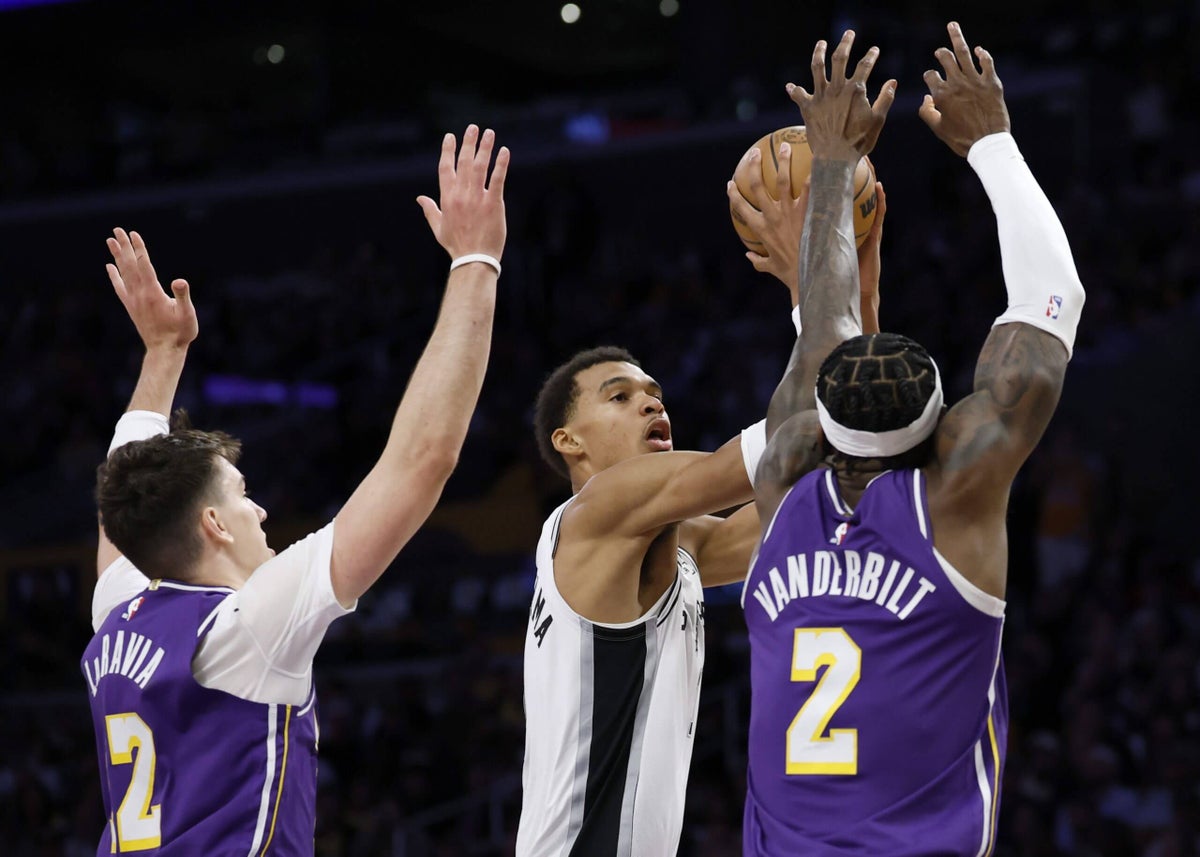
LOS ANGELES — Wherever he goes, Victor Wembanyama has a whole team waiting for him. He is not defended by one player. He is defended by an entire organization.
The situation presents the ultimate opportunity. NBA teams dream of bending defenses to their will. Wembanyama wakes up in the morning and gets doubled before he can open his blinds. He plays with a default double.
That has been tearing at the fabric of the connection between him and the ball this past week. His hot start is officially over. You put out a fire by smothering it, and defenses have been throwing a blanket over him. Wembanyama and the San Antonio Spurs have not figured out how to free him from the defensive entanglement.
But his coach wants him to demand the ball anyway. Not just ask for it. Not just wave for it. Even when he’s lost in a sea of purple jerseys, he’s still in there and he still should be fighting to get what’s his.
“He should yell at everybody in the gym,” Spurs coach Mitch Johnson said. “Including his teammates and myself. He’ll be fine. We’ll be better.”
Wembanyama is facing his first crossroads of the season. After losing 118-116 to Luka Dončić’s Los Angeles Lakers, he and the Spurs are figuring out how his ego juxtaposes with the typical superstar mindset. Wembanyama spent the preseason fixated on playmaking, spending most of his minutes playing every role besides center.
Once the regular season started, he moved back to the post and has struggled to adapt as the league got more tape to work with. Johnson said Wednesday that he needs to resist getting pushed off his spot now that teams are guarding him with smaller but stouter players. He needs to get to his position earlier so they have more clock to work with. He needs to drop a shoulder into the defense more and force the refs to use their whistles.
There are so many things Wembanyama can do to play like a superstar. But the results don’t line up with the potential he’s already demonstrated.
Dončić took 27 shots en route to 35 points Wednesday night. Wembanyama has 28 points on 28 shots in his last two games combined. The Spurs’ big man is far from the kind of usage king that defines MVP-caliber players.
He’s learning how to define what makes the right play. Take what the defense gives you or force the defense to give you what you want?
“It’s harder than you think,” Wembanyama told The Athletic last month. “Sometimes, things are easier said than done. But this is where the real challenge is, doing the simple things over and over again.”
Wembanyama is mature beyond his years. Few 21-year-olds could handle the same pressure and responsibility foisted upon them. No — earned by them.
He isn’t getting the ball thrown at him 100 times a game in hopes he might know what to do if he manages to catch it. He’s demonstrated he has a clear idea of what he wants. But he’s learning how hard it is to get it. There has to be a good connection between star and system to account for that.
It’s not there right now.
“Personally, I haven’t seen this kind of defense from teams,” Wembanyama said. “We need to adapt as a collective, and obviously, our (offense) was bad against Phoenix as well. … We got stalled out some times. So we’re learning. We’re going to learn.”
That’s on him to learn how to fight coverages and game plans. It’s on Johnson to get the team aligned around him. It’s on his teammates to take advantage of the gaps they’re yielding. He has to get used to how quickly the double teams are coming. The guards need to know how to take care of the ball and make quick enough decisions around him to get flow into the offense.
Right now, it’s not working, and that points to things being too predictable around Wembanyama.
“There’s no worry, really,” Wembanyama said. “It feels like the game is going fast. As we got better as a team and we got better individually, as well, it’s like the opponents have stepped up in some ways defensively. I feel, in a way, that the game feels fast right now.”
Wembanyama is seeing more bodies when he is off the ball than almost anyone else in the NBA. Defenses want to lean into him at all times with maximum leverage, which means hitting him once up top and then hitting him again if he goes down low.
The Suns sold out on this game plan, running essentially a box zone around the paint in which a defender would hit him when he reached the free-throw line, then another defender would be waiting for him in the post if he kept cutting. After that game, Wembanyama said it was apparent that Phoenix spent all of shootaround walking through the Spurs’ various approaches to getting him the ball.
The idea is both to chip away at Wembanyama’s stamina over the course of the night and to make sure he can never get any downhill motion toward the rim. When the defense has a few big wings who can lean on him and some guards who can both swipe at the ball when he’s in the post or rotate over for the charge when he’s on the move, it puts too many bodies in his way to let him get a rhythm.
“It feels like sometimes you just need to take a step back and look upon what you’ve done, how you’ve gotten better, and try to anticipate what’s coming,” he said. “Because the defenses aren’t getting any softer or easier.”
This taps back into Wemby and the Spurs’ understanding of his identity. There seems to be a lack of certainty about how to best use him. He demonstrated in October that he is destructive in the open floor and he can get a shot off wherever he wants. Now he is spending so much energy fighting for post position that his field-goal attempts often look like a reluctant outcome.
He flipped his 3-pointer to free-throw ratio so dramatically this season that it looks like he forgot when and why to take a 3. Wembanyama took those shots often last year to develop himself into a shooter, then abandoned them this year in the pursuit of playmaking development.
At times, he has made the games look like scrimmages, reps for him to hone what should inevitably be a game that will rewrite the sport. He looks like he is playing for the future, for the hypothetical Wemby and the idealized Spurs. But he has to keep developing the killer instinct as well.
There’s so much talk these days about how point guards have to learn to hunt their shot so they can draw enough defensive attention to make their passing fruitful. That’s the lesson he often looks like he is neglecting, and his coach made it clear with his comments after the game that it needs to be addressed.
But the public discussion runs parallel to their secret plan.
They have a grandiose and meticulous idea for what Wembanyama can become. We know the broad strokes of it. But the details, the little elements that can push him from great to greatest, are classified.
“I’m not going to tell all of it because we still got opponents and the media,” Wembanyama told The Athletic. “But there is a direction, and it’s a multidimensional player, team player and playmaker.”
Wembanyama welcomed the adversity after the game Wednesday, saying he and the team need these struggling reps in real games if they’re going to grow. He did so much work this offseason to simulate pressure, but it’s still merely a simulation. Preparing for unpredictability has its limits, and he’s seeing how much work comes in the postmortem.
Growth is not linear. Far from it in the NBA. The season rolls through expanding concentric circles. Refinements and reassessments. It’s a constant push and pull between what you want and what you get. The Spurs are not getting what they want and have to return to the drawing board.
“But it’s the same for everything, for life in general,” Wembanyama said. “We either respond or not respond. We’ll respond.”