
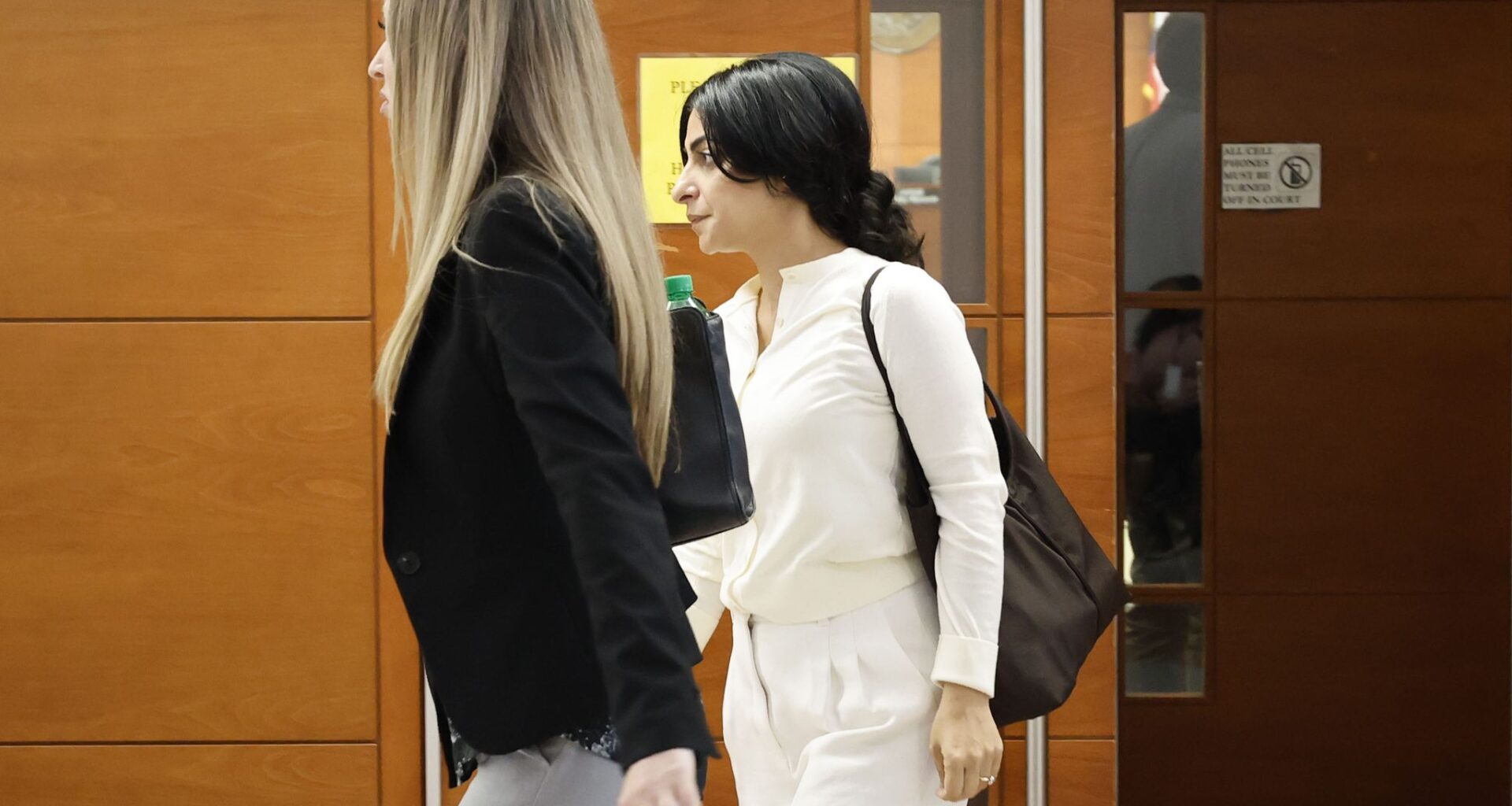
The surrogate, McKenna West (center), leaves the courtroom after a hearing on Tuesday in Dallas.
Chitose Suzuki/The Dallas Morning News
Everyone is here but the baby.

McKenna West, the surrogate, sits on one side of the Dallas County courtroom. Nausheen Gilkar and Omar Ahmed, the intended and biological parents, sit on the other.
There are teams of attorneys and a gaggle of journalists in the room, with photographers and videographers flanking the hallway outside. The courtroom is full. Everyone is here about a newborn baby who, as the hearing proceeds, is in critical care at a Dallas children’s hospital.
Article continues below this ad
The surrogate, the couple and the baby are bound together, all of them the focus of a politically polarizing multistate controversy. The case has become explosively public, with a torrent of news coverage, social media takes and political posturing. Dallas has become the battleground for it all, for the baby’s medical care and for the parentage claims swirling around him.
Related: Biological mother and surrogate both testify in Dallas court hearing
It started months ago when Gilkar and Ahmed, who live in California, signed a surrogacy agreement with West, who lives in Alaska. When the surrogate was about 20 weeks pregnant, the fetus was diagnosed with a severe heart condition. The couple wanted to terminate the pregnancy, but West refused. West later traveled to Texas and gave birth in a Dallas hospital.
Since the baby’s birth, a court order has barred West from seeing the baby. Gilkar and Ahmed have been in the hospital with him and watching over his medical care, including an open heart surgery days after his birth.
West has spoken publicly about the case multiple times, garnering fierce support from anti-abortion politicians and advocates. Her legal fees, she testified, are being paid by the conservative Christian advocacy group Alliance Defending Freedom.
Article continues below this ad
West has focused on her desire to give the baby a life, a chance.
Nausheen Gilkar (right) testified that before deciding on a surrogacy, she and her husband went through eight rounds of IVF to try to get pregnant. All were unsuccessful.
Chitose Suzuki/The Dallas Morning News
Gilkar has been quieter publicly. This week’s court hearing, on the third floor of a Dallas courthouse, was the first time the public heard from her directly.
The hearing revolved around the question of parental claim. Attorneys for the surrogate want the court to give West full decision-making authority for the baby. The couple’s attorneys want the court to uphold a California ruling that deemed Gilkar and Ahmed to be the parents.
Tuesday’s hearing ended without an immediate decision — Judge Ashley Wysocki extended the existing temporary orders pending her ruling.
Article continues below this ad
The bulk of the hearing, though, was testimony from Gilkar and West. That testimony peeled back the curtain on a complicated, emotional and highly publicized case.
In the courtroom, Gilkar was called to the stand first.
The first witness
Gilkar held a tissue in her hand, a constant companion, as she walked across the courtroom.
Gilkar’s right wrist was encircled by a red wristhand. Her husband wore a matching red bracelet. The couple has spent every day in the hospital, Gilkar testified, as much time as they can since the baby was born earlier this month.
Article continues below this ad
She sat down at the desk and looked in her husband’s direction. Ahmed nodded, several times in quick succession, as the questioning began.
Before they pursued surrogacy, Gilkar testified, she and her husband went through eight rounds of IVF. All unsuccessful. Eventually, she told the court, her body “gave up,” and she had a hysterectomy.
That left surrogacy as their only path to having a child that’s fully genetically related to them. When her attorney, Lee Budner, asked Gilkar who the baby’s biological parents are, she began to cry. She and her husband are the biological parents, Gilkar testified.
As her voice broke, her husband, sitting across the room from her, began again to nod. He pressed his hands together, prayer-style, and held them toward his wife. He looked up at the ceiling for a moment.
Omar Ahmed (right) and his wife, Nausheen Gilkar (center), wanted the surrogate to terminate the pregnancy after the fetus was diagnosed with a severe heart condition 20 weeks into the pregnancy.
LM Otero/Associated Press
Why is it important for you to make medical decisions for the baby? Gilkar’s attorney asked.
Article continues below this ad
“Because he’s our child,” she said.
A couple more questions, and Gilkar began sobbing on the stand. The judge called a recess, but Gilkar didn’t move from the desk until the judge directly told her that she could.
Gilkar stepped through the courtroom’s double doors, the sound of her sobs drifting behind her.
When she took the stand again, Gilkar’s attorney asked her to describe how the baby is doing now. At her attorney’s prompting, Gilkar told the court that the baby — whose birth certificate names him Rumi, according to court testimony — has struggled in the days since his birth.
It’s something that West, the surrogate, can’t know firsthand: Under a Dallas court order, she’s barred from seeing or holding the baby.
Article continues below this ad
Related: In surrogacy controversy, court documents give new detail on contract, medical plans for baby
At birth, Gilkar said, the baby, who has hypoplastic left heart syndrome, had to be intubated. He stopped breathing and, Gilkar added after an attorney had called out an objection, the hospital workers called a chaplain at one point.
The guardian ad litem — appointed by the court to represent the best interests of the baby — will say later in the hearing that the medical providers told the couple there were two medically appropriate options for the baby. The first option was open heart surgery. The second option was palliative care, which would focus on making the baby comfortable and would mean he would likely die within a couple weeks.
When the couple learned that the baby was a candidate for the first open heart surgery, Gilkar testified, they chose that option “immediately.” Children with hypoplastic left heart syndrome typically need three open heart surgeries by the time they’re 5 in order to survive.
Related: North Texas baby in surrogacy case undergoes open heart surgery, attorney says
The baby has had that first surgery. Gilkar said she and her husband have watched the baby gasp for air, choke on tubes.
“He’s the most beautiful person I’ve ever seen,” Gilkar said. “He’s the love of our lives. He’s suffering a lot.”
Throughout Tuesday’s testimony, Gilkar did not contest that she and her husband wanted West to terminate the pregnancy after the fetal anomaly diagnosis.
One of West’s attorneys, Jeff Domen, asked Gilkar what her biggest regret is from 2026.
“I don’t have any regrets,” Gilkar replied.
You don’t regret, Domen continued, requesting West to undergo an abortion?
Gilkar cut him off to say again: no.
“Would you trust someone to care for your child that wanted your child dead?” Domen asked.
Gilkar replied that she doesn’t know how to answer that.
The second witness
McKenna West (center) has spoken publicly about the case multiple times, garnering fierce support from anti-abortion politicians and advocates.
Chitose Suzuki/The Dallas Morning News
It was West’s turn next, just past 3 p.m., and she sat at the same desk with her hands folded in front of her.
The attorneys’ questions jumped around at times. Pieced back together, West’s testimony went like this.
West testified that, when she was pregnant and shortly after the fetal diagnosis, she initially agreed to go to an appointment at a California abortion facility. That’s what the couple asked her to do. But West didn’t go to the appointment.
Related: After refusing abortion, pregnant surrogate seeks legal protection, medical care in Texas
One of West’s attorneys, Lincoln Wilson, asked the surrogate how she felt when she imagined going through with the abortion.
It was the only time, in more than an hour on the stand, that West showed significant emotion. She took a shuddering breath. She reached for a tissue from the box on the desk.
“It was terrifying,” West said.
Budner, the couple’s attorney, asked the surrogate why she’s making a parental claim, why she wants the Dallas court to overrule the parentage order that the couple already received in California.
Because she gave birth to the child? Budner asked.
“Because since the diagnosis was made I have been absolutely willing to fight and defend his life,” West said, “and he is here, and he has a birthday because of the fight I have put up.”
Are you requesting custody of the child? Budner asked her.
“That would be something of a discussion that could be had between the parties,” West replied.
West has said publicly, including in a column for the New York Post, that she would drop her parentage claim if the couple committed to providing life-saving care for the baby.
In the courtroom, West said she doesn’t feel that the couple has made that commitment yet. What if the court finds the commitment has been made, Budner asked, then will you drop your parentage claim?
“That’s a discussion I’m open to having,” she said, but Budner objected. She didn’t answer the question, Budner said, and the judge agreed.
“Please answer the question, ma’am,” Budner said.
Throughout her testimony, West paused frequently before answering questions. Still, this pause was extended. Seconds ticked by.
“Yes,” West said. As in, yes, she would drop her claim if the court found the couple had committed to life-saving care.
Related: Baby at center of multistate surrogacy controversy born in North Texas
West’s attorney, Wilson, asked her about this, too. He asked if she trusts Gilkar’s testimony to mean that the couple will actually provide life-saving medical care to the baby.
West said that she does not trust the testimony to mean that.
“Hearing her say,” West said of Gilkar, “that she doesn’t regret wanting him to be terminated even though he’s here and he’s alive now.”
Budner seized on something in this. Didn’t you change your mind, he asked West, from the time you agreed to the surrogacy contract’s termination clause, to the time of the actual abortion appointment?
There was some back and forth. Some pauses. West, eventually, said yes, she did change her mind.
“Why can’t Nausheen and Omar?” Budner asked. “Why can’t they change their mind?”
“I don’t know that they have,” West replied.
Gone public
Nausheen Gilkar (right) comes out from a courtroom during a recess in a court hearing regarding a signed a surrogacy agreement involving a baby who was diagnosed with a severe heart condition 20 weeks into the surrogate’s pregnancy. The couple wanted to terminate the pregnancy, but the surrogate refused.
Chitose Suzuki/The Dallas Morning News
The case is complicated, fraught.
It’s also highly unusual, two experts told The Dallas Morning News. It is rare, the experts said, for a surrogate to make a parental claim on a child born through surrogacy.
Alexis Cirel, a New York City-based family and fertility attorney, said it’s even more unusual for a parentage claim to be made by a “gestational carrier,” which is a surrogate who is not genetically related to the child.
“It’s not just uncommon,” Cirel said. “When we’re talking about gestational carriers like this, it’s virtually never.”
Also notable, said Heather Jacobson, a professor and reproductive scholar at the University of Texas at Arlington, is the involvement of anti-abortion groups and politicians.
Related: Five things to know about surrogate pregnancies
Attorney General Ken Paxton has weighed in on the case, both publicly and legally. Texas Right to Life, a prominent anti-abortion advocacy group, has highlighted the case, as has Texas Alliance for Life.
In addition to her legal fees being covered, West said she’s also not paying for the house she’s living in, in Farmersville. She testified that she doesn’t know who’s paying for the house.
And while the story didn’t originally have much to do with Texas at all, now that the surrogate and the baby and the intended parents are all here, Texas’ strict abortion ban is playing a part in the conversation, too.
Tuesday’s hearing, with its deeply personal testimony, was a reminder that at the center of it all is a baby.
A baby who, as the guardian ad litem reminded the court, may survive. He may survive, the guardian ad litem said, and he may Google himself one day.
If he does, he’ll find all of this — the fight, the tears, the agony. He’ll find it all, laid bare for everyone to see.