
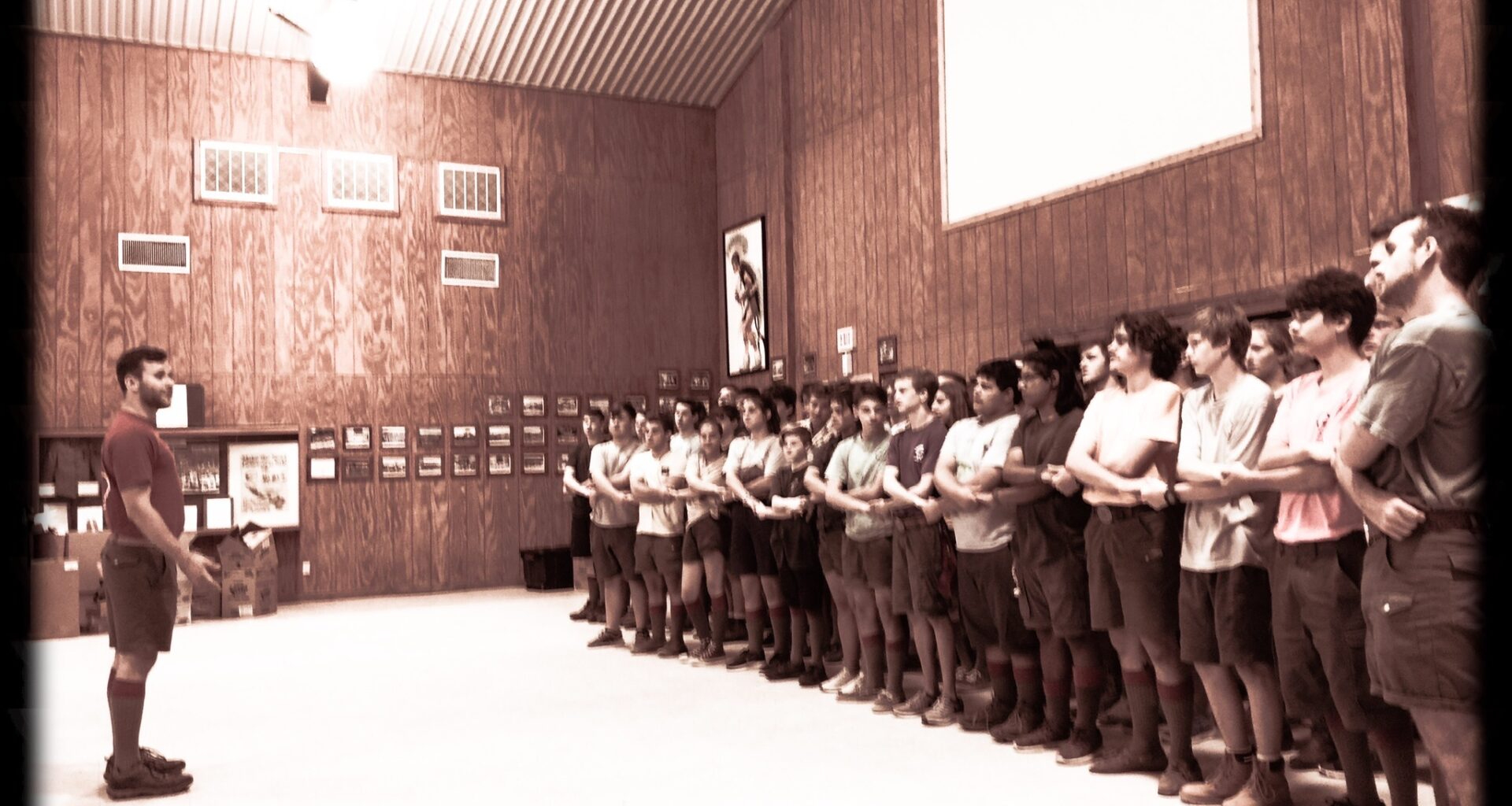
Scouts gather at Worth Ranch in an undated photograph.
Joe Otto
They piled into an old pickup, a gaggle of boys with sleeping bags, and drove west from Fort Worth toward camp.

Joe Otto was 11 years old and a little anxious. He had never been away from home before that summer in 1988. He spent the time learning to become a Boy Scout — building a fire with sticks and fashioning a water filter from a sock and cooled charcoal.
Otto fell in love with the camp, and he returned to Worth Ranch in Palo Pinto year after year as a camper, then later a staff member and camp cook. While living in New York City in his late 30s, he tattooed the camp’s logo of a sunrise and camp’s initials on his left bicep.
Article continues below this ad
“This camp has a lore that’s like nothing else,” said Otto, 49, a photographer who now lives in Fort Worth. “It becomes part of who you are.”
This week, Otto is among the thousands of Texans grieving the destruction of the 97-year-old camp, a victim of the explosive Ross wildfire that has roared through a swath of rural Texas about 60 miles west of Fort Worth.
Scouts gather at Worth Ranch in an undated photograph.
Joe Otto
Scouts at Worth Ranch in uniform in an undated photograph.
Joe Otto
Worth Ranch camping teepees are seen in the distance.
Joe Otto
The American flag waves at Worth Ranch.
Joe Otto
The camp overlooks the Brazos River.
Joe Otto
Worth Ranch pictured in an undated photo.
Joe Otto
Scouts participate in a Worth Ranch flag ceremony.
Joe Otto
Scouts participate in a ceremony at Worth Ranch.
Joe Otto
The Worth Ranch logo depicts a sun set.
Joe Otto
The Brazos River runs through the camp.
Joe Otto
Undated photograph of Worth Ranch
Joe Otto
A double rainbow flanks the camp.
Joe Otto
A double rainbow flanks the camp.
Joe Otto
Scouts participate in a flag ceremony.
Joe Otto
Scouts are pictured in an undated photo.
Joe Otto
As of Friday, the blaze had scorched 85,000 acres and was 26% contained, according to the Texas A&M Forest Service. No one has died in the fire, which is one of the largest in the state’s history.
Related: Beloved Texas Boy Scout camp gutted by Palo Pinto wildfire
Article continues below this ad
At Worth Ranch, photographs of the devastation show charred buildings with melted roofs, piles of rubble beside blackened cedar and juniper trees that once blanketed the camp in green.
Numerous structures, including the dining hall and a meeting hall, were destroyed. The amphitheater, where counselors entertained campers with elaborate skits and songs, appears decimated.
Tributes have poured in. Drive through the camp’s stone and steel gate, campers say, and enter a sacred space.
“It feels like a different planet,” said Mark Coomes, 63, of Denton, whose father, a former camp commissioner, requested his ashes be buried at the camp. “When you’re there, you completely detach from the outside world.”
Officials with the Longhorn Council, which operates the Scouting America camp, described the damage as “catastrophic.” “It was a direct hit,” said Greg Bird, chairman of the council’s property foundation.
Article continues below this ad
The fire ignited shortly before 1:30 p.m. Monday west of the town of Palo Pinto near U.S. Highway 180. A cause is not yet known, but the fire quickly erupted to 25 acres, provoked by a combination of searing heat, wind and parched land.
Within six hours, the fire shot 10 miles north to Worth Ranch, where the only ranger on site had already evacuated.
The Ross Fire destroyed numerous buildings at Worth Ranch, a longtime popular Boy Scout camp in Palo Pinto.
Longhorn Council
An 800-acre sanctuary overlooking the Brazos River, Worth Ranch is one of the oldest and most cherished scouting camps in the United States. Nearly 200 years ago, the Comanche Nation called the grounds home.
The Boy Scout Foundation bought the land in 1929, and soon declared the spot the “finest camp west of the Mississippi.” Worth Ranch eventually earned the nickname “The Big Adventure,” where kids swim, fish, canoe, hike and learn archery.
Article continues below this ad
Camp is steeped in history. Campers have since 1929 recited the same pre-meal grace. Every summer, they share the same camp stories, including one about a mad scientist who operated a secret lab, now a narrow crevice and path called Hugo’s Crack at the camp’s Kyle Mountain.
A book about Worth Ranch’s history, Palo Pinto Campfires by Pete Normand, recently sold for $950 on eBay. Some online have called for a reprint of the book.
“There’s a mystique about Worth Ranch,” said Alfred Wettermark, a Fort Worth family physician who first attended camp there in the late 1980s. “It was far enough from home that you felt like you were in an entirely different place.”
Wettermark, 51, recalled hiking up Kyle Mountain, a rite of passage for young campers. They would trudge up the 1,350-foot hill, watch the sunset, sleep under the stars and return the next morning after sunrise.
He planned to soon take his own son, who is 13 — the same age Wettermark first attended. That trip is now delayed indefinitely, which he and several other fathers said is particularly crushing.
Article continues below this ad
“This camp is part of our fabric,” he said. “A lot of boys grew up there.”
Related: What to know about the Texas wildfires burning thousands of acres
In recent years, girls also explored Worth Ranch. Scouting America, formerly Boy Scouts of America, amended its rules to allow girls in Cub Scouts in 2018 and pre-teen and teenage girls in Scouts in 2019.
Isabelle Smith, a 21-year-old senior at Tarleton State University in Stephenville, attended Worth Ranch as a counselor-in-training in 2019, learning to save lives as a lifeguard and cook tin foil dinners with meat and vegetables over a campfire. Her father worked at the camp in the 1990s, and she was thrilled to follow.
At night, campers would huddle to watch the sunset, which she called the “most gorgeous” she has ever seen, tell stories and sing camp songs. It was her favorite part of every camp day.
Article continues below this ad
“I am the person I am today because of Worth Ranch,” she said. “You learn so much about people, and you learn to become a better person.”
Jim Goldthwaite, 72, has watched that transition hundreds of times as an assistant scoutmaster at Worth Ranch for the past 30 years. Kids come to camp timid and homesick, he said, and they go home more confident and assured.
Goldthwaite, who helped restore many of the old stone and petrified wood buildings at the camp, said seeing photos of the scorched remains broke his heart. He met with his troop Tuesday night at St. Stephen Presbyterian Church to make sense of the fire and reminisce about their beloved second home.
“You have a sense of place when you’re there,” he said. “You know exactly where you are. You’re living in a fantasy of what scouting could and should be.”
Otto, the photographer, thumbed through old photographs this week: a double rainbow flanking the camp, canoes threading the Brazos River, scouts grinning in uniform.
He is eager to return to camp, down the same gravel road and through the gate, which survived the fire, if only to see the sunrise again at Worth Ranch.