
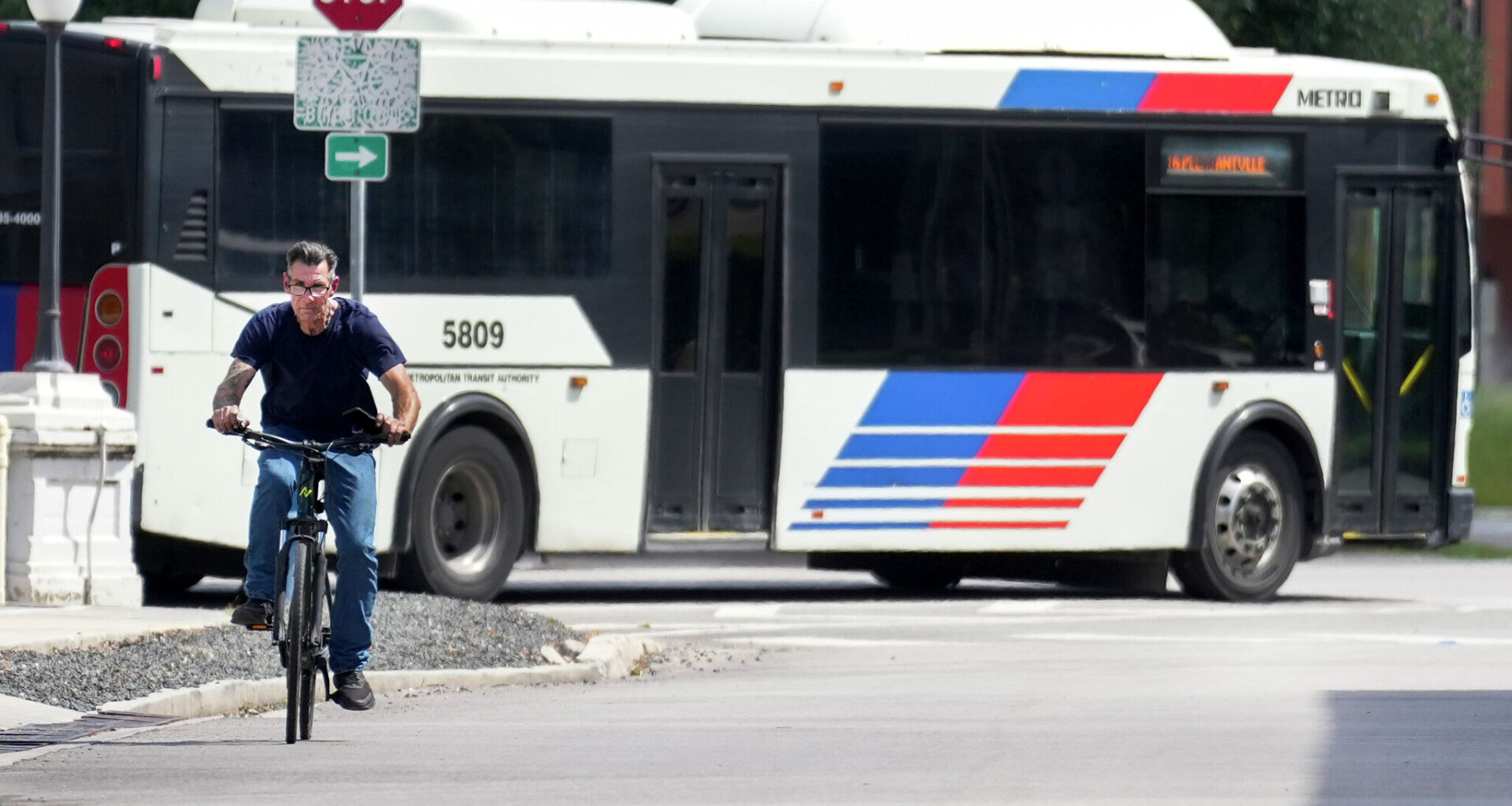
A biker rides as a METRO bus passes in East Downtown in Houston, Saturday, April 26, 2025.
Jason Fochtman/Houston Chronicle
The Metropolitan Transit Authority is proposing to cut bus and rail service hours next fiscal year as officials deal with budget pressures.
Metro’s proposed $1.7 billion budget for the fiscal year that starts Oct. 1 would mark its first reduction in spending since the COVID-19 pandemic and test whether the agency can preserve core services without weakening its finances or leaving riders to absorb deeper service cuts in the years ahead.
Metro: What Houston drivers should know about highway ramp meters. Do they help with traffic?
Article continues below this ad
Houston’s transit agency proposes to cut rail service hours by 5% and bus hours by 1.6%. Metro officials said the agency has not yet identified specific route or frequency changes.
The proposal would balance Metro’s operating budget by cutting spending by $40 million and pulling $146 million from the agency’s fund balance. The budget also would reduce spending on longer term projects by $241 million next year.
Metro also plans to restructure its debt to lower its costs over the next four years, extending the repayment period at a higher interest rate.
This would give Metro flexibility in the near term but would mean higher debt costs over time. It also could prompt scrutiny from credit-rating agencies, financial adviser Carlos Allen of PFM told the Metro board on Monday.
Article continues below this ad
Harris County: Harris County officials propose a $3.1B budget as costs for law enforcement and healthcare rise
Metro said in a statement that its projected five-year cash flow has declined by $1 billion over the last year because of “external financial pressures” and that the restructuring is a response to that “financial shock – not a symptom of structural or systemic fiscal strain.”
Metro’s financial pressure stems in part from a downward shift in the amount of sales tax revenue the agency expects to collect in the coming years. A year ago, Metro projected it would collect $20 million more in sales taxes than it now expects to this budget year. The agency also has dropped the amount it expects to collect in the coming fiscal year by $43 million.
Metro officials cast the proposed cuts as part of a broader effort to protect essential services. A Metro spokesperson said traffic patterns are constantly changing and that “fine-tuning service is a routine practice.” Metro staff on Monday also said they would continue reviewing lower-ridership services for possible “optimization” next year.
“I want to assure everyone that our priority is to protect the essential services that our community relies on the most,” Metro board member Terry Morales said at the hearing.
Article continues below this ad
Metro board member Roberto Trevino said Monday that he will vote against the budget because of what he described as a lack of transparency about Metro’s financial problems and the assumptions behind the proposal.
Trevino also questioned how Metro officials could cast the budget as protecting core services while also projecting fewer bus and rail service hours.
“When we hear that there is no cut to services but the dollars allocated to that go down, what’s actually being cut?” Trevino said. “That’s some of the clarity we need to get.”
Houston finances: Houston’s utility system gets negative S&P outlook after taking on financial strain from solid waste
Cutting services
Metro’s proposal also would transfer $228 million in sales tax revenue to local governments in its service area for road repairs, part of the agency’s longstanding, voter-approved “General Mobility Program.”
Article continues below this ad
In addition to those funds, however, the proposal allocates $40 million for additional street improvement projects, most of them within Houston city limits.
Peter Eccles of transit advocacy group Link Houston said that money should instead support transit services.
“With their successful experiment increasing frequency during the World Cup, Metro proved again that increased service leads to higher ridership,” Eccles said. “It’s frustrating to see Metro consider cutting service while diverting another $40 million to road repaving while riders keep asking for more frequent and more reliable service.”
The budget also includes money for new vehicles and improvements intended to make the system more reliable. Metro plans to add 68 buses, 116 MetroLift vehicles, 195 vans and 39 alternative-service vehicles.
Article continues below this ad
Metro projects local bus boardings will increase 2% next year, while Park & Ride boardings are projected to grow 12% and MetroLift trips 2%. The agency also plans to continue funding Community Connector, its on-demand microtransit service, as well as more bus shelters and road repairs along bus routes.