
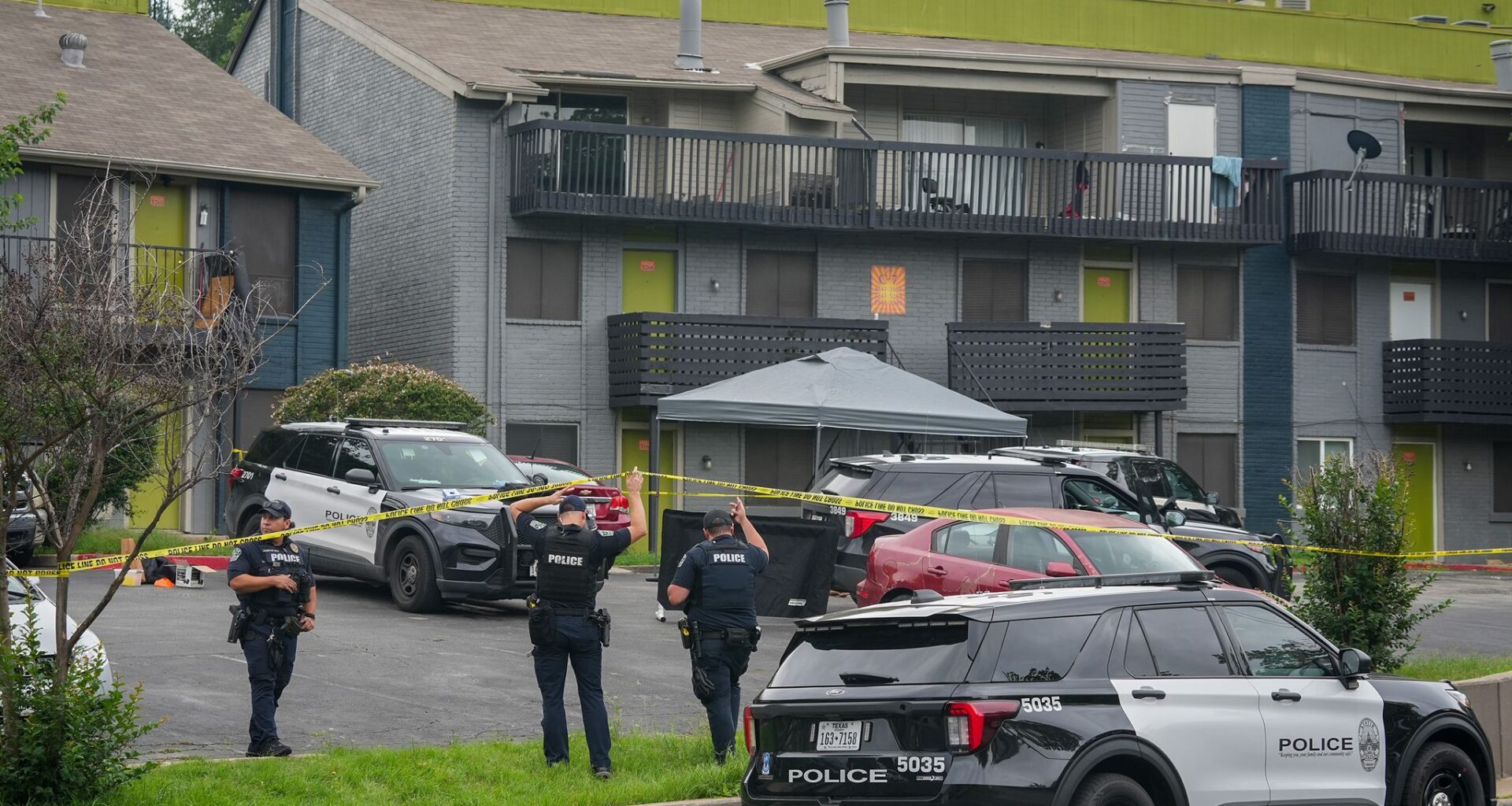
Police investigate a homicide in the 1500 block of Royal Crest Drive in Austin, Thursday, April 23, 2026.
Jay Janner/Austin American-Statesman
The U.S. attorney for the Western District of Texas made a startling announcement earlier this week: Austin has experienced a “surge in federal violent crime prosecutions.”

Justin R. Simmons said his prosecutors had filed “approximately 40 federal cases against defendants for gun-related crimes in recent months” in Austin and that, since 2015, homicides are up 187% and “rape and aggravated assault are up 65% and 38%, respectively” in the city.
Article continues below this ad
Prosecutors in District Attorney José Garza’s Public Integrity and Complex Cases Unit have secured an indictment against former Travis County tax office employees and a third person for allegedly engaging in organized criminal activity.
Jay Janner/Austin American-Statesman
“Just this year, we’ve seen multiple violent criminals engage in acts which endangered the lives of peace-loving Austinites, including the March 1st shooting on 6th Street,” Simmons said in a Tuesday news release, referencing the mass shooting near Buford’s Bar that left four dead and 14 injured. “It’s plain to see that gun crime poses a significant threat to the law-abiding citizens of Austin, and the U.S. attorney’s office takes that threat seriously.”
Simmons’ broader claims about rising violent crime are supported by some measures, but not all. The figures depend on which data set is used and whether crimes are counted as raw totals or adjusted for Austin’s population growth. The available data show that Austin’s homicide rate rose substantially between 2015 and 2025, while aggravated-assault and rape rates increased by smaller amounts. But one of Simmons’ specific claims — that rape increased 65% — is not supported by the data reviewed by the American-Statesman.
The news release cited crime data from the Major Cities Chiefs Association and said the U.S. attorney’s office had worked with the Austin Police Department, the Texas Department of Public Safety, the Bureau of Alcohol, Tobacco, Firearms and Explosives and the Travis County District Attorney’s Office to prepare the cases.
Article continues below this ad
Michael Lahrman, a public affairs officer for the U.S. Attorney’s Office, said the association’s data was used because it was the most current public reporting. He referred questions about the data to the association, but a representative for the group did not respond to the Statesman’s inquiries
Lahrman also said the number of cases federal prosecutors had filed against Austin-area defendants year-over-year was not readily available, so it is unclear how much of an increase the 40 cases represents compared to prior years. Lahrman noted that the 40 cases were filed in just a two to three month period.
That means the federal prosecution figure cannot, based on the information available, be used to establish a year-over-year increase. It does show that federal prosecutors have filed dozens of gun-related cases recently, but the U.S. Attorney’s Office did not provide a historical comparison.
What the crime data shows
Data in the Major Cities Chiefs Association’s reports, released quarterly, support Simmons’ homicide and aggravated assault figures when comparing raw counts of those crimes from 2015 to 2025. Homicides increased from 23 to 66, while aggravated assaults increased from 1,919 to 2,636.
Article continues below this ad
But the association’s data shows Austin rape cases declining from 753 in 2015 to 684 in 2025 — a 9% decrease, not a 65% increase.
FBI agents arrive at the site of a shooting at Buford’s on west 6th street in Downtown Austin, Texas on Sunday, March 1, 2026.
Aaron E. Martinez/Austin American-Statesman
The discrepancy appears to stem, at least in part, from the use of different data sources or categories. A Statesman analysis of data pulled directly from the Federal Bureau of Investigation’s Crime Data Explorer, which is updated monthly, produced different raw-count changes over the same period: Homicides increased 122%, rape offenses increased 53% and aggravated assaults increased 28%.
But neither set of raw counts accounts for Austin’s population growth.
Article continues below this ad
The city grew from about 905,738 residents in 2015 to about 1,002,632 in 2025, according to estimates from the U.S. Census Bureau.
Crime rates measure offenses per 100,000 residents and generally offer a better comparison of crime trends over time because they account for population change. A growing city can record more crimes without the typical resident facing a larger public safety risk, because the city has more people living in it.
Using FBI crime data and Census population estimates, the Statesman calculated that Austin’s homicide rate grew from 2.5 per 100,000 residents in 2015 to 5.1 per 100,000 residents in 2025. Over the same period, the rate of aggravated assaults grew from 227 to 262 per 100,000 residents while the rate of rapes grew from 54 to 74 per 100,000 residents.
On a population-adjusted basis, the data show increases in all three categories, but those increases are smaller than the raw-count figures cited in Simmons’ announcement:
Article continues below this ad
The homicide rate increased about 104%, compared with the 187% increase in the Major Cities Chiefs Association’s raw counts.
The aggravated-assault rate increased about 15%, compared with the association’s 38% figure.
The rape rate increased about 37%, compared with Simmons’ 65% figure.
The FBI data and the Census estimates also do not independently support the exact figures Simmons cited. The available data does, however, support the broader conclusion that Austin’s homicide rate was higher in 2025 than in 2015.When asked about the data, Travis County District Attorney José Garza said more recent data provide a better picture of how crime trends have shifted in Austin.
Travis County District Attorney Jose Garza speaks at a news conference at Austin City Hall about the 1991 I Can’t Believe It’s Yogurt murder investigation on Monday, Sept. 29, 2025.
Jay Janner/Austin American-Statesman
“When it comes to crime trends, it’s been documented and substantiated that crime began to rise in 2020, spiked in 2021 and has been declining since then,” Garza said.
Article continues below this ad
The data show a more mixed pattern, however. Homicide rates rose sharply in 2020 and peaked in 2021, but increased slightly in 2023 and 2024 before declining in 2025. Aggravated-assault rates continued rising through 2022 before declining for three consecutive years. Rape rates, however, increased in 2024 and 2025 after a brief decline in 2023.
Specifically, from 2020 to 2025, the data showed:
Homicides increased from 45 in 2020 to 51 in 2025, a 13% increase. The homicide rate rose 9%.
Aggravated assaults fell from 3,130 to 2,631, a 16% decrease. The aggravated-assault rate also fell 16%.
Rapes increased from 638 to 743, a 16% increase. The rape rate rose 12%.
So while several categories of violent crime have fallen from their pandemic-era peaks, Austin’s 2025 rates were not uniformly lower than they were in 2015. The longer-term trend depends on the offense and the period being compared.
Article continues below this ad
What the federal cases show
Simmons, an appointee of former U.S. Attorney General Pam Bondi, said the 40 cases his prosecutors have filed in recent months represented an effort to target people he called “the worst of the worst.”
Garza said the defendants already faced state charges when the U.S. attorney’s Office approached his office several months ago about cases that might be appropriate for federal prosecution, particularly firearm cases.
The cases include 26 charges against convicted felons accused of possessing firearms, three charges against immigrants accused of illegally possessing firearms and cases involving drug trafficking, carjacking, possession of an illegal machine gun and operating an unlicensed firearms business.
Article continues below this ad
The Bureau of Alcohol, Tobacco, Firearms and Explosives (ATF) use an explosive detection K-9 to search for gun power residue after 13 people were injured during a shooting early Saturday morning on 6th Street.
Ana Ramirez
Eleven defendants have pleaded guilty, Lahrman said, and two were sentenced to federal prison.
Simmons highlighted the case of Joshua Dixon, who was arrested by a state trooper in May after a vehicle pursuit. According to his arrest warrant, Dixon was facing state charges for money laundering, a third-degree felony. Investigators found 11 firearms, more than 3,000 grams of methamphetamine and roughly $50,000 in cash in Dixon’s vehicle upon his arrest.
In another case, Austin police officers arrested Kamron Smith Overton for the unlawful possession of a firearm by a felon, a third-degree felony. In Overton’s arrest warrant, investigators said they found a pistol equipped with a “machine-gun conversion device” in the suspect’s bedroom. The warrant also says the gun produced a presumptive ballistic match to bullet casings recovered after a drive-by shooting at a child’s birthday party in which two people were shot.
Article continues below this ad
Police Department spokesperson Anna Sabana said Austin officers worked with the ATF through the department’s Crime Gun Intelligence Unit to help assemble the cases. The Police Department serves as the host agency for the ATF’s regional National Integrated Ballistic Information Network program, Sabana said, and two Austin detectives work full time as deputized ATF task force officers.
Sabana said the specific initiative announced Tuesday is ending, but the department will continue working with federal law enforcement officials.